Most people don't know their body fat percentage. Some assume they're much leaner than they are. Others are harder on themselves than they need to be and discover they're already closer to their goals than they realized.
Online body fat charts don't help much. The numbers may come from less reliable measurements, guesses, or photos taken under completely different lighting. And those numbers matter because body composition can affect more than your appearance. It can also influence your sleep, performance, energy, and how you feel day to day.
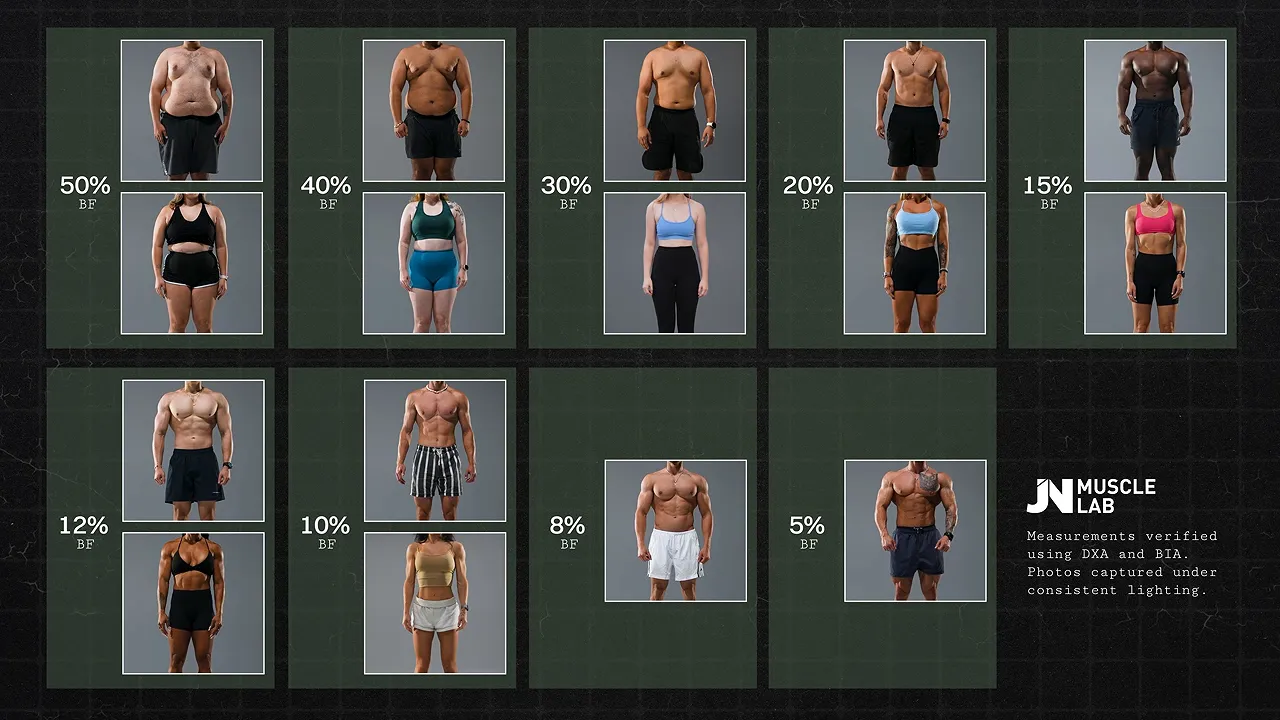
To build a more useful reference, I measured real people using both DEXA and bioelectrical impedance analysis, or BIA, and photographed their physiques under consistent lighting. The examples range from approximately 50% body fat down to 5%.
The biggest lesson? The same percentage can look very different on different people, and leaner does not automatically mean healthier.
Key Takeaways
- The same body fat percentage can look different depending on muscle mass, structure, and fat distribution.
- Men and women need different reference points because women carry more essential body fat.
- Extreme leanness can compromise energy, sleep, hormones, mood, and long-term sustainability.
- Choose a maintainable range that supports health, training performance, and everyday quality of life.
Table of Contents
- How to Interpret These Body Fat Examples
- Approximately 50% Body Fat: Different People, Different Starting Points
- Approximately 40% Body Fat: A Smaller Waist, but Plenty of Individual Variation
- Approximately 30% Body Fat: Muscle Mass Makes a Big Difference
- Approximately 20% Body Fat: Often Much Leaner Than People Expect
- Approximately 15% Body Fat: Lean for Men, Very Lean for Women
- Approximately 12% Body Fat: A Very Fit Look, With More Dietary Structure
- Approximately 10% Body Fat: Not an Effortless Sweet Spot
- Approximately 8% Body Fat in Men: Shredded, but Usually Temporary
- Approximately 5% Body Fat in Men: Extreme Contest Conditioning
- What's the Best Body Fat Percentage for You?
- Make Your Nutrition Support That Balance
How to Interpret These Body Fat Examples
DEXA is widely used as a reference method for body composition in research and clinical practice. A 2020 review of body composition assessment supports its usefulness alongside methods such as MRI. It's a much stronger starting point than simply assigning a percentage to a photo.
Still, these are measurements, not perfectly exact descriptions of your body. You'll notice that DEXA and BIA sometimes agree almost completely and sometimes differ by several percentage points. Don't treat the decimal place as a verdict.
There are three other things to keep in mind:
- Muscle mass changes the picture. Two people can have almost identical body fat percentages but very different amounts of lean mass.
- Structure and fat distribution matter. Height, bone structure, and where you store fat affect how a percentage looks.
- Men and women need different reference points. Women carry more essential body fat, so the same numerical percentage doesn't represent the same degree of leanness.
As a rough visual comparison, 30% body fat on a woman can resemble the relative leanness of 20% on a man. That isn't a precise conversion formula. It's a reminder not to apply male body fat expectations to female physiques.
Approximately 50% Body Fat: Different People, Different Starting Points
Joe, a 36-year-old dad, measured 45.3% on DEXA and 50.7% on BIA. He described low motivation and ambition alongside a history of low testosterone. His DEXA result was actually lower than he'd expected, and he wanted to work toward 25% body fat.
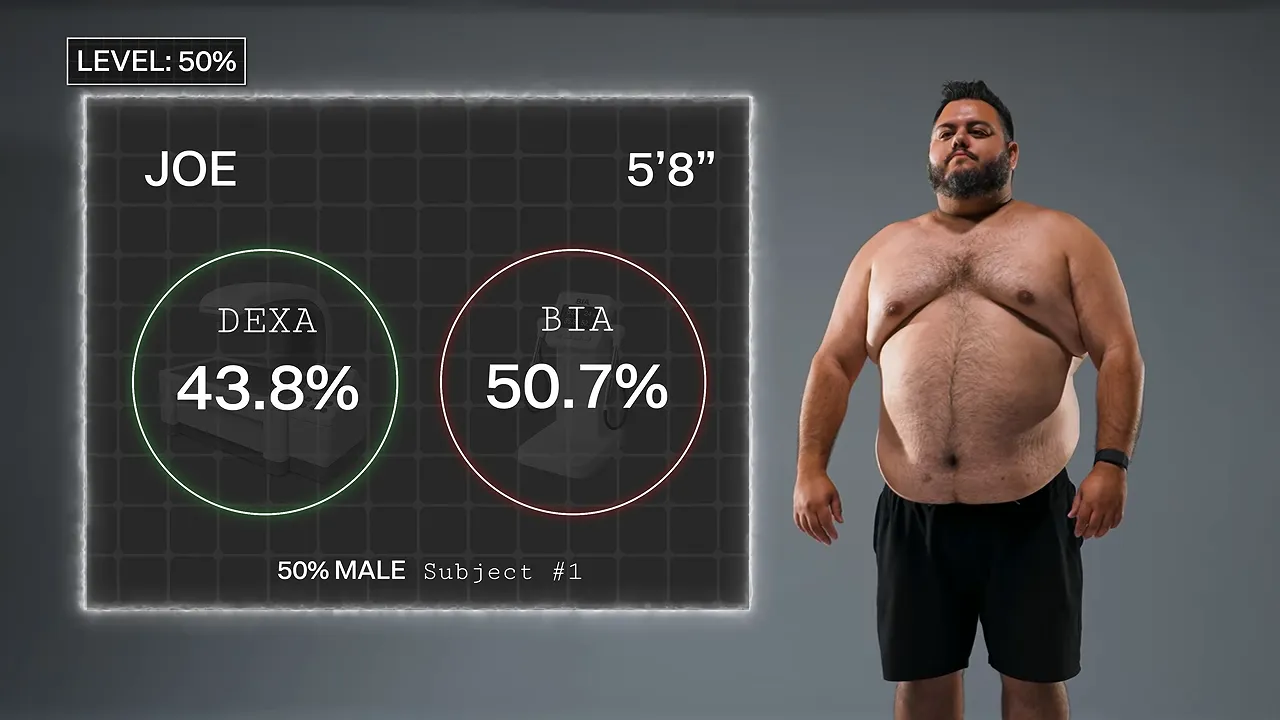
Alexis, a 19-year-old university student, measured 48.2% on DEXA and 47.2% on BIA. Her experience was different. She enjoyed training, felt good in the gym, and didn't report major difficulty with everyday activities. But after significant changes during her first year at university, she wanted to feel more comfortable and confident in her body again, while improving her long-term health.
Daniel had one of my favorite reasons for wanting to lose weight: he wanted to go skydiving. The operators he was considering had weight limits around 220 to 240 pounds. That gave him something concrete to work toward, beyond a number on a scale.
That's important. If you have a lot of weight to lose, a personally meaningful reason can make the process feel less abstract. For one person, that's skydiving. For another, it's having the energy to play with their children.
But purpose alone isn't enough. Motivation comes and goes, especially when weight loss takes longer than expected. The goal is to build habits that eventually feel as routine as brushing your teeth. Following through consistently also builds trust in yourself.
Several people at this end of the range described persistent fatigue and difficulty with tasks as simple as putting on shoes. Others felt relatively good. Their experiences weren't interchangeable.
One assumption did come up repeatedly: if getting leaner improves how you feel, getting extremely lean must feel even better. Unfortunately, that isn't how it works. Push far enough in the other direction, and fatigue, sleep problems, and low energy can come right back.
Approximately 40% Body Fat: A Smaller Waist, but Plenty of Individual Variation
Himanish measured 37.2% on DEXA and 40.7% on BIA. Compared with the approximately 50% examples, the waistline was smaller and the overall physique was leaner, while the general pattern of fat storage remained similar.
Katie, a nurse who had recently become a personal trainer, measured 37.6% on DEXA and 40.3% on BIA. Despite having a very similar percentage to Himanish, her physique looked different.
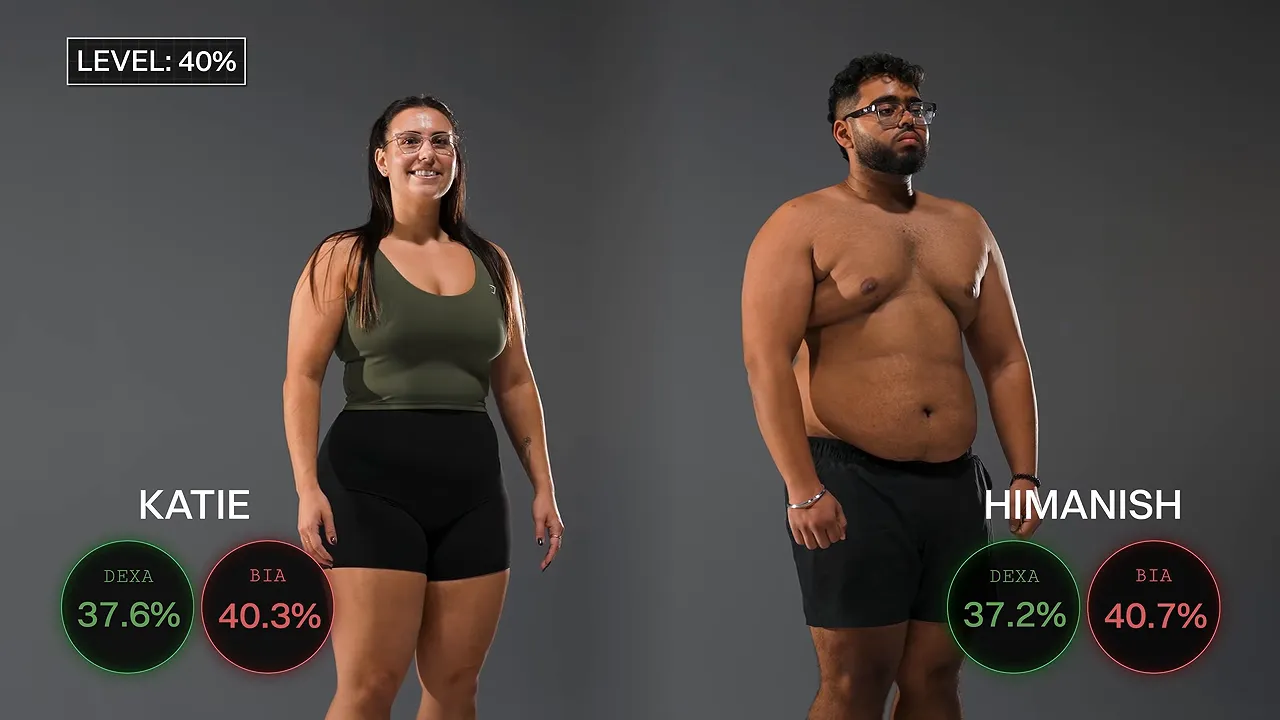
Women tend to store more fat around their hips and thighs, while men tend to carry more around their abdomen, lower back, and neck. Hormones help influence those patterns, but individuals still vary considerably.
How people felt varied, too. Katie reported good energy and solid strength. Matthew, whose DEXA result was 43.8%, described disrupted sleep and difficulty taking his shoes off. He suspected sleep apnea, although he hadn't been diagnosed.
At around 40%, cardiovascular and metabolic risk is generally more concerning for men than for women at the same percentage. But neither appearance nor one body composition result tells the whole health story.
Importantly, exercise still helps even when the scale isn't moving. Research on the benefits of exercise shows that improvements in health, strength, and mental well-being don't depend entirely on losing weight first.
For context, the average American woman was approximately 39% body fat in the 2017 to 2018 NHANES data used for these comparisons. Average doesn't necessarily mean optimal, but it does help put fitness-industry expectations into perspective.
Approximately 30% Body Fat: Muscle Mass Makes a Big Difference
What 30% Looks Like on Men
Saptarshi measured 33.3% on DEXA and 30.1% on BIA. Greg measured 32.5% on DEXA. Their DEXA percentages were almost identical, but Saptarshi had about 97 pounds of lean mass compared with Greg's 150 pounds.
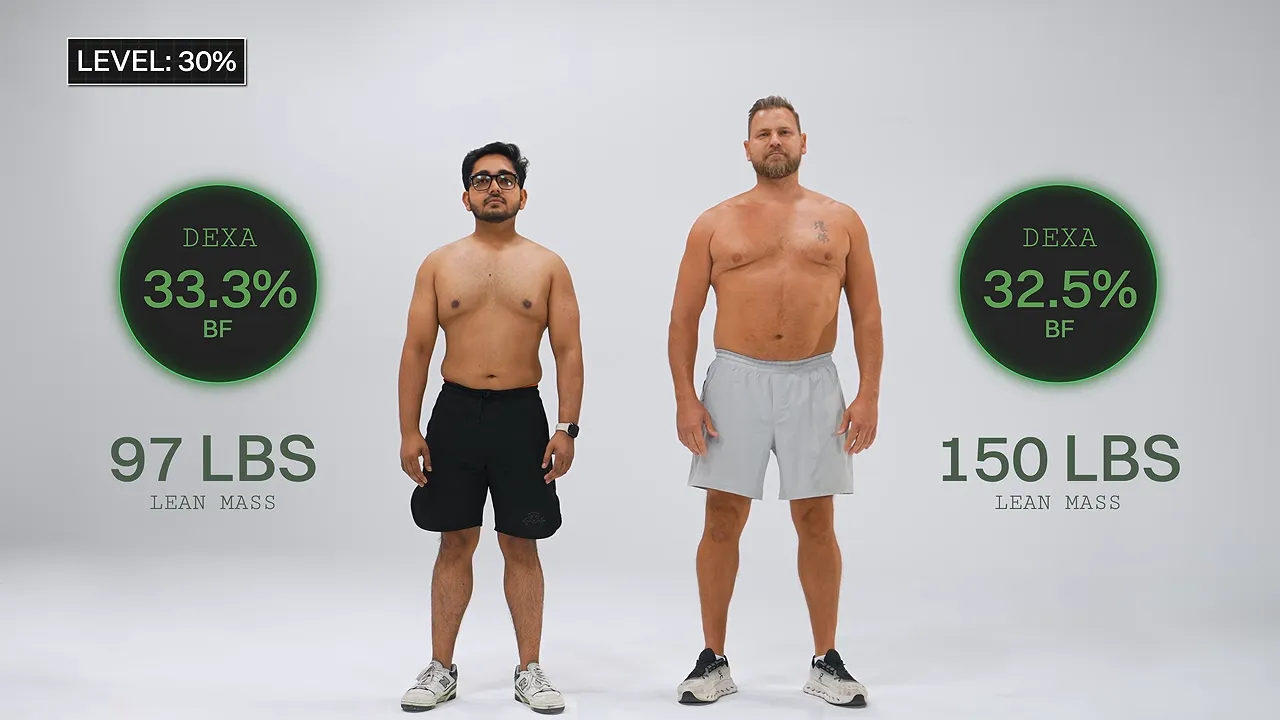
This is the range some people describe as a dad bod. If you lift, you may have visible muscular outlines in your arms and legs without much separation or fine detail.
With good sleep, a healthy diet, and regular exercise, energy and gym performance can be solid. Greg even liked the extra size his body fat gave him. There's nothing wrong with having an aesthetic preference that doesn't revolve around visible abs.
For men, however, 30% remains above the ranges generally recommended for long-term health. The average American man in the NHANES comparison was approximately 27% body fat. At 30%, roughly 40% of men had a higher percentage and about 60% were at or below it.
What 30% Looks Like on Women
Breckin measured 28.4% on DEXA and 28.2% on BIA. This is a body composition that can be healthy and sustainable for many women, with plenty of room for strong performance and good energy.
It's also leaner than a lot of people expect. Fitness culture throws around numbers like 10% and 15% so frequently that a woman can hear 28% and assume it must be high, even when she looks athletic.
In the US population comparison used here, a woman at 30% was leaner than approximately 90% of women. Thirty percent on a woman is not the equivalent of 30% on a man.
Approximately 20% Body Fat: Often Much Leaner Than People Expect
Men at 20%
Jay measured 20.8% on DEXA and 18.6% on BIA. Another participant, Nicholas, measured 19% on DEXA, but his shorter stature and greater muscularity created a different look.
I've also been here. During a bulk, I reached 20.6% body fat. On my frame, that looked different again.
If you lift, around 20% can mean noticeable definition in your shoulders and arms, with some abdominal outline when you flex under favorable lighting. For many men, it's a healthy, sustainable place to maintain, with good energy and performance.
It didn't feel ideal for me. I felt sluggish and bloated, and I generally feel better closer to 10% to 15%. But that's my experience, not a rule everyone needs to follow.
Some men feel comfortable closer to 20% to 25%. Trying to maintain below that can leave them constantly hungry, depleted, and low on energy. In that situation, maintaining a somewhat higher percentage may make more sense than repeatedly dieting down and rebounding.
Genetics play a substantial role in the range your body seems comfortable maintaining. And 20% is already relatively lean compared with the general population: in the US comparison used here, only about 12% of men were leaner.
Women at 20%
Christina had trained consistently for more than a decade and measured 21.4% on DEXA and 17.5% on BIA. Her physique showed visible muscle shape and clear definition through the midsection.
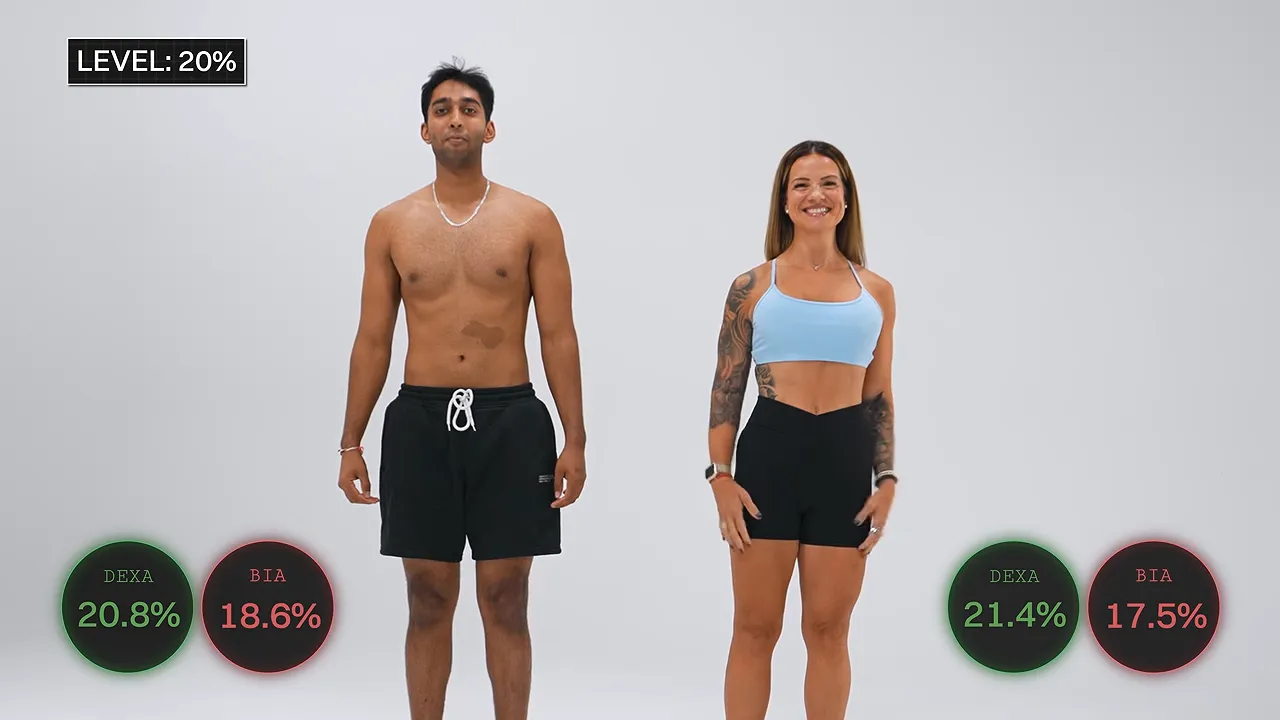
For women, approximately 20% is a genuinely lean, athletic level. Some can maintain it comfortably. Others will find it below the range where their energy, recovery, and health feel best.
In the population comparison, fewer than 1% of women were leaner than 20%, and only about 2% were below 25%. Those figures are useful context, not targets everyone needs to beat.
Unless you're naturally very lean or have a specific sporting reason, 20% is already near the lean end of what many women can realistically sustain while feeling and performing well.
Approximately 15% Body Fat: Lean for Men, Very Lean for Women
Men at 15%
My friend Shemar had lost 25 pounds and measured 15.3% on DEXA and 15.4% on BIA. At this level, muscular men often show clear separation, visible abs, and some veins through the biceps and forearms.
I don't consider this extreme leanness for men. I think it's a realistic year-round goal for many men who train hard and pay attention to their diet. But realistic doesn't mean effortless.
If your natural maintenance range is higher, hunger may become more noticeable. Your food environment starts to matter: keeping highly tempting snack foods constantly within reach can make maintenance much harder.
One participant measured 15.6% and initially felt disappointed because he expected a lower result. But he was happy with his physique, making progress, and performing well. At that point, what would a lower number actually improve?
Shemar felt better after losing weight gradually while continuing to train hard. With more muscular definition, he even appeared bigger despite weighing less.
Fifteen percent is leaner than many people realize. In the population comparison used here, only about 2% of American men were below that level.
Women at 15%
Vanessa, who was training for a HYROX competition combining running with exercise stations, measured 15.7% on DEXA and 14.8% on BIA.
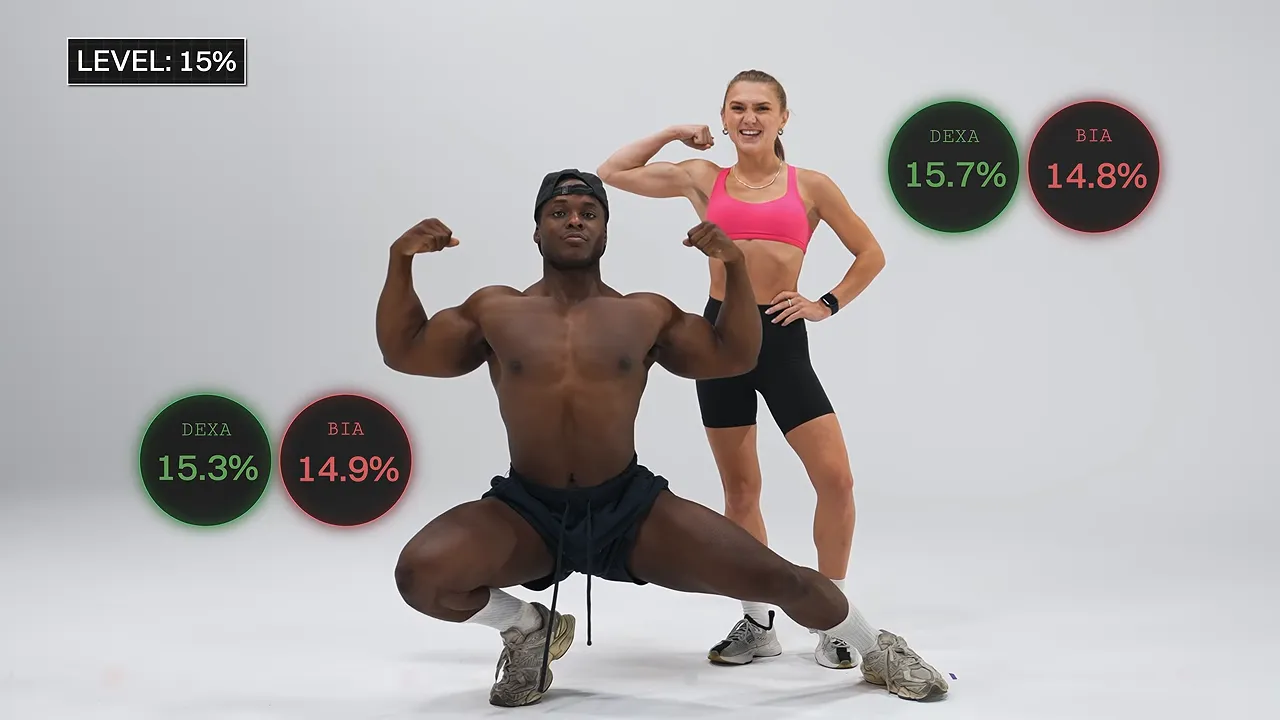
For women, this is very lean and more commonly associated with serious athletic preparation than an everyday maintenance goal. Some women tolerate it, but many experience problems, especially when maintaining it for extended periods.
- Increased hunger and food preoccupation.
- Lower energy and disrupted sleep.
- Irregular or absent menstrual cycles.
- Potential bone mineral loss and gastrointestinal issues over time.
One participant explained that additional stress could disrupt her menstrual cycle and sleep. That kind of feedback matters more than whether a percentage looks impressive.
Vanessa also described previously choosing a target weight based on another fitness personality of the same height. It wasn't safe or sustainable for her. Matching someone's height or physique goals doesn't mean their maintenance weight will work for you.
Approximately 12% Body Fat: A Very Fit Look, With More Dietary Structure
Men at 12%
Jimmy measured 12.1% on DEXA and 13.8% on BIA. This is a very lean physique: a clearly defined six-pack, a little remaining fat around the lower abdomen and lower back, and visible muscle striations when flexing under good lighting.
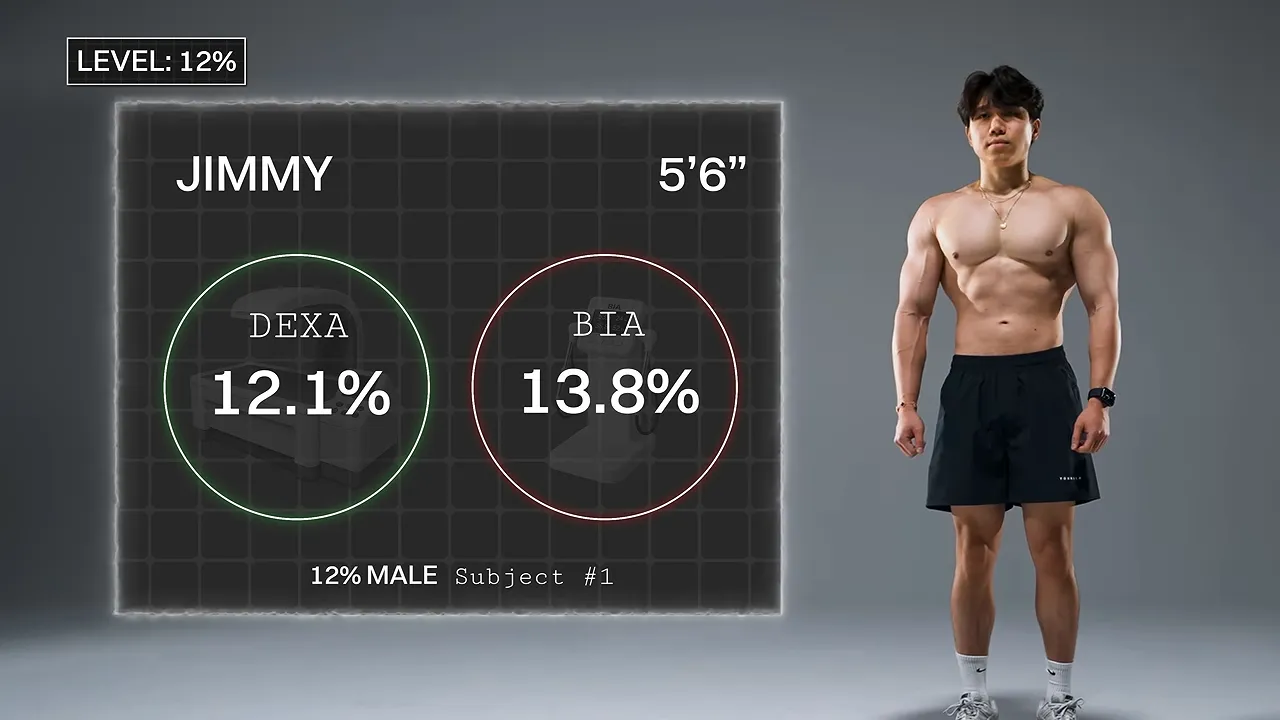
Gym performance can still be good here. Maintenance, however, often takes deliberate structure. Many men will need calorie tracking or a consistent meal plan rather than simply eating however they feel.
Some naturally lean men can sit here without much difficulty. For others, it starts to feel like they're always dieting.
To illustrate how unusual this is outside fitness circles, one data report cited in the research included more than 9,000 American men, with only one measuring below 12%. That's a result from that particular dataset, not a universal probability, but it shows how far fitness expectations can drift from the general population.
Women at 12%
Alicia, a professional bodybuilder, measured 12.2% on DEXA and 14.7% on BIA. For women, this is extreme leanness, generally associated with bodybuilding rather than ordinary health or recreational training.
Strength and energy can suffer, and food can become difficult to stop thinking about. Alicia described intense chocolate cravings and reaching the end of a busy day feeling overwhelmingly hungry.
This isn't simply a more disciplined version of maintaining 25%. The physical cost is very different.
Approximately 10% Body Fat: Not an Effortless Sweet Spot
Men at 9% to 10%
Three examples around this level were Niklas at 10.5% on DEXA, Ali at 9.0%, and me at 9.0%.
Here, the abs are sharply defined, separation between muscle heads becomes obvious, and striations show through the chest and shoulders. Depending on muscularity and fat distribution, you may also see detailed separation through the quads, back, and hamstrings.
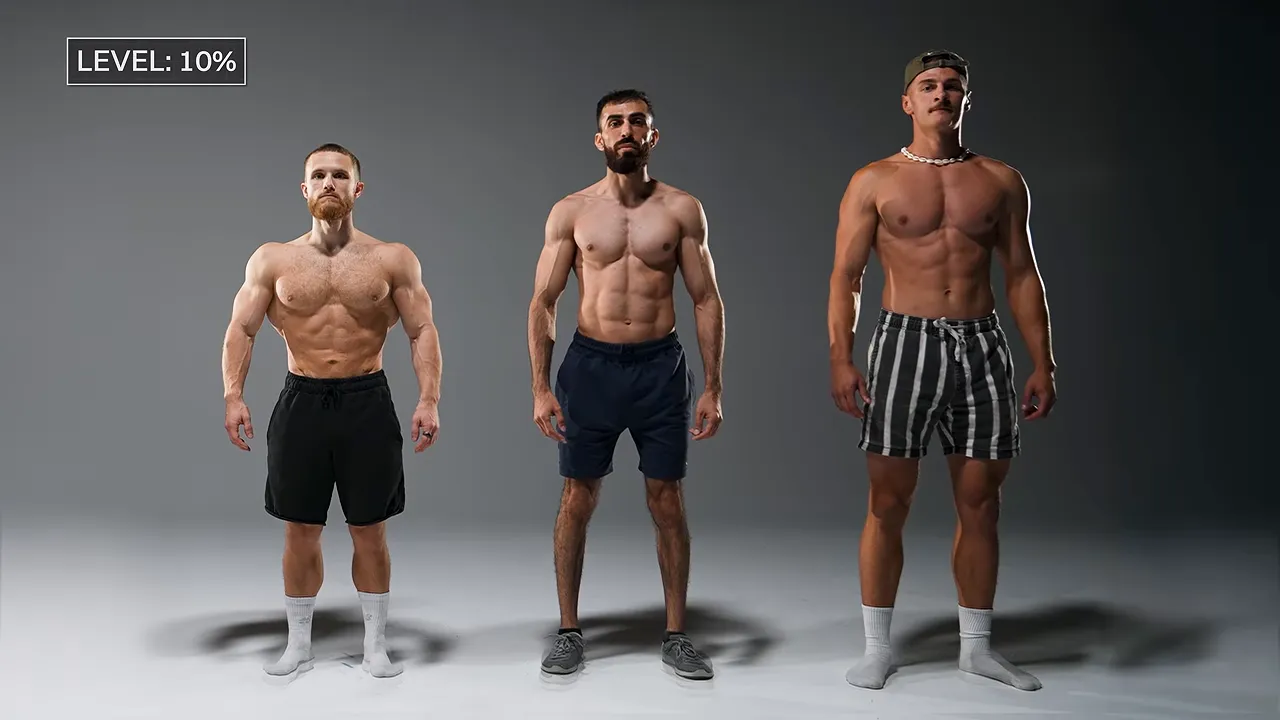
I expected Ali to measure even lower because his arms looked so vascular and defined. That's another reminder that true 9% to 10% body fat is already extremely lean.
The fitness industry often presents 10% to 12% as a comfortable sweet spot where everyone can have great definition without sacrificing quality of life. I'm not convinced that's realistic for most men.
I do this for a living, and I think I'm genetically leaner than average. Getting to around 10% was still harder than I expected.
There are exceptions. Niklas described feeling good, performing well, and maintaining a physique near this level as something close to his default. That's great for him. It doesn't mean someone else should expect the same experience.
There's a selection effect here: people who can maintain very low body fat comfortably are more likely to recommend it. Achievable and sustainable are not the same thing.
Women Around 10%
AJ, a professional bikini competitor, measured 9.9% on DEXA. Gia, a national-level competitor, measured 9.1%. These are exceptionally low readings, not everyday physique targets.
AJ described feeling terrible, losing hair, and going months without a menstrual period. Gia reported a substantial decline in energy, lightheadedness when standing, and ordinary walking or climbing stairs becoming exhausting.
Both also described intense food cravings. This level is not something I recommend as a long-term goal. If pursued at all for a short competitive period, it warrants qualified coaching and medical supervision.
There is no useful reason to keep pushing the female examples lower. The health risks already outweigh any general fitness benefit.
Approximately 8% Body Fat in Men: Shredded, but Usually Temporary
Luke, a professional natural physique competitor two weeks away from competition, measured 8.4% on DEXA and 9.5% on BIA.
This is what I'd call shredded. Deep striations are visible through most muscle groups, although the glutes may still lack the full striation seen at even lower levels.
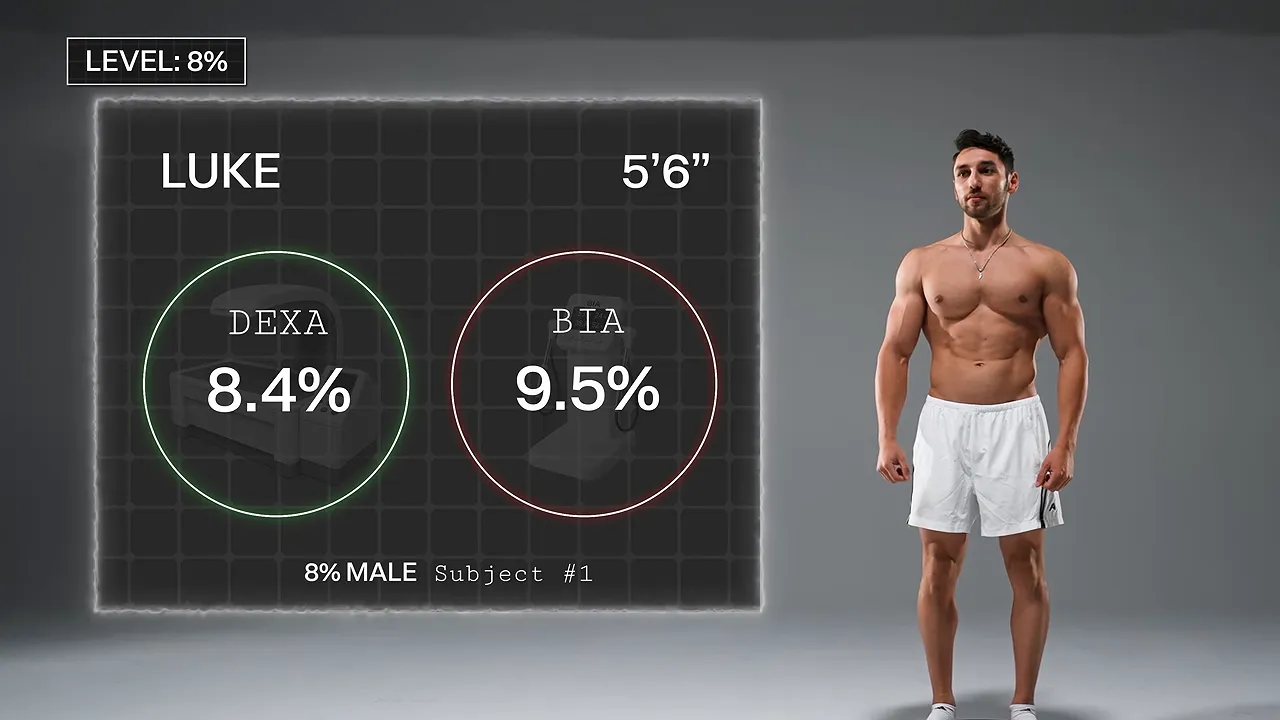
The trade-offs can be substantial. Testosterone may decline, hunger can dominate your attention, and sleep can deteriorate. Luke described brain fog, feeling mentally slow, and becoming irritated by small things.
A few genetic outliers may tolerate this better, but most men should think of it as a short-term condition, not a default maintenance level.
If a man chooses to prepare for a competition or photo shoot, the relatively healthier approach includes:
- Keeping protein intake high.
- Losing weight gradually instead of crash dieting.
- Prioritizing nutrient-dense whole foods.
- Paying attention to mood, recovery, and everyday functioning.
- Having a clear plan for after the diet.
That last point is huge. The event may be over, but the hunger doesn't necessarily switch off. Some people rapidly regain weight and overshoot their starting point.
I generally wouldn't recommend single-digit body fat without a compelling reason and a solid recovery plan.
Approximately 5% Body Fat in Men: Extreme Contest Conditioning
Lachlan, three weeks away from a classic physique competition, measured 5.5% on DEXA and 3.1% on BIA. The difference between those methods is another reason not to become overly attached to a precise number.
At this level, muscle separation has a dense, grainy appearance. This is extreme contest conditioning, not a general health goal.
Getting this lean while preserving substantial muscle is very difficult, particularly without anabolic assistance. Even with assistance, the side effects can be rough. Hunger can become relentless, and ordinary tasks can feel surprisingly demanding.
Lachlan described needing to mentally prepare himself just to get out of the car and walk into work. Interestingly, people at the opposite end of the body fat range described similar difficulty with daily activities. Different circumstances, but a familiar loss of ease and energy.
Mood Changes Do Not Excuse Mistreating People
After our measurements, Lachlan and Ali had a confrontation at the gym that spread on social media. I spoke with both afterward. Lachlan apologized and took responsibility for how he handled the situation. Ali also emphasized that body shaming and online harassment weren't acceptable responses.
Extreme dieting and anabolic drug use were discussed as possible contributing factors to irritability, but one incident cannot establish what caused someone's behavior. Neither leanness nor drug use excuses threatening or disrespecting another person.
The gym should be a place where people feel safe and welcome, regardless of their size or shape.
What's the Best Body Fat Percentage for You?
After all those numbers, my conclusion is that the exact percentage matters less than most people think.
For many women, 20% to 30% is a useful starting range when balancing health, performance, and appearance. The American College of Sports Medicine range cited here is a little broader, at 20% to 32%.
For men, the cited ACSM range is 10% to 22%. My general starting point is around 10% to 20%, with an important qualification: the lower end can require substantial effort and may not be comfortable for you.
- Men prioritizing lean aesthetics: approximately 10% to 15% may fit the goal, provided the trade-offs are acceptable.
- Men prioritizing strength performance: approximately 15% to 20% may offer a better balance.
- Women balancing health and performance: approximately 20% to 30% is often a more practical target than chasing extremely low numbers.
These are starting points, not diagnostic boundaries. Being slightly above or below them doesn't automatically make you unhealthy. Genetics, muscle mass, training history, and the behaviors required to maintain your physique all matter. The research on body fat ranges provides context, but it doesn't replace an individual assessment.
Instead of asking only what percentage you should reach, ask:
- Am I sleeping well and recovering from training?
- Is my energy good throughout the day?
- Can I eat in a way that feels manageable rather than constantly restrictive?
- Am I maintaining strength and performance?
- Do I feel healthy, confident, and able to enjoy my life?
The goal isn't the lowest percentage you can achieve. It's a range where you can live well. Body fat is one piece of the puzzle. It doesn't define your worth, and it doesn't tell the whole story of your health.
Make Your Nutrition Support That Balance
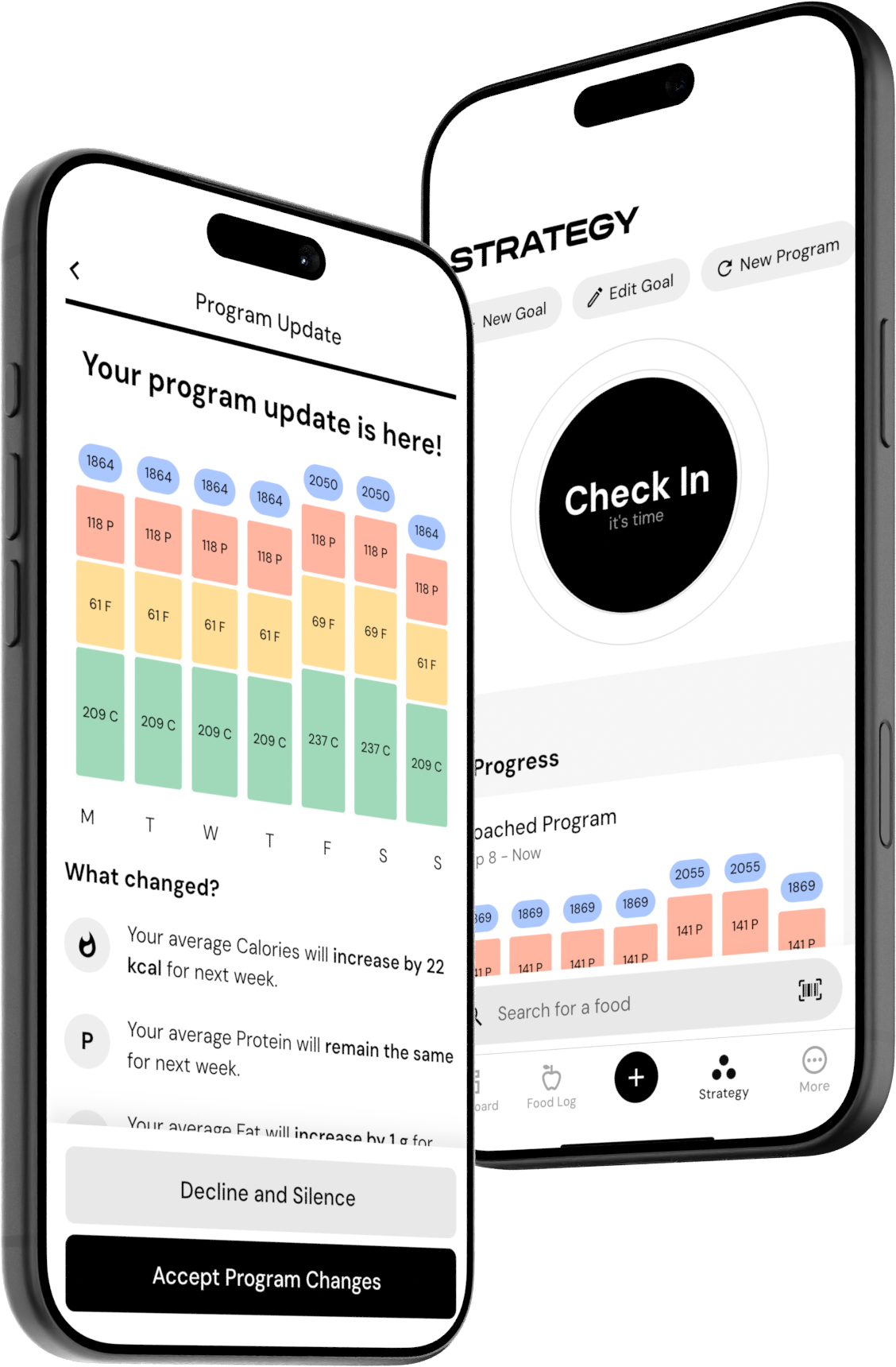
A sustainable body composition depends heavily on having a nutrition approach you can actually maintain. That's why I recommend MacroFactor, the nutrition app I co-own.
It combines food tracking with coaching algorithms and weekly check-ins to help guide you toward your goal. It doesn't punish missed tracking days or guilt-trip you about particular foods. Once a cut is over, dynamic maintenance mode helps you transition toward maintaining your weight, or you can change your goal to a lean bulk.
Whatever approach you choose, the point is to support your training and your life, not make your life revolve around a body fat reading.
|
This information is educational and is not a substitute for medical advice. Consult a physician before starting an exercise program or pursuing extreme changes in body composition.


