Peptides are everywhere. Lose fat, heal an injury, slow aging down. Scroll through social media long enough and you could get the impression that there is a peptide for pretty much everything.
Claims like that usually set off my nonsense detector. But here is what makes this topic interesting: some peptides really do work, and the effects can be huge. Medications like semaglutide have changed what is possible with nonsurgical weight loss. That naturally raises a question: if one peptide can do that, what can the others do?
The answer gets a lot less impressive once you move beyond weight loss. To separate the legitimate breakthroughs from the hype, we need to look at three categories: fat loss peptides, injury healing peptides, and anti-aging peptides.
I am not sponsored by any peptide company. My interest here is the science, including where it is strong, where it is promising, and where we are being asked to take a pretty massive leap of faith.
Key Takeaways
- Approved weight loss peptides have strong human evidence and can be effective medical tools.
- Resistance training and adequate protein remain important during medication-assisted weight loss.
- BPC-157 and anti-aging peptides lack convincing human evidence for their promoted benefits.
- A peptide’s effectiveness depends on its own research, not the success of other peptides.
Table of Contents
- What Are Peptides, Exactly?
- Fat Loss Peptides: The Hype Has Real Evidence Behind It
- BPC-157: Promising Injury Research, Very Little Human Evidence
- Anti-Aging Peptides: Epitalon and the Longevity Leap
- The Bottom Line: Judge the Compound, Not the Category
- A Tool I Use to Stay Consistent With Nutrition
What Are Peptides, Exactly?
Peptides are not mini steroids. Chemically, they are nothing like testosterone. They are not stimulants like caffeine, either, and they are not vitamins or minerals.
They are most similar to protein.
Imagine zooming into a scoop of protein powder. The protein molecules are long chains of amino acids folded into complicated shapes. A peptide is a shorter chain of those same building blocks.
With roughly 20 standard amino acids available in different sequences, you can make an enormous variety of peptides. And those different sequences matter. Calling something a peptide tells you something about its chemical structure, but very little about whether it will help you lose fat, recover from an injury, or live longer.
For health and fitness, the big three categories getting attention are:
- Fat loss peptides: medications such as semaglutide and tirzepatide that act on appetite-related pathways.
- Injury healing peptides: compounds such as BPC-157, often marketed as “Wolverine” peptides.
- Anti-aging peptides: compounds such as epitalon that are promoted for longevity and healthier aging.
The important thing is to evaluate each compound on its own evidence. One successful peptide does not validate the entire category.
Fat Loss Peptides: The Hype Has Real Evidence Behind It
How semaglutide works
Semaglutide is the peptide sold under the brand names Ozempic and Wegovy. It activates receptors for GLP-1, a hormone involved in blood sugar regulation and appetite.
It is commonly injected beneath the skin because delivering peptides orally is difficult. The digestive system breaks them down, making absorption a challenge. Oral semaglutide formulations use special absorption technology and higher doses to overcome that problem. Research on oral semaglutide for weight management suggests that this approach can also produce substantial results.
Once absorbed, semaglutide acts through several connected pathways:
- Pancreas: it helps regulate blood sugar.
- Stomach: it slows gastric emptying.
- Brain: it reduces hunger signals.
The practical result is simple, but powerful: you feel less hungry.
Unlike the typical fat burner, semaglutide does not primarily work by cranking up your metabolism. It makes eating fewer calories easier. The calorie deficit still matters. The medication changes how difficult that deficit feels.
How much weight do people actually lose?
In a large placebo-controlled semaglutide trial, nearly 2,000 adults were assigned to semaglutide or a placebo. Both groups received lifestyle support, including dietary counseling and encouragement to exercise. Participants did not know which treatment they were receiving.
The average starting weight was about 232 pounds. After 68 weeks, roughly 16 months:
- The semaglutide group lost about 34 pounds on average.
- The placebo group lost about 6 pounds on average.
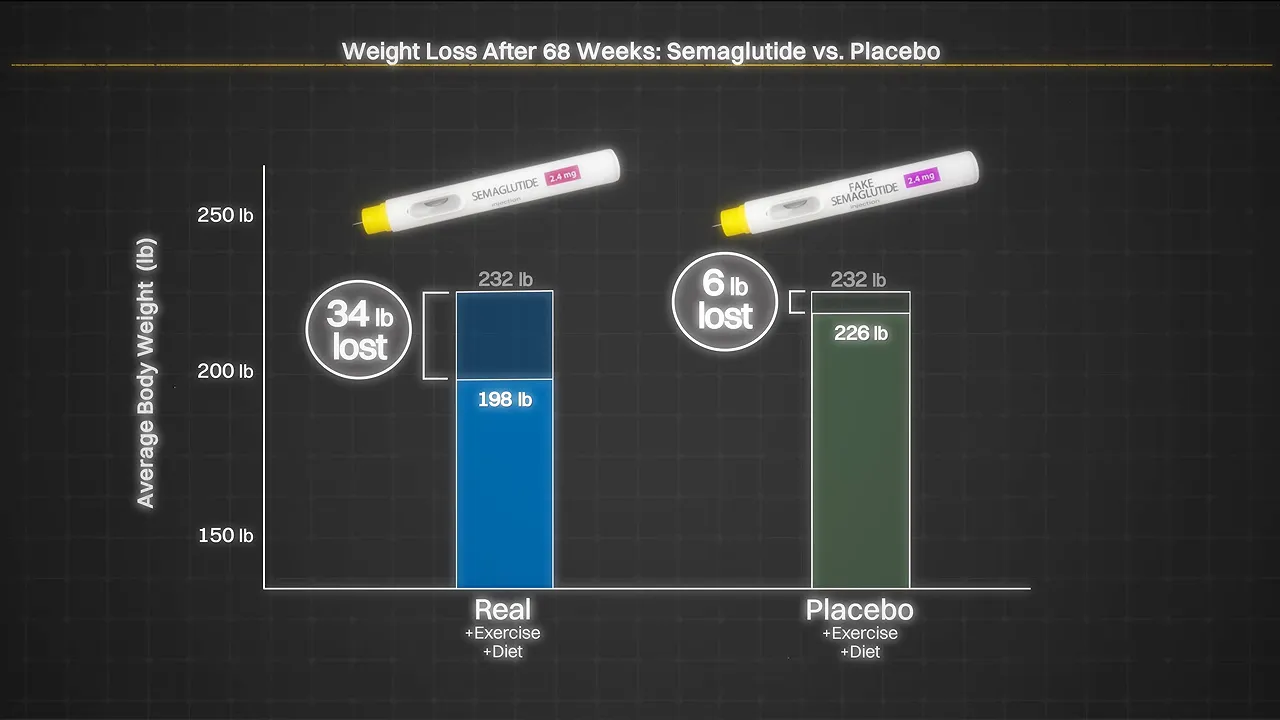
That is a massive difference. It is also a much stronger kind of evidence than before-and-after photos or someone saying a product changed their life.
What about tirzepatide and retatrutide?
Semaglutide is not the end of the story. Newer compounds target additional receptors and have produced even larger average weight losses in the research discussed here:
- Semaglutide: approximately 15% weight loss, targeting GLP-1 receptors.
- Tirzepatide: approximately 23% in the results highlighted here, targeting GLP-1 and GIP receptors.
- Retatrutide: approximately 28% in the reported phase 3 results, targeting three receptor pathways.
These numbers come from different trial settings, so they are not a clean head-to-head ranking or a guarantee of what any individual will lose. But the overall picture is pretty striking: this newer generation of medications can produce very substantial weight loss.
For a sense of scale, a loss of around 28% from a starting weight of 250 pounds would be roughly 70 pounds over about a year and a half.
The additional receptor targets can further blunt appetite, and there may be metabolic effects as well. For more detail, the tirzepatide clinical trial and reported retatrutide phase 3 findings provide useful context.
Are weight loss peptides safe?
Effectiveness is only half the question. Something can work and still be a bad idea.
When I spoke with physician Dr. Spencer Nadolsky, who prescribes these medications, his assessment was that approved weight loss medications in this category have a strong safety profile when used in the appropriate patient population. That does not mean they are side-effect-free, or that every rare risk will show up in a clinical trial.
The most common issues are gastrointestinal:
- Nausea: often more noticeable when treatment begins and may decrease over time.
- Vomiting: can occur, particularly with more severe gastrointestinal intolerance.
- Constipation: may persist rather than fading as nausea sometimes does.
- Gallstones and gallbladder problems: less common, but still relevant to medical monitoring.
A long-term semaglutide safety study adds to the evidence base, but safety still needs to be evaluated for the individual, not just the average trial participant.
There is also an important regulatory distinction. Semaglutide and tirzepatide have approved products through the FDA, Health Canada, and European regulators. At the stage of research discussed here, retatrutide was still investigational, with phase 3 results emerging rather than regulatory approval. Promising results do not make an experimental compound equivalent to an approved prescription medication.
The muscle loss problem is not something to ignore
A medication that makes weight loss easier does not replace everything exercise does.
Lifting helps preserve muscle. Exercise also provides mental health benefits that cannot be reduced to a number on the scale. If someone uses a weight loss medication as a reason to stop training entirely, that is a real concern.
Some semaglutide body-composition findings suggest that around 40% of the weight lost can be lean mass. That deserves attention, but lean mass is not identical to muscle, and that percentage should not be treated as an inevitable outcome for everyone.
The likely issue is not simply that the peptide directly destroys muscle. Losing a lot of weight without enough protein or an adequate resistance-training stimulus creates a situation where lean tissue can be lost too. The research on semaglutide and lean mass is worth considering alongside total weight loss.
If you are using a weight loss medication, protein intake and resistance training still matter. A lower body weight is not the only outcome worth protecting.
There may even be ripple effects in the supplement market. More people appear to be thinking about protein, which is encouraging, although rising demand and supply constraints may also be contributing to higher protein powder prices. That connection is less certain than the clinical evidence for weight loss itself.
Prescription medicine and online peptide sourcing are different things
The safety evidence for a properly manufactured medication does not automatically apply to a vial bought from an unknown online seller.
People who do not qualify for a prescription, or who do not want to go through a doctor, can turn to black market and gray market sources with unreliable quality control. That adds a separate layer of risk, regardless of whether the active compound works in clinical trials.
I am also concerned about already lean, healthy people using these drugs to become even thinner. That is different from treating obesity to help someone reach a healthier weight. Easier access could push expectations about what a desirable body should look like further in an unhealthy direction.
Is using a GLP-1 medication “cheating”?
I do not think treating obesity with medication is a moral failure.
Obesity has biological drivers. Hunger, appetite, and food reward are not just reflections of how disciplined someone is. We generally do not shame someone for taking blood pressure medication while also improving their diet and exercise habits. The same basic reasoning should apply here.
There is a difference between constantly chasing an easy way out and using effective medical technology to make a difficult health problem more manageable. More suffering does not automatically make an approach better.
My practical position is this: if you are already at a healthy body fat level, feel good, and perform well, I do not see a compelling reason to take one just to get leaner. Nutrition and exercise should remain foundational. If you have been struggling with weight loss, whether medication makes sense is a decision to make with your doctor.
BPC-157: Promising Injury Research, Very Little Human Evidence
Injuries suck. For a serious lifter dealing with a shoulder, elbow, or knee that will not settle down, the idea of a peptide that accelerates healing is incredibly appealing.
That is the pitch behind BPC-157.
BPC stands for body protection compound. BPC-157 is a chain of 15 amino acids associated with a larger protective protein found in gastric juice. Croatian researchers began studying it in the early 1990s, initially investigating potential protective and healing effects in the digestive system.
Why the mechanism sounds plausible
Animal research has produced some intriguing results. In one injured-leg model, researchers reported about 50% more blood vessel formation following treatment.
More blood vessels could mean better blood flow and greater delivery of nutrients to damaged tissue. Other animal studies have investigated healing in muscles, tendons, and ligaments, with promising findings.
So the mechanism is not obviously nonsense. There is a reason researchers are interested.
But there is a big catch: those healing results largely come from animals, not humans.
The evidence gap is enormous
The human research base discussed here consisted of only three small pilot studies totaling about 30 people. Some findings were encouraging for knee pain, bladder pain, and preliminary safety, but there were no adequate placebo or control groups.
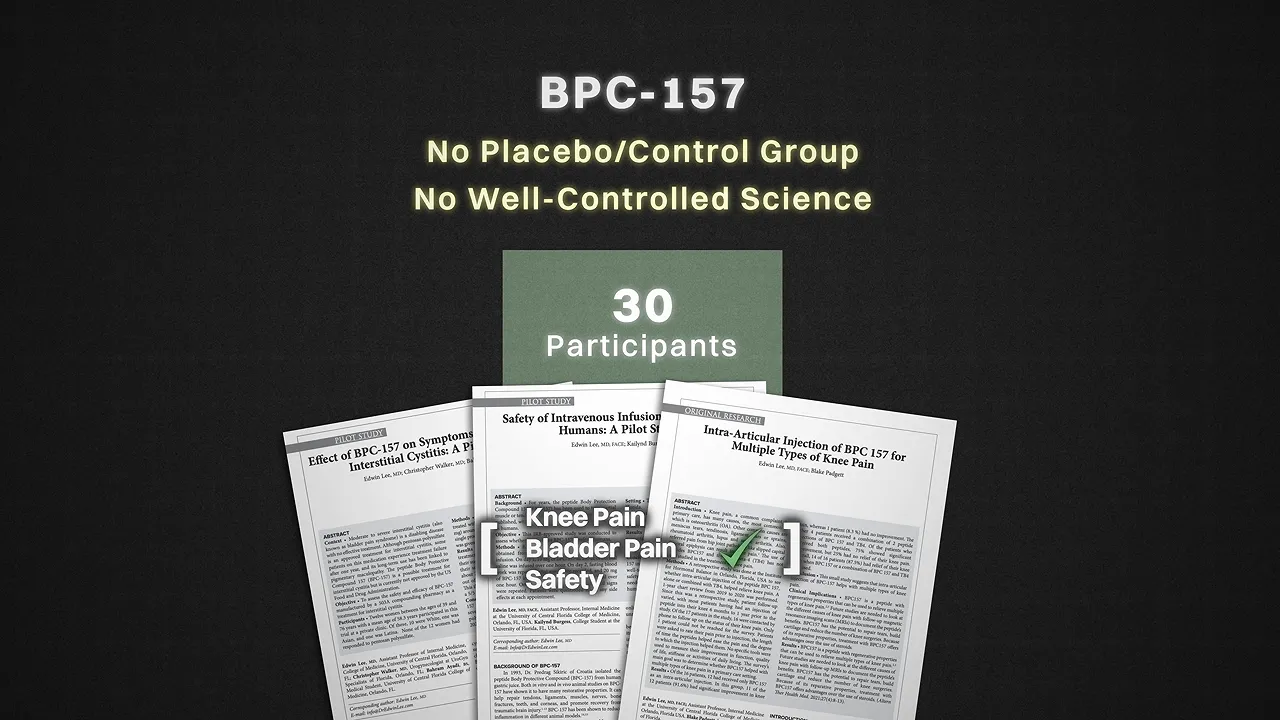
Compare that with semaglutide and tirzepatide, which have been studied in tens of thousands of participants across large clinical programs. These are not remotely comparable levels of confidence.
The early studies, including pilot research on knee pain, may justify better trials. They do not establish that BPC-157 reliably heals lifting injuries or that its longer-term use is safe.
Why success stories cannot settle the question
I know people who describe longstanding injuries improving after taking BPC-157. The internet is full of similar stories involving elbows, shoulders, knees, and more.
I do not think those experiences are worthless. But they are difficult to interpret.
Suppose your shoulder has been bothering you, you start a peptide, and six weeks later it feels better. Maybe the peptide helped. Or maybe the shoulder was going to improve over those six weeks anyway.
Without a well-controlled trial, we cannot separate a treatment effect from natural recovery and other changes happening at the same time. A plausible mechanism plus a compelling anecdote is still not the same thing as demonstrated effectiveness.
What I would do instead
My answer to whether I would recommend BPC-157 right now is no. The human evidence is too limited, sourcing can be questionable, it is not FDA-approved, and it is banned by the World Anti-Doping Agency.
For now, I would stick with the less exciting approach:
- Manage your training load. Adjust the demands you are placing on the irritated tissue.
- Find pain-free variations. Look for ways to train without repeatedly provoking the problem.
- Build back gradually. Increase what you can tolerate over time rather than rushing straight back to previous loads.
- Get qualified help if it is not improving. A physical therapist can assess the injury and guide rehabilitation.
I hope better human research happens. Being open to that possibility does not mean we should act as though the evidence already exists.
Anti-Aging Peptides: Epitalon and the Longevity Leap
Fat loss and injury recovery are ambitious enough. Epitalon aims at something bigger: aging itself.
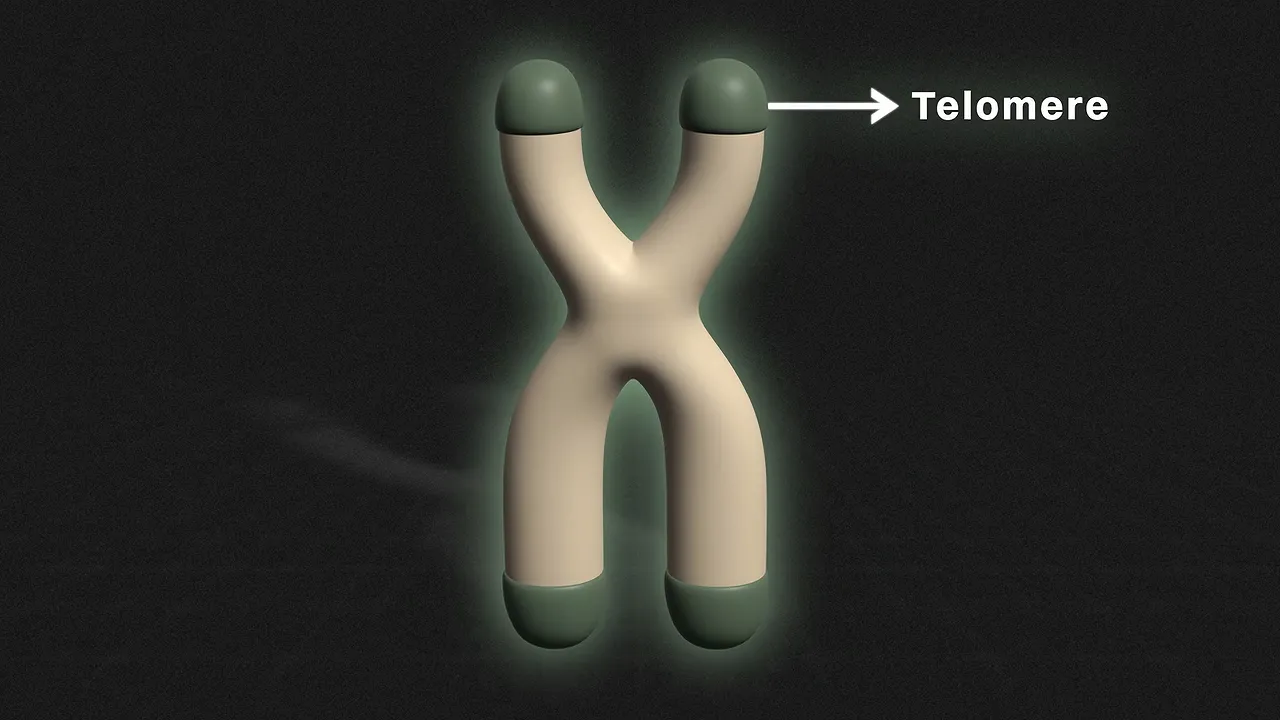
This tiny peptide contains just four amino acids. The proposed mechanism centers on telomeres, the protective structures at the ends of chromosomes.
Telomeres, telomerase, and the appeal of a simple fix
Your DNA contains the instructions used throughout your body. That DNA is packaged into chromosomes, and telomeres help protect their ends.
Telomeres tend to shorten as we get older, and that shortening is involved in the biology of aging. Epitalon is proposed to activate an enzyme called telomerase, which can help maintain or rebuild telomeres.
It sounds like a neat solution: restore the protective caps and slow aging down.
The problem is that aging is not a single broken component with a simple replacement part. A mechanism involving telomeres and aging does not, by itself, demonstrate that taking a compound will extend human life.
Does epitalon actually increase lifespan?
There are encouraging lifespan findings in flies, mice, and rats. Human evidence is a different story.
The human longevity claims discussed here lean heavily on older Russian research from 2003 and 2006 involving related pineal peptide preparations, including epithalamin. Those studies were not independently replicated outside that research setting. They are not a solid foundation for claiming that commercially available epitalon extends human lifespan.
There is also a biological reason not to assume that more telomerase activity must always be better. Telomerase activation can be involved in cancer development. That does not prove epitalon causes cancer, but it does show why manipulating this pathway requires much more than an appealing theory.
The human evidence for anti-aging benefits simply is not strong enough.
Humans already live unusually long lives compared with many mammals of similar size. Results from shorter-lived animals do not automatically translate into additional healthy years for us. That translation problem shows up repeatedly in longevity research.
The boring longevity habits still win
Fortunately, we do not need to wait for an experimental peptide to do useful things for long-term health.
One of the biggest priorities is maintaining relationships: friends, family, and a sense of community. A substantial analysis of social relationships and mortality supports taking social connection seriously.
The rest will sound familiar:
- Exercise regularly.
- Sleep well.
- Do not smoke.
- Avoid excessive alcohol consumption.
- Maintain a healthy body weight.
Those habits are not as exciting as a vial marketed as an anti-aging breakthrough. But they have much better human evidence behind them.
Would I recommend an anti-aging peptide right now? No. The uncertainty is too large, and the benefits being advertised run well ahead of what has been established.
The Bottom Line: Judge the Compound, Not the Category
Peptides are neither universally amazing nor universally bogus.
Approved weight loss peptides can be powerful medical tools for the right person. BPC-157 has interesting animal data but inadequate human evidence. Epitalon has an ambitious mechanism without convincing evidence that it extends human life.
The mistake is taking the success of semaglutide and using it to give every other peptide a scientific stamp of approval. Sharing a chemical category does not mean sharing an evidence base.
Meanwhile, the daily habits still matter. Whether your goal is fat loss, muscle retention, recovery, or healthier aging, training, nutrition, sleep, and relationships remain central.
A Tool I Use to Stay Consistent With Nutrition
One habit I follow almost every day is tracking my nutrition with MacroFactor. I am a co-owner of the app, so I want to be clear about that connection.
Beyond logging food, MacroFactor uses your intake and weight data to estimate your energy expenditure and adjust calorie and macro targets over time. It is designed to make a consistent nutrition plan easier to follow, not to replace the habits that make the plan work.
The app has no ads, does not sell your data, and offers support if you get stuck. If you want to try it, code JEFF gives you a two-week free trial.
|