There’s a difference between having developed shoulders and having delts that look round, wide, and three-dimensional. Building that look takes more than finding one magical lateral raise variation.
These are seven strategies I use in my own shoulder training, from a simple technique cue to some surprisingly detailed anatomy. Most have at least some scientific support, but none outrank the basics: train hard and stay consistent. Think of these as ways to make that effort more productive.
Key Takeaways
- Spread shoulder work across more sessions instead of continually adding sets to one workout.
- Progress heavy presses with load increases and isolation exercises with a rep-range-based double progression.
- Include varied muscle lengths and movement angles for more complete shoulder training.
- A smaller waist and greater muscle definition can make your shoulders look substantially broader.
Table of Contents
- 1. Stop Letting Your Traps Take Over
- 2. Train Your Shoulders More Often
- 3. Get Seriously Strong on a Shoulder Press
- 4. Bring Your Waist Down to Make Your Shoulders Stand Out
- 5. Train Your Delts at Different Muscle Lengths
- 6. Match Your Progression Scheme to the Exercise
- 7. Train Beyond the Three Familiar Delt Heads
- Make Your Shoulder Training Measurable
1. Stop Letting Your Traps Take Over
If your lateral raises feel more like shrugs, your side delts might not be getting the tension you intended.
Now, some trap involvement isn’t automatically bad. If you want bigger traps, getting some crossover work can be useful. And your delts can still grow when other muscles help. But in my coaching experience, some people struggle to engage their side delts when they focus only on getting the weight up.
The cue I’ve found most useful is simple: imagine holding a long shovel and scooping sand out to your side.
Instead of shrugging the dumbbells toward your ears, initiate the movement with your shoulders down and sweep the weights outward. The emphasis changes from lifting up to reaching out.
I tested this informally with people at the gym. First, I asked them to move the weight however they needed to. Then I had them try the shovel cue. Everyone reported feeling more side delt involvement with the second approach, and several found the same weight noticeably harder.
That isn’t a scientific experiment, and feeling a muscle more doesn’t prove it will grow more. But it’s a practical cue worth trying if your traps seem to dominate every lateral raise.
One important distinction: you’re reducing unnecessary shrugging, not eliminating normal shoulder blade movement. As your arms rise, your shoulder blades need to rotate, and the traps naturally contribute. The goal is to start the raise with a deliberate outward sweep rather than an aggressive shrug.
2. Train Your Shoulders More Often
In a poll of my audience, about 60% trained shoulders twice per week, 24% trained them once, 11% trained them three times, and only 4% trained them more often. If shoulders are a priority, I think higher frequency deserves more consideration.
The reason isn’t that frequency is magic. It’s that there’s a limit to how much productive work you can cram into one session.
My practical reading of the per-session volume evidence is that returns start diminishing substantially around six to eight sets for a muscle in one workout. A more recent meta-analysis suggests the estimated ceiling could be closer to 11 sets, but that doesn’t mean every set up to 11 is equally productive.
Six sets isn’t a hard biological cutoff. The useful point is that later sets tend to deliver less additional benefit. Rather than continually adding work to an already long shoulder session, spread that work across three or four days.
Earlier in my bodybuilding career, I did three sets of dumbbell lateral raises after every workout, five days per week. I think that helped my shoulders grow. That’s an anecdote, not proof that everyone needs five shoulder sessions, but it illustrates how small doses can fit into an existing split.
What about recovery?
In my own training and coaching, shoulders tend to recover quickly, particularly from isolation exercises such as lateral raises and rear delt flies. After three to six hard sets, I often find they’re ready to train again within 24 to 48 hours.
That’s a coaching observation rather than a universal recovery rule. Use your ability to repeat good-quality work as the practical check, rather than assuming you must be ready because a day has passed.
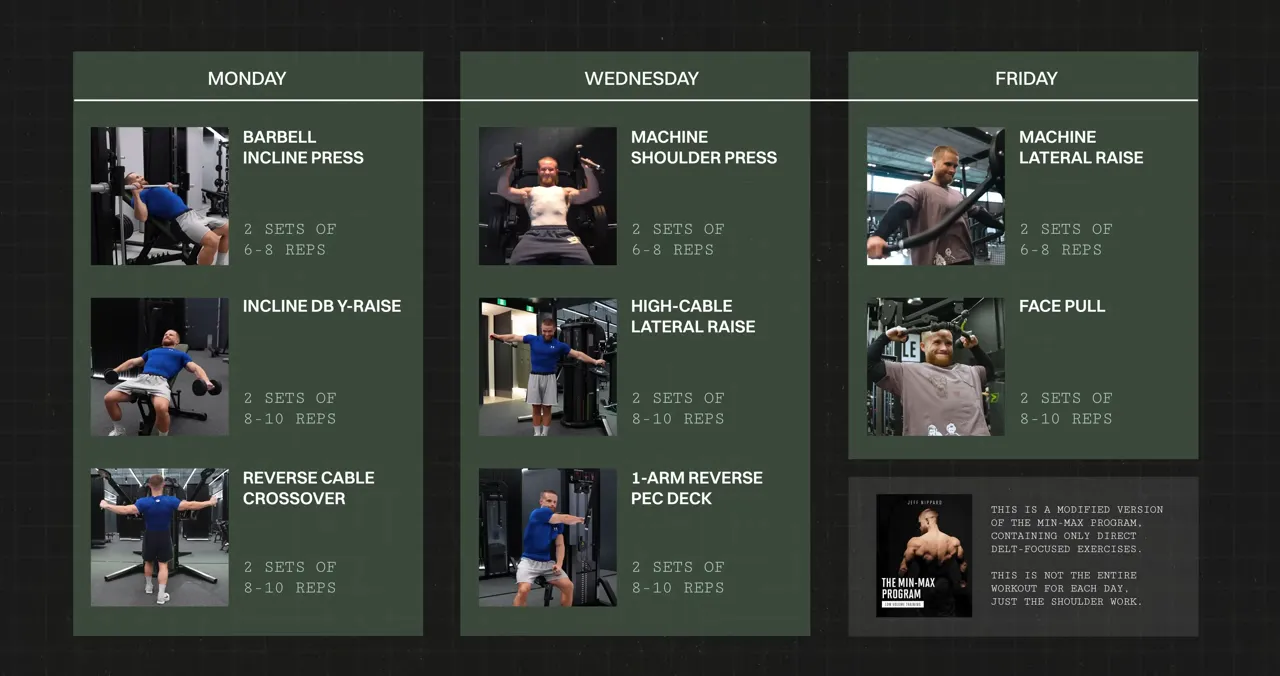
The example below shows how I’d organize a higher-frequency shoulder plan, borrowing from my Men’s Max program.
3. Get Seriously Strong on a Shoulder Press
Pick a vertical press you can progressively overload and commit to improving it. For me, that’s a machine shoulder press. A dumbbell or barbell press can work too.
Choose a weight you can lift for five or six solid reps, then work toward adding weight while keeping the reps and technique consistent. Stick with it for a full year, not just a few workouts.
The logic is straightforward: mechanical tension is the main driver of muscle growth. Getting stronger on a stable movement gives you a useful way to keep challenging your delts over time.
Strength and size aren’t identical. Improving a lift doesn’t automatically prove that you’ve added muscle. But when you’re lifting more weight on the same exercise, for the same reps, with the same form, muscle growth is a likely contributor to that improvement.
Shoulder presses aren’t just front delt exercises
A common argument against vertical pressing is that the front delts already get plenty of work from bench presses and other horizontal presses. That part is fair. But it overlooks how much the side delts can contribute to a vertical press.
In my own EMG testing, I actually recorded more side delt activation than front delt activation on the machine shoulder press I use. That’s a personal measurement, not a long-term growth study, but it challenges the idea that shoulder presses only train the front delts.
A heavy press also solves a practical problem: you can’t keep adding weight to lateral raises forever. Having a strength-focused compound movement gives you another route for progressing your shoulder training.
4. Bring Your Waist Down to Make Your Shoulders Stand Out
This might be the most overlooked strategy here, even though it can have the biggest impact on how three-dimensional your shoulders look.
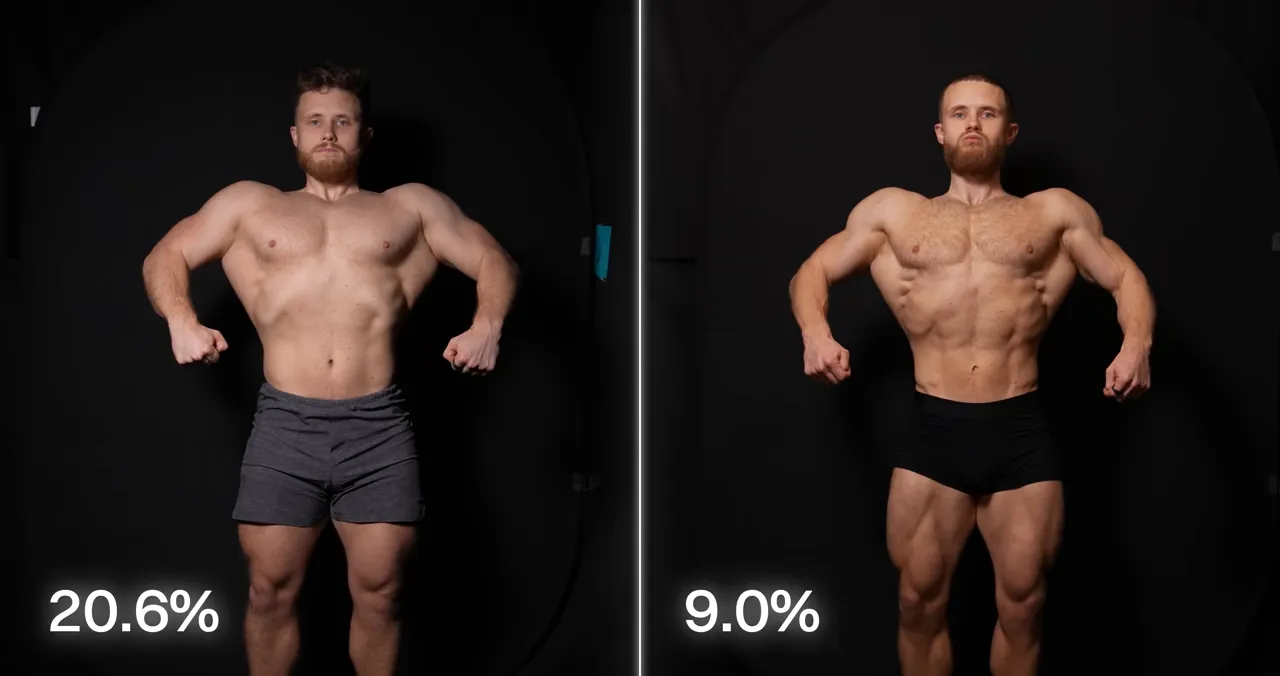
When I went from roughly 20% body fat to 9% using MacroFactor during my cut, my shoulders looked broader and rounder. That wasn’t simply a matter of building more delt muscle. My waist was smaller, and less body fat was covering the muscle I already had.
There are two effects working together:
- Proportion: a smaller waist makes your shoulders look wider by comparison.
- Definition: less fat around the delts reveals deeper contours and more separation between regions.
Those percentages describe my comparison, not a body-fat target everyone needs to chase. The takeaway is that looking more muscular and adding muscle aren’t always the same thing. If getting leaner fits your goals, doing that while continuing to train your shoulders hard can make a major visual difference.
5. Train Your Delts at Different Muscle Lengths
A muscle is longer in its stretched position and shorter in its contracted position. Your exercise selection and range of motion determine where it experiences the most tension.
A lot of typical shoulder training emphasizes shorter muscle lengths:
- Shoulder presses: stopping early at the bottom leaves out some of the deeper range.
- Dumbbell lateral raises: resistance is greatest near the top, when the side delts are relatively shortened.
- Rear delt flies: skipping the cross-body portion reduces the stretched range.
Research on other muscles gives us a reason to care. Three studies on the quads, biceps, and calves reported roughly 130% to 190% more growth with longer-length training than their comparison conditions. Those are relative differences in those specific studies, not predicted gains for your shoulders.
What does the shoulder research show?
An eight-week study comparing cable and dumbbell lateral raises found similar shoulder growth with both exercises.
That’s interesting because dumbbells emphasize tension higher in the raise, while cables can provide more tension near the bottom. Based on the longer-length research, the authors expected cables to perform better. They didn’t.
My conclusion isn’t to throw out dumbbells or declare cables superior. Include both shorter-length and longer-length work. The evidence doesn’t justify making shoulder training exclusively about the stretch.
There’s also a useful detail: participants in that study stopped the cable raise at their side. They didn’t sweep the working arm across the body. That may have limited one potential advantage of cables, although it doesn’t prove that adding the cross-body range would produce more growth.
How I add more lengthened work
- Press deeper: lower your upper arms as far as you comfortably can instead of automatically stopping at parallel.
- Let cable lateral raises cross your body: use the cable to maintain tension as the working arm moves inward, rather than ending every rep at your side.
- Try cross-body cable Y raises: move from across your body up and out into a Y for a large range of motion.
- Use a dumbbell alternative: if cables aren’t available, lie back on a bench set to about a 20° incline and perform cross-body dumbbell Y raises.
- Give rear delts a stretched start: allow the arm to travel across your body before sweeping back into a controlled squeeze.
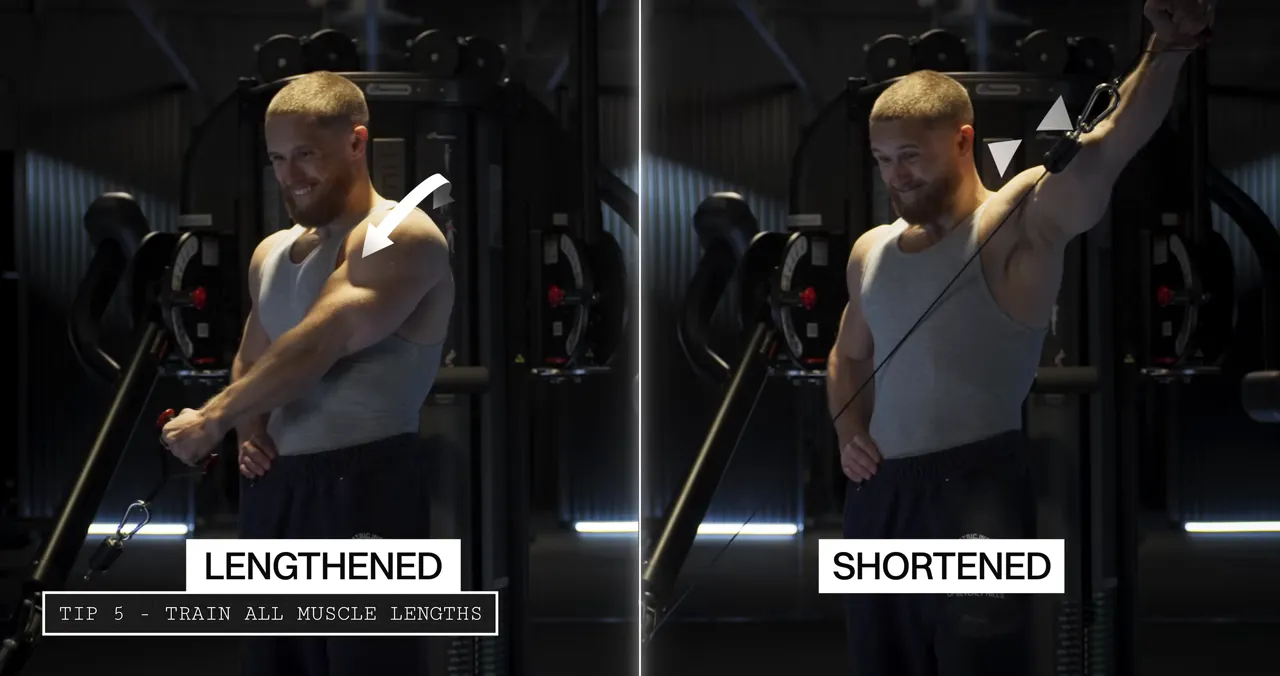
For rear delt work, the same principle applies whether you use cables, dumbbells, or a machine: don’t turn every rep into a tiny squeeze at the back. Include the cross-body portion as well.
6. Match Your Progression Scheme to the Exercise
Progressive overload matters, but the method needs to suit the movement.
Imagine starting lateral raises with 15-pound dumbbells and adding five pounds every week. By week eight, you’d be using 50s. That’s not a realistic long-term plan for strict lateral raises, no matter how motivated you are.
Your shoulder press and your lateral raise shouldn’t have identical progression rules.
For presses, use a simple load progression
For a heavy shoulder press, I like a fixed target of five or six reps, with the aim of adding five or 10 pounds from week to week when you can maintain that target and your technique.
Every four to eight weeks or so, take a deload: reduce the weight a little and don’t push quite as hard. The objective is sustained progress, not forcing a heavier load when you can no longer perform the exercise the same way.
For isolation exercises, use double progression
For lateral raises and rear delt flies, choose a rep range instead of a fixed rep target. Here’s how that might look using 10 to 12 reps:
- Start with 10 reps: choose a weight that brings you close to failure, or to failure, with controlled form.
- Build to 11 reps: keep the weight the same and aim to add a rep.
- Build to 12 reps: reach the top of your chosen range.
- Increase the weight: return toward 10 reps and repeat the process.
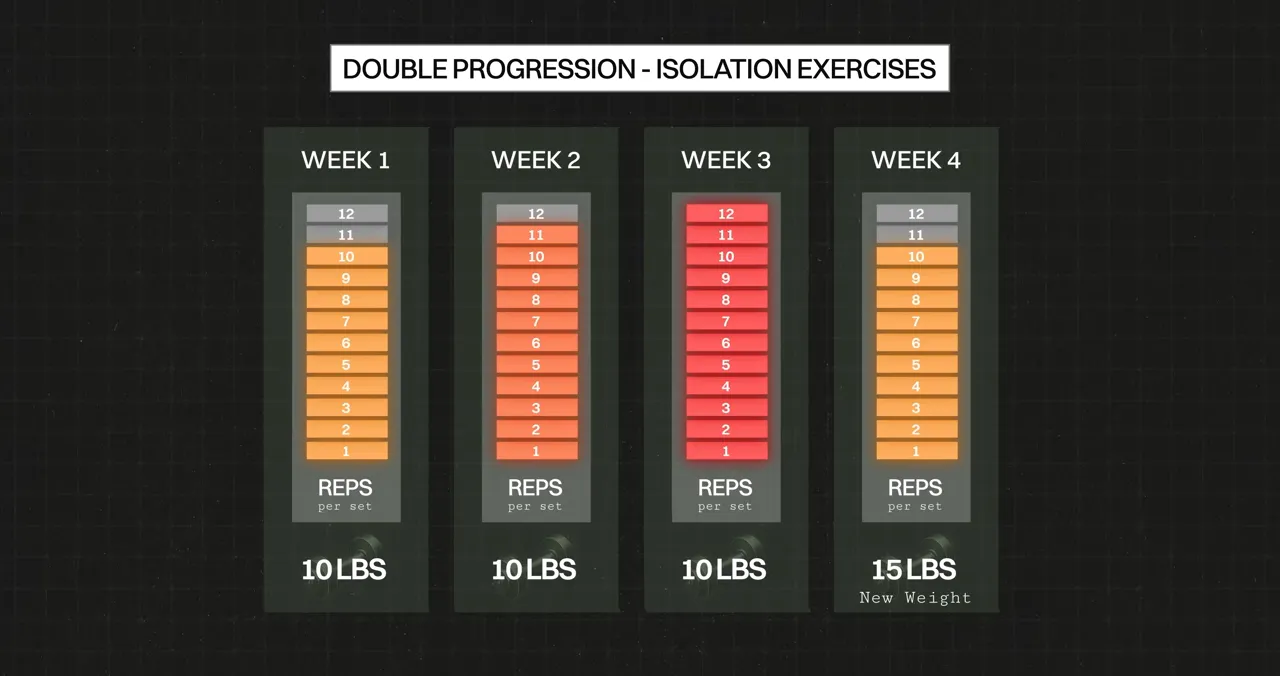
You don’t have to improve every set at once. If you’re doing three sets, adding one rep to one set is still progress, especially as you become more advanced.
Eventually, you may reach a point where you can’t add even one rep without your form breaking down. At that stage, I like rotating in a different exercise and starting another progression.
For example, move from dumbbell lateral raises to cables, then to a machine once progress on cables has run its course. This isn’t random exercise hopping. You’re keeping a movement long enough to progress it, then changing it when you’ve stalled.
The important part is having a plan you actually record and follow. It’s surprisingly easy to spend months repeating the same weights and reps without realizing nothing is changing.
7. Train Beyond the Three Familiar Delt Heads
Most people learn that the deltoid has three heads: anterior, lateral, and posterior. That’s useful, but it isn’t the whole anatomical picture.
An anatomical study involving 60 cadavers described seven intramuscular segments, each associated with its own tendon. The familiar front and rear regions each contain three segments, while the middle region contains one.
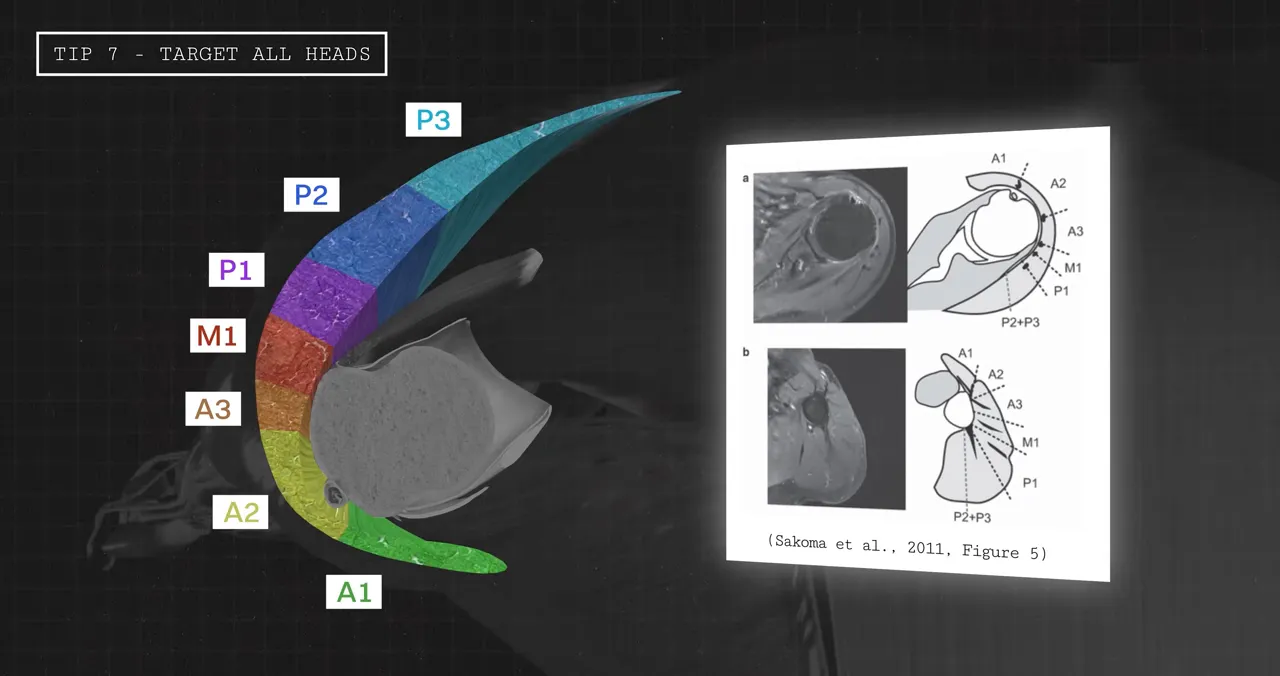
Because these segments have slightly different functions and lines of pull, I like including movements that sit between a conventional front raise, lateral raise, and rear delt fly.
That’s an anatomy-informed strategy, not proof that you need seven separate exercises to build complete shoulders.
Incline dumbbell Y raises
To bias the A2 and A3 segments, I use incline dumbbell Y raises. Raise your arms up and out in a Y rather than directly forward or directly sideways. The idea is to bring the resistance path more in line with those intermediate fibers.
45° cable rear delt pulls
For the P1 and P2 segments, try a 45° cable rear delt pull:
- Reach your working arm across your body at roughly a 45° angle.
- Sweep the weight down and back.
- Think of drawing an arrow from a quiver to use with a bow.
Your shoulder is a ball-and-socket joint with a huge amount of freedom to move. If you want three-dimensional delts, it makes sense to train through more than a few rigid movement paths.
Make Your Shoulder Training Measurable
The common thread is deliberate training: use a cue that keeps the work where you want it, distribute your sets productively, train through useful ranges, and track a progression scheme that fits each exercise.
That tracking principle is also behind MacroFactor Workouts, which I announced for a January 2026 launch. The announced features included workout logging, adaptive programming, detailed analytics, syncing with the MacroFactor nutrition app, and a way to load my existing training programs. I also announced a substantial workout-app discount for current MacroFactor members.
For nutrition, MacroFactor is the app I used during my cut. You can try it free for two weeks using code JEFF.
|