A heavy deadlift double, one brutally hard squat set, and focused work for the hamstrings, quads, and calves. That was the plan when Dr. Layne Norton and I trained legs together at Pure Muscle and Fitness in Ontario.
Layne was my first science-based coach. He coached me to a Canadian national gold medal in natural bodybuilding and helped shape how I think about training and nutrition. He convinced me that getting shredded doesn't require eating exclusively “clean” foods if you're hitting your macros, challenged the practice of cutting water before bodybuilding competitions, and showed me that powerlifting and bodybuilding can complement each other.
He also walks the walk. He's a professional natural bodybuilder, a two-time US national powerlifting champion, and earned a gold medal at Worlds for a 668-pound squat at 205 pounds of body weight. So, yes, he's an absolute monster.
Since Layne was in the middle of powerlifting prep, deadlifts were nonnegotiable. I guided the rest of the workout toward hypertrophy. What followed was a useful lesson in managing effort, adapting technique to your anatomy, and keeping one disappointing lift from ruining an otherwise productive session.
Key Takeaways
- Low-volume strength work can complement a leg workout focused primarily on muscle growth.
- Arm and femur lengths help explain why effective deadlift setups look different between lifters.
- Adjust the day's load when necessary instead of letting one missed lift derail the session.
- Emphasize controlled stretched positions and patient progression in quad and calf training.
Table of Contents
- The Full Leg Workout
- Start with a Short Dynamic Warm-Up
- 1. Deadlift: One Heavy Double, Not an All-Out Max
- 2. Pendulum Squat: Make the Working Set Count
- 3. Glute-Ham Raise: Understand Assistance Versus Resistance
- 4. Leg Extension: Put More Emphasis on the Stretch
- 5. Leg Press Toe Press: Stretch, Pause, and Progress
- The Bigger Lesson: Train Hard Enough to Progress, Sensibly Enough to Continue
The Full Leg Workout
Here's the workout structure, with warm-up sets kept separate from working sets:
- Deadlift: 3 to 5 progressively heavier warm-up sets, then 1 working set of 2 reps at RPE 7 to 8.
- Pendulum squat or hack squat: 2 to 4 warm-up sets of 2 to 5 reps, then 1 working set of 8 to 10 reps at RPE 9 to 10.
- Glute-ham raise: 3 sets of 8 to 10 reps.
- Leg extension: 3 sets of 10 to 12 reps.
- Leg press toe press: 3 sets of 12 to 15 reps.
On the pendulum squat, our initial target during the session was 6 to 8 reps, but my set ended up at nine. The practical prescription above uses an 8 to 10 rep range. Either way, the point was the same: work up to one genuinely hard set, rather than accumulating a bunch of additional heavy sets.
The loads we used were personal examples, not targets to copy. Choose weights that match the prescribed effort and your current ability.
Start with a Short Dynamic Warm-Up
Before touching the deadlift working weights, we did two quick drills.
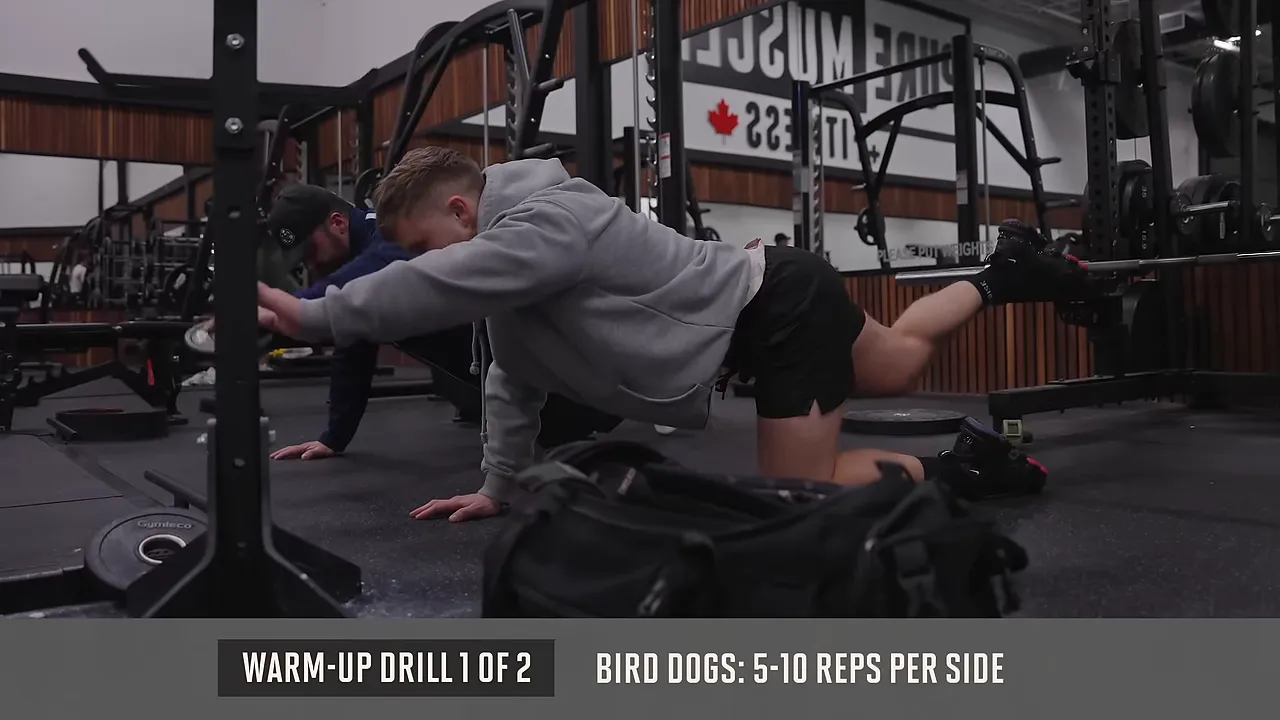
Bird dogs
From a hands-and-knees position, extend the opposite arm and leg. Layne uses a little weight in the hand and can make the movement more challenging by reaching farther out. We used 5 to 10 reps per side.
Hip and back opener
This drill combines bringing one foot forward, holding that foot with the same-side hand, rotating the torso open, and then shifting back to stretch the hamstring of the forward leg. We did two sets of five per side.
It was new to me, and I really liked it. After those drills, we moved into the exercise-specific deadlift warm-up.
1. Deadlift: One Heavy Double, Not an All-Out Max
Layne's plan was to work up to one double at about RPE 7. My goal was similar: maintain, or slowly build, deadlift strength while putting most of my remaining training effort into hypertrophy.
At the time, I was doing only one deadlift working set per week. That prompted an important distinction from Layne: what works and what is theoretically optimal are not necessarily the same thing.
One weekly set probably isn't ideal for maximizing strength. But it can be enough to maintain strength, and potentially improve it, depending on the lifter and the lift. For Layne, reducing main-lift volume was also a practical way to manage his training and stay consistently in the gym.
A program that looks perfect on paper isn't especially useful if you can't sustain it.
Build up with a warm-up pyramid
We added weight progressively, generally moving up a plate at a time before making smaller adjustments near our working weights. A useful starting framework is:
- First warm-up: approximately 45% of your planned working weight for 4 to 5 reps.
- Second warm-up: approximately 65% for 3 to 4 reps.
- Third warm-up: approximately 85% for 1 to 2 reps.
- Additional warm-ups: add intermediate sets as needed before the heavy double.
Those percentages refer to the weight you're planning to use for the working set, not your one-rep max.
Your deadlift should reflect your proportions
During the warm-ups, we compared our starting positions. I'm about 5 feet 4½ inches tall, while Layne is 5 feet 10½ inches. But height alone doesn't explain the differences. Femur length and arm length matter a lot.
I have relatively short femurs, which let me bring my hips closer to the bar, and short arms, which require me to get farther down to reach it. The result is a lower hip position and a more upright torso. My deadlift looks almost squat-like.
Layne has longer femurs and longer arms. His hips start higher, and his torso is more inclined forward.
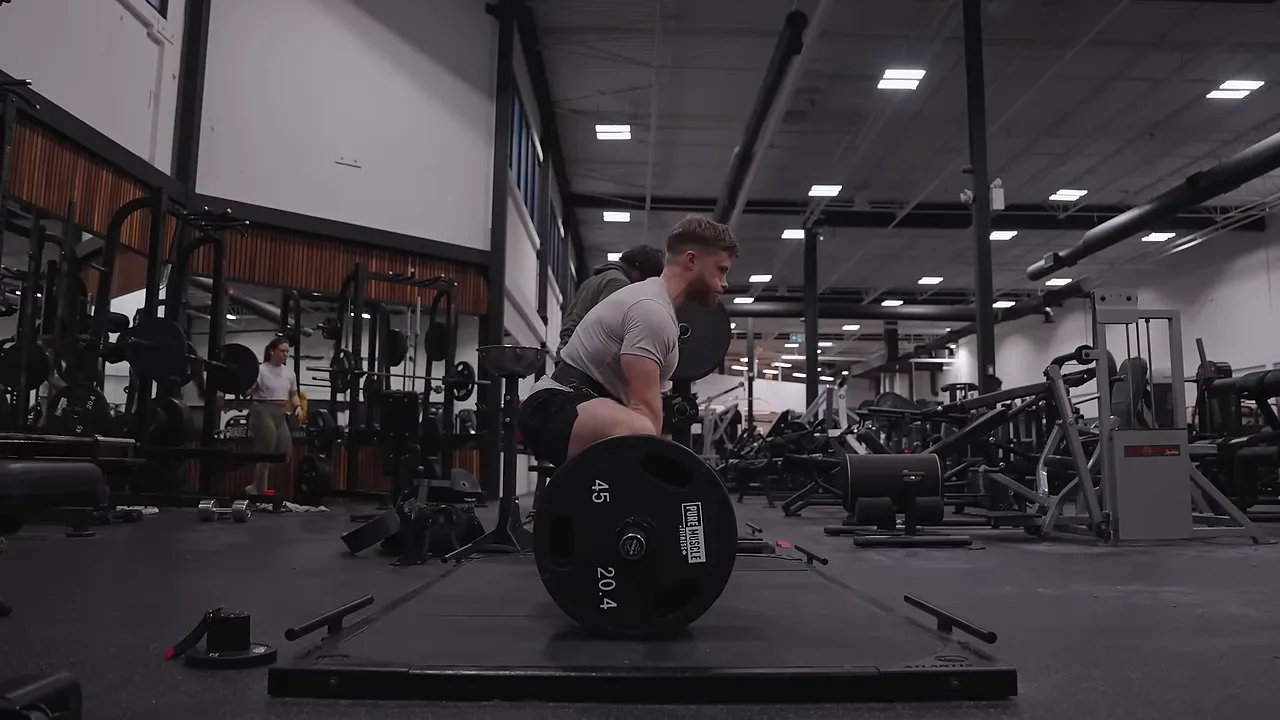
Neither position is automatically better. The lesson isn't that shorter people must squat their deadlifts and taller people must start high. It's that different skeletal proportions can produce different-looking, effective techniques. Don't force your setup to look identical to someone with a completely different build.
Use bar speed to help assess effort
Layne had a rep-speed tracker attached to the bar by a thin cord. It measures bar velocity and range of motion, giving him another way to estimate how hard a set actually was.
As you approach failure, the lifting portion of a rep generally slows down. That relationship can help inform your estimate of reps in reserve:
- RPE 10: no additional reps available.
- RPE 9: approximately one rep left.
- RPE 8: approximately two reps left.
- RPE 7: approximately three reps left.
This is the basic idea behind the repetitions-in-reserve-based RPE scale. The device adds information to that assessment, but a particular speed isn't a universal RPE for every person.
For example, my 405-pound warm-up moved at about 0.30 meters per second. Layne's 495-pound warm-up moved at about 0.32 meters per second. The tracker also measured my range of motion at 371 millimeters compared with his 434 millimeters. Same exercise, different loads and different movement distances.
Adjust when the planned weight isn't there
After my warm-ups, I loaded 455 pounds for the double. And then I couldn't complete even the first rep.
That was frustrating. Before my injury, I'd pulled that weight for six reps. It's hard not to start mentally spiraling when a weight you used to handle suddenly feels glued to the floor.
Layne felt that hesitation and confidence were part of what was happening, rather than the miss being a straightforward measure of my strength. Fatigue can also affect performance. We joked through the usual excuses, but the useful response was simple: reduce the load and reassess.
I dropped to 430 pounds and completed the double.
Meanwhile, Layne's final warm-up at 585 pounds moved at 0.28 meters per second, faster than he would typically expect at that stage. Based on how it felt and moved, he chose 660 pounds, roughly 300 kilograms, for his top double.
His two reps registered approximately 0.222 and 0.212 meters per second. He rated the set around RPE 7, perhaps 7.5, and felt confident he could have completed another three reps.
That was a great reminder that RPE 7 doesn't always look like an easy warm-up. A heavy deadlift can move slowly off the floor without being close to failure. Layne's focus was on staying in position rather than interpreting a slow start as an immediate reason to give up.
For me, the takeaway wasn't to force every stalled attempt. It was to recognize how quickly I can psych myself out, and how useful it is to make a sensible adjustment instead of letting one miss define the day.
2. Pendulum Squat: Make the Working Set Count
Next came one of my favorite machines in the gym: the pendulum squat.
I like it because it provides substantial lower-back support and, to me, feels smoother than a hack squat. On this particular machine, the counterbalance sits behind you. I find that makes it a little easier to get out of the bottom and a little harder near lockout, giving it a distinctive resistance profile.
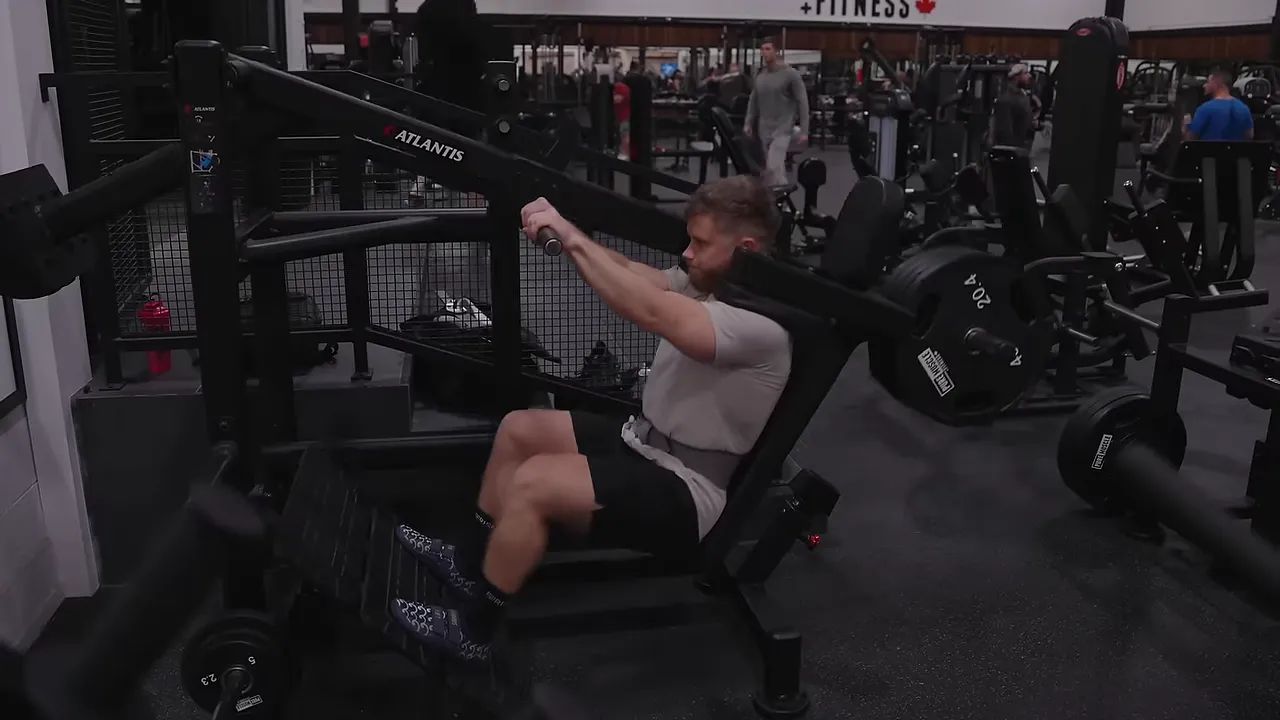
It's also a movement I feel comfortable pushing very close to failure. After several progressively heavier warm-ups, the plan was one hard top set with around one rep left in the tank.
I worked up to four plates per side and got nine reps, which appeared to be one more than the previous week. After the deadlift disappointment, that felt like redemption.
Layne estimated my set at closer to RPE 9.5 than 9. He wasn't confident I had another full rep available, although I might have managed the same nine reps with slightly more weight.
He then loaded four and a half plates per side and repped it out. He rated his own set around RPE 8.5, with one or possibly two reps remaining.
Two things stood out:
- A bad first exercise doesn't mean a bad workout. I missed my planned deadlift and still progressed on the pendulum squat.
- Powerlifting strength can carry over to bodybuilding work. Layne's squat and deadlift strength translated impressively to a machine he didn't regularly use.
That doesn't mean every bodybuilder needs to become a competitive powerlifter. But building strength and building muscle don't have to be competing goals.
3. Glute-Ham Raise: Understand Assistance Versus Resistance
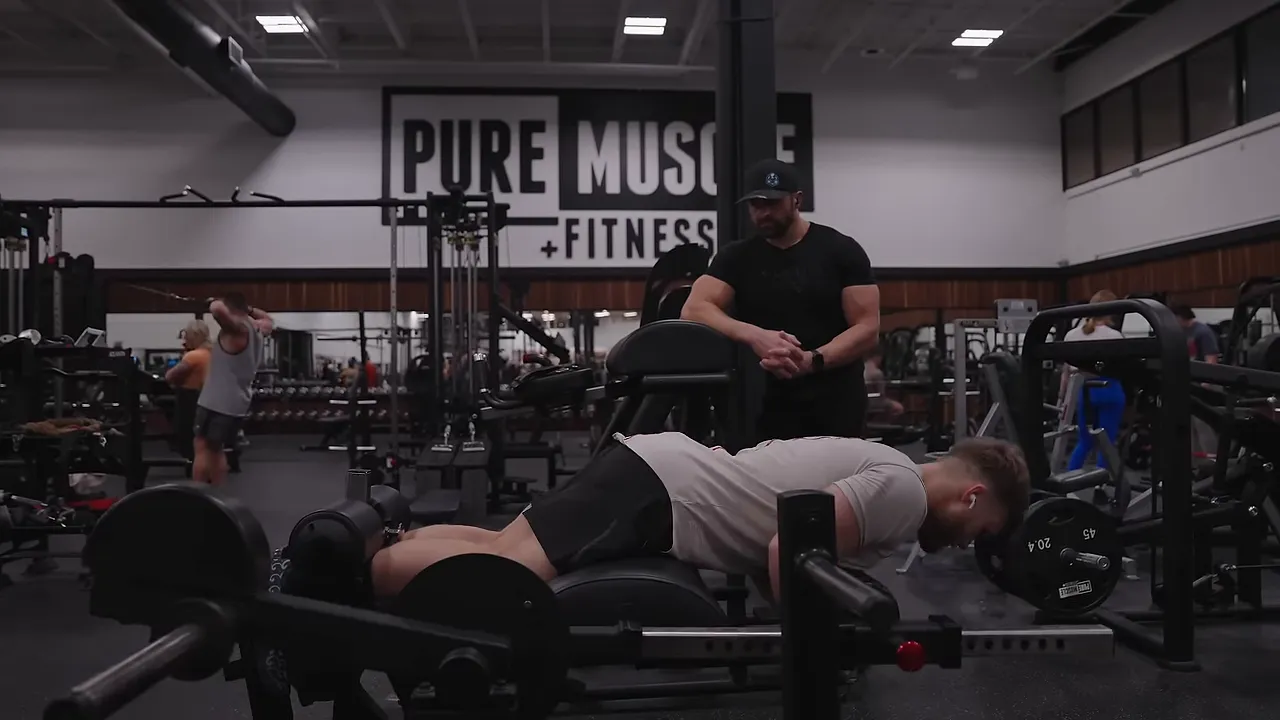
For hamstrings, we performed three sets of 8 to 10 reps on a glute-ham raise machine.
This particular machine has a chest pad you can hold onto and a counterbalance system. The important detail is that adding plates to the counterbalance makes the exercise easier, not harder. Those plates provide assistance.
We started with body weight and no counterbalance assistance.
Layne suggested that if body weight feels too easy, you can slow the lowering phase and spend more time in the challenging midrange. Becoming completely upright lets tension drop off substantially. Staying slightly forward keeps the hamstrings working before you drive through the heels and pull yourself back up.
After the first set, we both realized we could add external resistance:
- For my second set, I held a 10-pound plate against my chest and completed eight reps at around RPE 9 to 9.5.
- For my third set, I held 12.5 pounds, using a 10-pound plate and a 2.5-pound plate.
- Layne finished with 10 reps while holding a 25-pound plate.
Notice the distinction: holding a plate against your chest adds resistance, while loading the machine's counterbalance adds assistance. It pays to understand what a machine's loading system actually does before assuming more plates means more difficulty.
Again, Layne's performance was a pretty striking example of strength carrying over to an exercise he wasn't practicing as often.
4. Leg Extension: Put More Emphasis on the Stretch
We used a Prime leg extension for three sets of 10 to 12 reps. This machine lets you change the resistance profile by loading different pegs:
- Top peg: emphasizes the bottom portion, where the knees are more bent and the quads are more stretched.
- Middle peg: distributes loading more evenly across the range of motion.
- Bottom peg: emphasizes the top, contracted position.
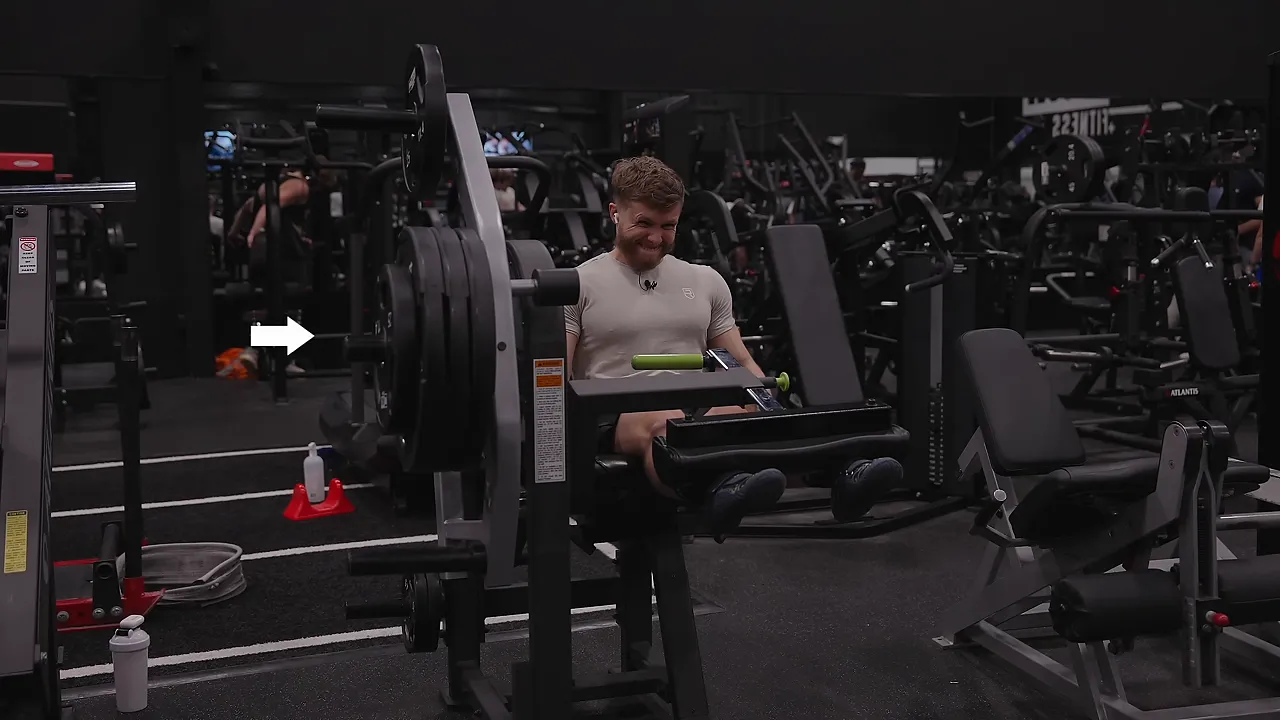
My preference was either a relatively even resistance profile or an emphasis on the stretched position. Layne liked placing most of the load on the top peg, with smaller amounts on the other pegs.
He also highlighted something worth checking on any leg extension: how far the ankle pad can travel back underneath the seat. A setup that permits more knee flexion allows a deeper quad stretch at the bottom.
Our emphasis was on challenging that stretched position rather than making the squeeze at full extension the main event. That doesn't mean the top of the rep is useless. It means we deliberately prioritized loading the portion where the quads were lengthened.
On my final set, I completed the full reps and then added a few partial reps in the stretched portion. That's an advanced intensity technique, not a requirement for every set. The foundation was still three hard sets of controlled leg extensions.
5. Leg Press Toe Press: Stretch, Pause, and Progress
We finished with three sets of 12 to 15 reps of calf work on a seated leg press.
For this machine, I used the lower plate as a reference point for my heels so I could consistently reach a deep stretch. That reference is specific to the equipment, but the principles are more general:
- Keep the knees slightly unlocked.
- Lower under control into a full calf stretch.
- Pause for about one second at the bottom. Don't bounce straight out of the stretch.
- Press through the balls of the feet and squeeze at the top.
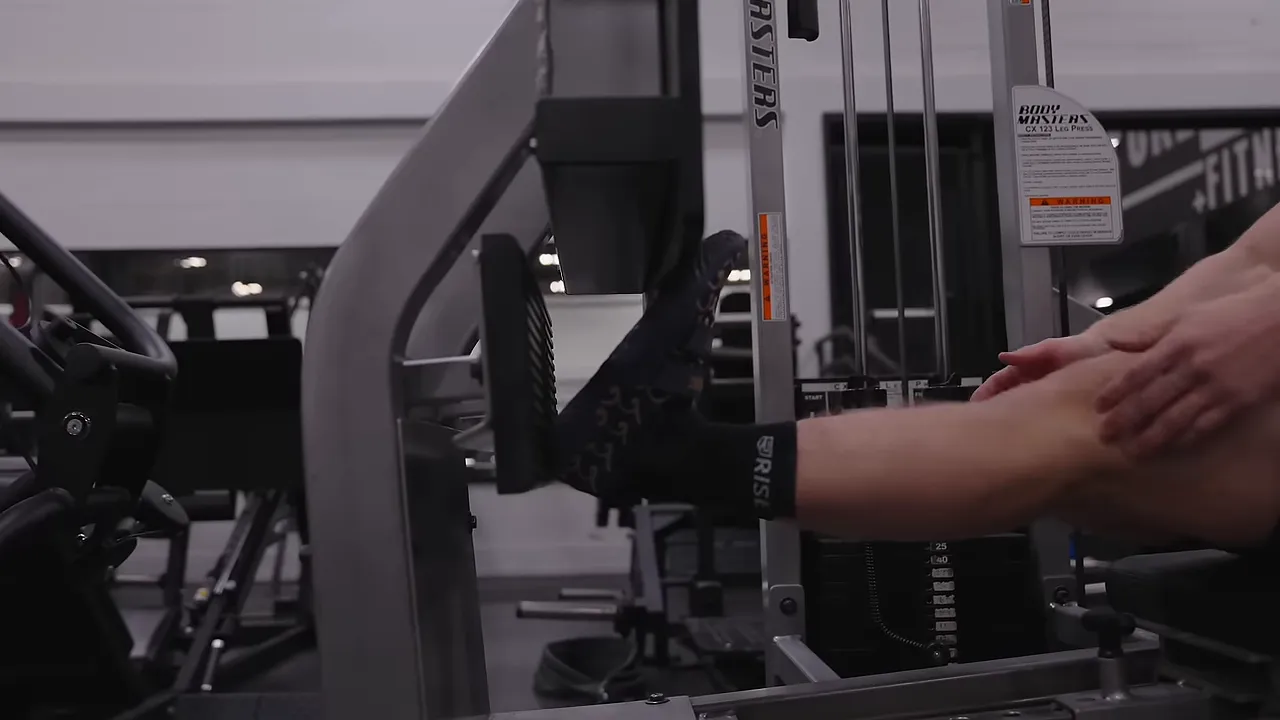
One cue I like is to think about rotating around the balls of my feet rather than just pushing up onto my toes. The balls of the feet act as the pivot point while the heels sweep down and back up.
Layne told me his calves had grown from about 12 inches to just over 16 inches. His main explanation wasn't a secret exercise. It was consistency across decades of training.
He did have periods when he trained calves four days per week with roughly 30 weekly sets, which seemed to stimulate additional growth for him. That's his experience, not a prescription everyone needs to copy.
Personally, I usually train calves twice per week for three or four sets each session. I think that's enough for many people to see growth if they're using good technique, emphasizing the stretch, and patiently adding reps or weight over time.
The Bigger Lesson: Train Hard Enough to Progress, Sensibly Enough to Continue
This session combined a low-volume strength exposure with hard hypertrophy work. The deadlift wasn't taken to failure. The pendulum squat was pushed much closer. The remaining exercises added focused work for the hamstrings, quads, and calves.
That difference in effort was intentional. Every exercise didn't need the same number of sets, the same rep range, or the same proximity to failure.
What I appreciated most was how practical Layne's approach was. Use your anatomy rather than fighting it. Let performance inform the day's load. Don't confuse an effective plan with a theoretically perfect one. And don't turn one missed lift into a verdict on your entire workout.
Train hard, make adjustments when you need to, and keep showing up. That's what gives progressive overload enough time to do its job.


