Drop sets, forced reps, supersets, and cheat reps all have their place. But one muscle-building technique has an especially compelling body of research behind it: long-length partials.
These are partial reps performed in the stretched portion of an exercise. The exciting part is that they don't just appear to outperform partial reps done in the contracted position. In some studies, they've produced more muscle growth than a full range of motion.
That doesn't mean full reps are suddenly obsolete. It does mean that deliberately cutting a rep short, in the right place and with good technique, could be a useful way to improve your hypertrophy training.
Key Takeaways
- Long-length partials keep the stretched portion of an exercise while removing the more contracted portion.
- Research suggests lengthened partials outperform shortened partials and may sometimes produce more growth than full reps.
- Use partials to extend selected sets, perform entire sets, or alternate with full reps.
- Maintain control and consistent endpoints while keeping full-range training as the foundation of your program.
Table of Contents
- What Are Long-Length Partials?
- What Does the Research Say?
- Method 1: Extend the Last Set Beyond Full-Range Failure
- Method 2: Use Lengthened Partials for the Entire Set
- Method 3: Integrate Full Reps and Partials
- Three Common Long-Length Partial Mistakes
- How I'd Put It All Together
What Are Long-Length Partials?
Think about a biceps curl. A full rep takes your elbow from roughly straight at the bottom, around 0 degrees of flexion, to deeply bent at the top, around 150 degrees.
You can divide that movement into two halves:
- Short-length partials: Curls in the top half, where the biceps are more contracted.
- Long-length partials: Curls in the bottom half, where the biceps are more stretched.
As a muscle stretches, it gets longer. That's where the name comes from. You'll also hear these called lengthened partials.
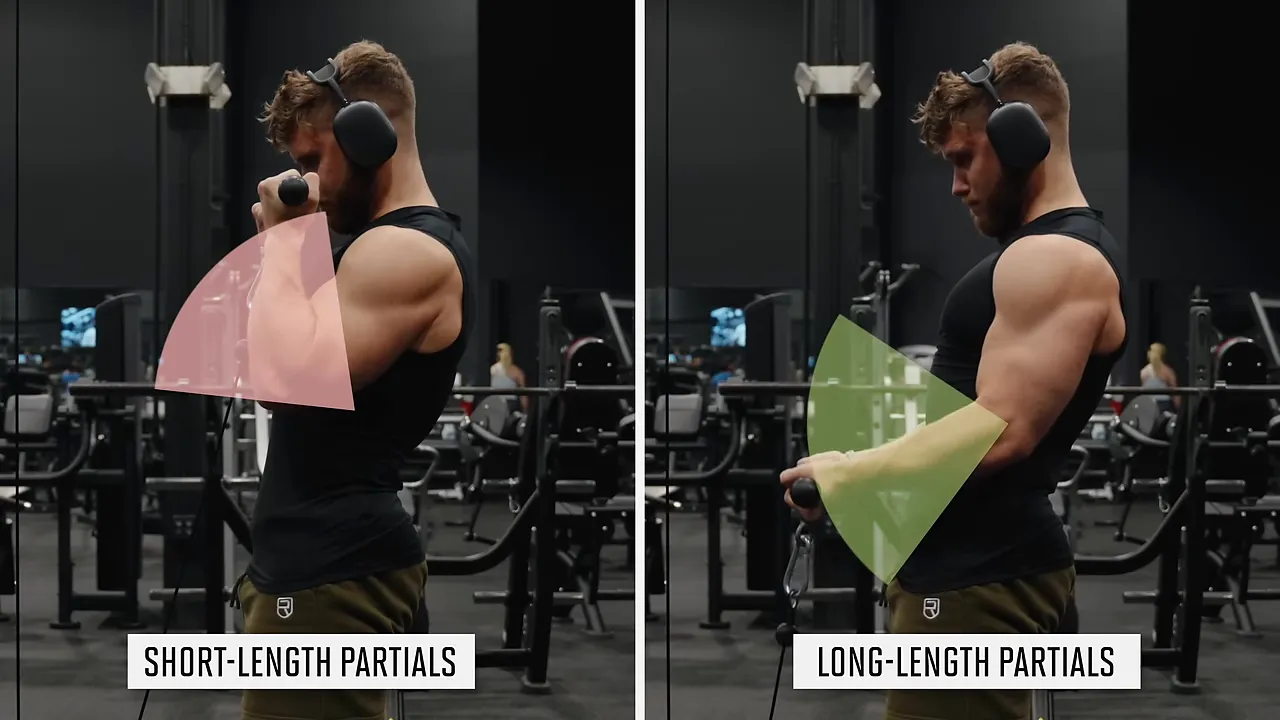
The simplest way to identify the correct portion of an exercise is to ask: Which half stretches the target muscle the most?
On a squat, that means descending into a deep stretch for the quads and glutes, then coming only about halfway up. You're keeping the bottom portion and removing the top portion. A shallow squat does the opposite: it keeps the shortened portion and removes the deep stretch. That's not the type of partial I recommend for this purpose.
On a lat pulldown, the stretched position is at the top, with your arms overhead. A long-length partial starts there and pulls the bar only about halfway toward your chest.
So, “bottom-half reps” isn't a universal definition. It's the bottom half of a curl or squat, but the top half of a pulldown. Muscle length, not the direction the weight travels, is what matters.
What Does the Research Say?
Many serious lifters assume a full range of motion is always best for muscle growth. The research behind lengthened partials challenges that assumption. It suggests that loading the stretched portion may matter more than simply moving through the largest possible range.
In the research available for this discussion, the comparisons were remarkably consistent:
- Long-length versus short-length partials: Seven of eight studies favored long-length partials for muscle growth. One found no difference, and none favored short-length partials.
- Long-length partials versus full range of motion: Four of five studies favored long-length partials. One found no difference, and none favored full range of motion.
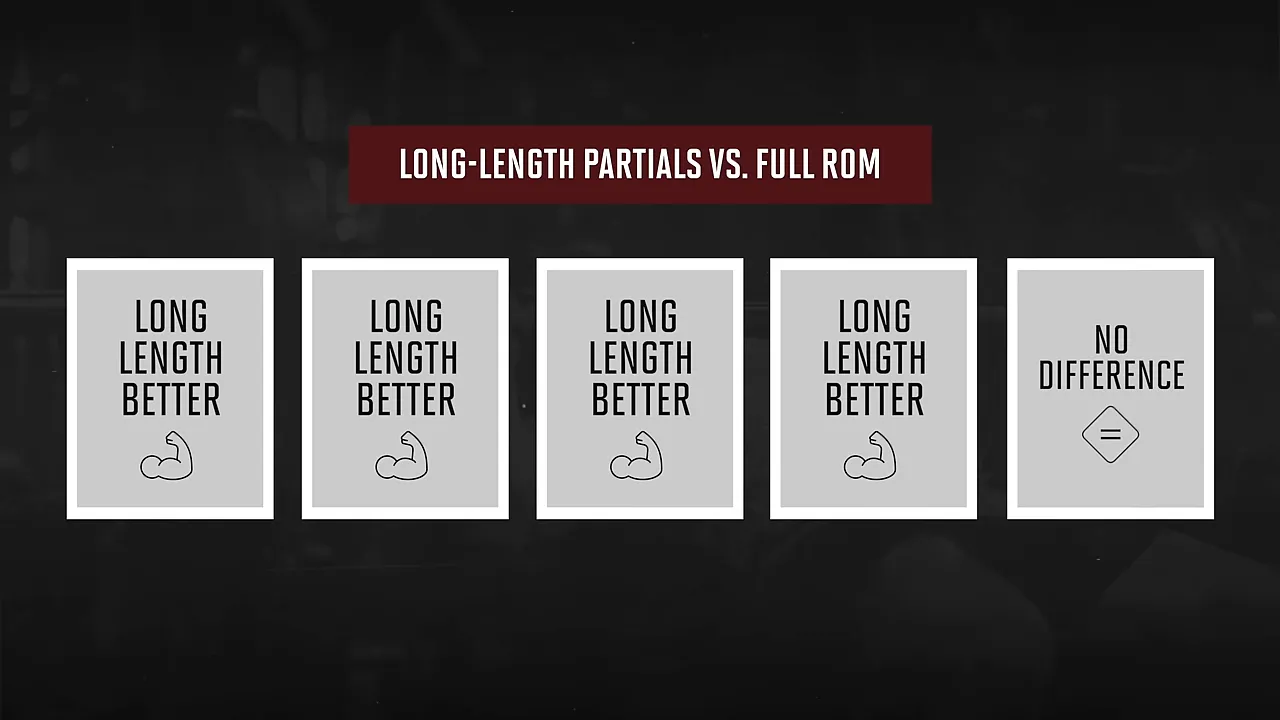
Interestingly, the study that found no difference between partials and full reps used only about 10% of the full movement for the partial-rep condition. Those very small reps, performed in the stretched position, still produced comparable growth.
You can explore the broader evidence in this systematic review and meta-analysis of partial versus full range-of-motion training, along with individual range-of-motion research.
Promising Doesn't Mean Revolutionary
I discussed this with muscle-length researcher Dr. Milo Wolf, who was enthusiastic enough about lengthened partials that he had been using them exclusively for his hypertrophy work for about nine or ten months.
But neither of us sees this as some magical breakthrough. In our discussion, Milo suggested that the potential improvement over full reps might be on the order of 5% to 10% more growth. That's an expectation, not a guaranteed result or a universal effect.
If you're trying to maximize hypertrophy, a modest advantage is meaningful. It's still very different from claiming that partials will transform your physique while full reps barely work.
Why Might Training at Long Muscle Lengths Work?
The general idea isn't new. We've had evidence for stretch-mediated hypertrophy for years.
A classic quail study on progressive stretch overload found substantial muscle growth when a wing was stretched under load. That isn't a direct prescription for human bodybuilding, but it helped establish that loaded stretching can be a powerful growth stimulus. Human training research has also supported the value of lifting at long muscle lengths.
The practical takeaway is straightforward: the stretched portion of a lift deserves attention. Lengthened partials give you a way to spend more of a set working in that position.
Method 1: Extend the Last Set Beyond Full-Range Failure
The first way I use long-length partials is as an intensity technique. I perform full reps first, then continue with lengthened partials after I can no longer complete the full movement.
I mainly reserve this approach for back exercises and hamstring curls. On these movements, reaching full-range failure often doesn't mean you've exhausted your ability to move the weight in the stretched portion.
Lat Pulldowns
- Perform your normal full-range reps.
- When you can no longer bring the bar to your chest, continue pulling it as far down as possible without breaking technique.
- As fatigue builds, allow the range to shorten while maintaining control.
- End the set when you can no longer pull the bar approximately halfway down.
You may find that your back still has quite a bit left after the last full rep. Those additional partials let you use that remaining capacity rather than ending the set immediately.
Pull-Ups and Rows
The same principle applies to your last set of pull-ups. Once you can no longer reach your usual full-range endpoint, continue with controlled reps in the stretched portion.
For rows, keep going after you lose the ability to achieve the full squeeze. Work from the stretched position until you can no longer bring the weight about halfway through the movement. I typically get another three to six partial reps this way.
Hamstring Curls
Hamstrings are another muscle group where I can often perform several additional partials after losing the full contraction.
Once I can't curl the weight through the full range, I continue with roughly five or six lengthened partials, stopping when I can no longer lift it at least halfway.
In theory, you could keep shrinking the movement into quarter reps, eighth reps, and eventually barely moving the weight. Personally, I think that may be overkill.
Standardize Your Endpoint and Manage Fatigue
Choose a consistent stopping point and use it from week to week. If one session ends at half reps and the next continues until the weight barely moves, your performance becomes harder to compare.
I also don't take every set of every exercise this far. Doing so would likely cause a substantial drop in performance later in the workout, potentially reducing the amount of productive volume you complete.
Recovery can become an issue, too, especially if your sleep and nutrition aren't in a good place. Use this as a selective tool, usually on the last set, rather than turning every set into an all-out endurance test.
Method 2: Use Lengthened Partials for the Entire Set
The second approach is different: perform lengthened partials from the very first rep, rather than adding them after full-range failure.
This is how I incorporated them into the last set of several exercises in my Pure Bodybuilding Program. Milo recommended this approach because it lets you spend more of the set in the portion of the movement that appears especially productive for growth.
Chest-Supported Machine Rows
One example is the last set of chest-supported machine rows. Start in the stretched position, pull about halfway up, and return under control. Repeat that same range for the entire set.
For a set targeting ten reps, select a load that brings you to failure around rep ten within that defined range. You may need a somewhat heavier weight than you would use for full reps, but the range and technique still need to stay consistent.
Dumbbell Flyes
Dumbbell flyes make a lot of sense here because their resistance profile already favors the stretched position. There's substantial tension near the bottom and very little at the top, when the dumbbells are stacked above your shoulders.
In the past, I argued that cable flyes were probably superior because cables maintain resistance more continuously throughout the movement. That difference is real, but the newer muscle-length research has made me rethink how much of a disadvantage the dumbbell's resistance profile actually is.
If the stretched portion is especially important, an exercise that naturally emphasizes it may be a pretty good option. You can lean into that feature by cutting out the top half and performing controlled lengthened partials.
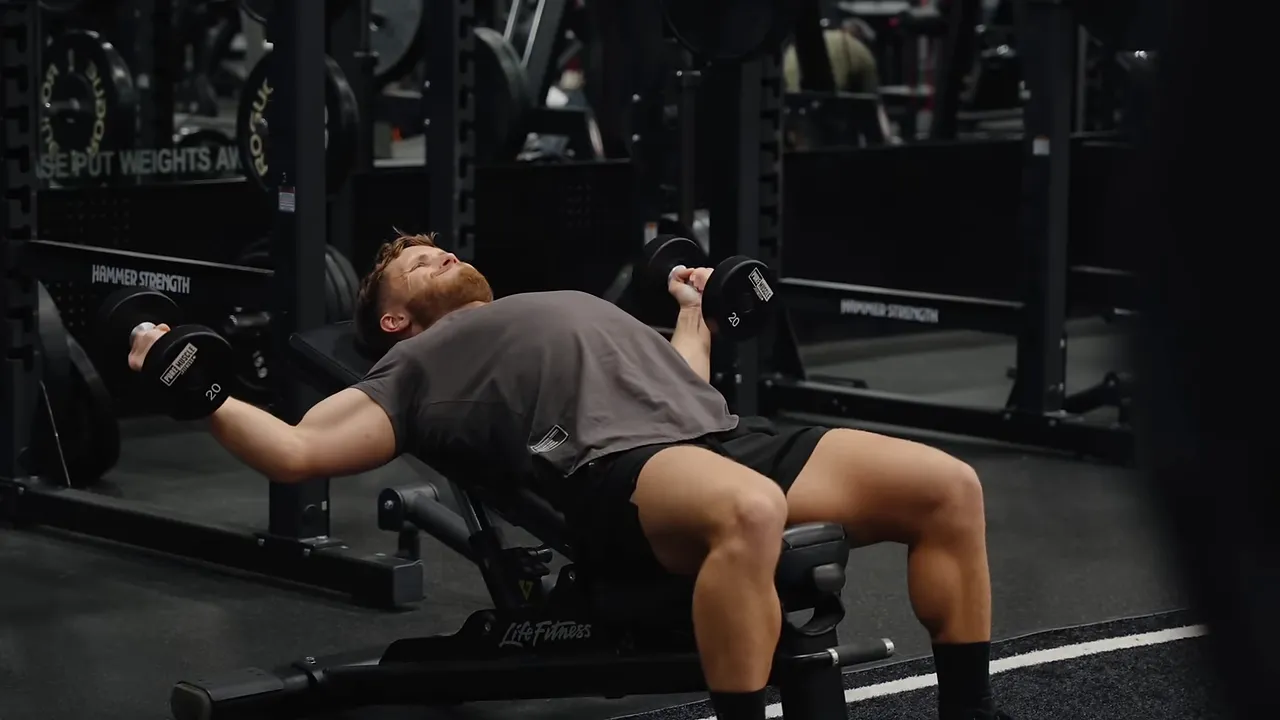
I still do cable flyes because I think exercise variety has value. But when I do dumbbell flyes now, I generally use long-length partials.
Smith Machine Presses and Leg Presses
I've also been experimenting with lengthened partials on Smith machine presses and leg presses. The deep stretch and pump on the Smith press feel fantastic, and I've found the partial leg presses enjoyable, too.
That doesn't mean they're easier. If anything, they can feel harder because you lose that brief mini-rest at full lockout. You're doing less range, but you're not necessarily doing less work where it counts.
Method 3: Integrate Full Reps and Partials
You don't have to choose between a full-rep set and a partial-rep set. A third option is integrated partials, where you alternate the two throughout the set.
I've been using this on the pec deck:
- Perform one full-range rep.
- Perform one lengthened half rep.
- Repeat that alternating pattern until you reach failure.
This lets you spend more total time in the stretched portion without completely removing the contracted portion. I also find that it keeps the set engaging and produces a serious pump.
It's a useful middle-ground option if you want to experiment with lengthened work while keeping full reps in the same set.
Three Common Long-Length Partial Mistakes
1. Treating Partials Like Cheat Reps
The biggest mistake I see is losing control as soon as the range gets shorter. People seem to associate partial reps with cheating, so the movement suddenly becomes loose and momentum-driven.
A partial should follow the same basic technique standards as any other rep:
- Control the negative.
- Minimize momentum.
- Maintain the stretch in the lengthened position.
The deliberate change is your range of motion, not your commitment to good form.
2. Barely Shortening the Range
If you're accustomed to full reps, cutting the movement in half can feel wrong. I get it. It's easy to end up doing almost the entire rep and simply skipping lockout.
That's fine as a training variation, but a rep using 90% of your normal range isn't the same thing as the lengthened half reps commonly used in this research.
Don't be afraid to shorten the range substantially. Keep the stretched portion, maintain control, and push the set with the same effort you normally would. You don't need to compensate for a shorter movement by making it sloppy.
3. Overhyping the Evidence
The opposite mistake is deciding that anything emphasizing a shortened muscle position is now useless.
For example, I still like the cable triceps kickback. It overloads the triceps in a more shortened position, which has led some people to argue that it must be a poor choice for muscle growth.
I think that takes the current evidence too far. The findings are convincing enough to influence exercise selection and technique. They aren't strong enough to throw out every shortened-position exercise, especially movements that people have used successfully for decades.
I also don't think we have enough evidence to remove the top half of every exercise and perform nothing but partials.
How I'd Put It All Together
For now, my recommendation is to use full range of motion most of the time, with lengthened partials in specific applications.
- Extend selected final sets of back exercises or hamstring curls with controlled partials.
- Use lengthened-only reps for the last set of selected exercises, such as chest-supported rows or dumbbell flyes.
- Try integrated partials when you want to retain full reps while adding more work in the stretched position.
- Keep your range, technique, and stopping point consistent so you can track progress.
Full-range training has decades of support behind it. Lengthened partials are promising, but when you zoom out, they aren't miles ahead of everything else.
The strongest conclusion is that long-length partials outperform short-length partials in the evidence reviewed here, and appear to work at least as well as full reps, with a possible advantage in some cases.
That's enough to make them worth trying, without making them your entire training philosophy. For a deeper exploration of the evidence and its practical implications, my full discussion with Dr. Milo Wolf goes into more detail.
My Pure Bodybuilding Program puts these applications into a structured hypertrophy plan, alongside other exercises and training techniques. It also includes a nutrition guide for goals such as fat loss, muscle gain, or both.
|


