Sam Sulek is clearly doing a lot right. He’s built an impressive physique, trains incredibly hard, and seems to genuinely love being in the gym. But getting great results and training optimally aren’t necessarily the same thing.
To separate what’s worth copying from what could be improved, I analyzed every workout he posted in the opening stretch of 2024. That added up to 460 sets, with a close look at his exercise selection, range of motion, effort, rep ranges, and distribution of training volume.
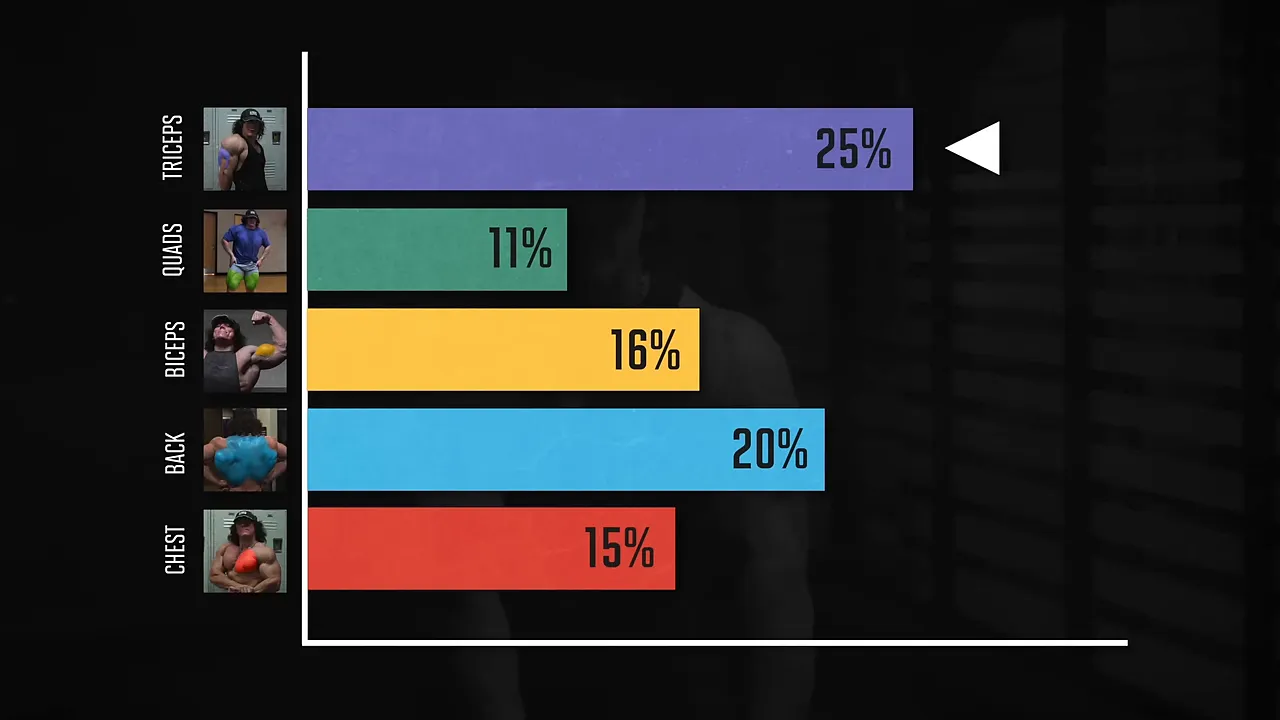
The numbers were pretty interesting:
- 15% of his sets were for chest.
- 20% were for back.
- 16% were for biceps.
- 11% were for quads.
- 25% were for triceps.
He also took roughly 96% of his sets to muscular failure. Exclude his forearm training, which accounted for most of the sets stopped short, and that figure rises to 98%.
There are three areas where I think his approach could be more effective, and three where he deserves a lot of credit. The goal isn’t to dismiss what works for Sam. It’s to figure out which lessons will help you build more muscle.
Key Takeaways
- Prioritize a deep muscular stretch and controlled lowering rather than simply moving heavier weights.
- Track weights and reps so consistent exercises become a measurable path to progressive overload.
- Spread training volume across sessions instead of concentrating excessive sets into one workout.
- Sam’s greatest strengths are hard training, sensible rep ranges, and genuine enjoyment of the process.
Table of Contents
- 1. Technique: Get the Stretch and Control the Weight
- 2. Progression: Stop Leaving Your Results to Chance
- 3. Training Split: Distribute Your Volume More Effectively
- 4. Effort: Sam Gets the Most Important Part Right
- 5. Rep Ranges: A Strong Setup for Hypertrophy
- 6. Enjoyment: The Biggest Lesson Worth Copying
- My Overall Grade: B
- Putting the Nutrition Side Into Practice
1. Technique: Get the Stretch and Control the Weight
Sam is comfortable with what he calls ego lifting: moving heavy weights while allowing some swinging, swaying, and momentum rather than keeping every rep completely strict.
I’m actually less of a technique purist than many science-based coaches. You can build plenty of muscle with imperfect form if you’re training hard. But that doesn’t mean every way of moving a weight is equally effective.
In a paper I coauthored on training technique for muscle growth, two especially important priorities stood out: training the muscle at long lengths and controlling the lowering phase.
Prioritize the stretched portion of the movement
Using a full range of motion is often a good way to get a muscle into a deep stretch, but full range of motion isn’t always essential. What matters more is whether the range you use includes that stretched position.
Sam often gets this right. There are also enough examples of him cutting the stretch short that I’d give him a B minus for range of motion.
For example, on one incline press, he stops the bar roughly three or four inches above his chest. That isn’t the end of the world, but I’d rather see him reduce the weight and bring the bar to his chest so his pecs get a deeper stretch.
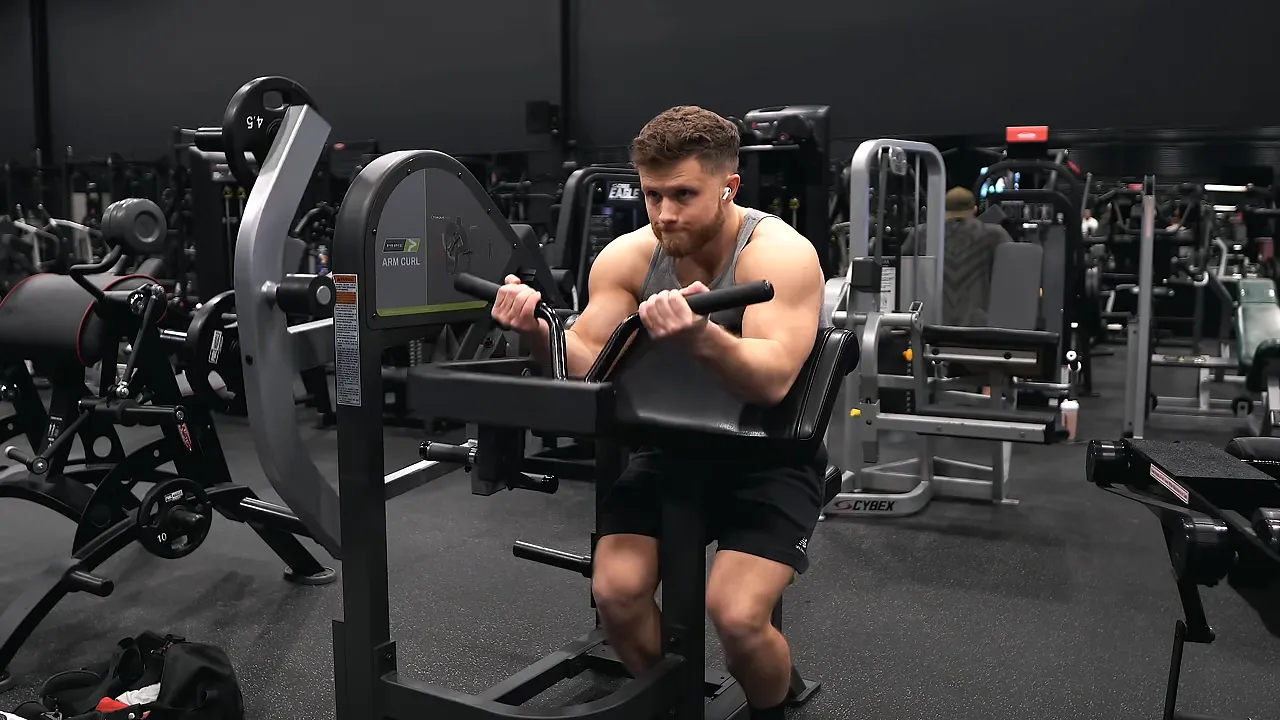
On some preacher curls, he leaves out approximately the bottom quarter of the movement. That’s a more meaningful omission because it removes the position where the biceps are most lengthened.
Two studies on preacher curls support emphasizing this part of the lift. Research comparing different portions of the curl’s range of motion, along with another study on partial-range preacher curls, points toward an advantage for the bottom portion over the top portion for muscle growth.
That’s why I often keep my own preacher curls in the bottom half. Partial reps aren’t automatically bad. Which part of the rep you perform matters.
Control the negative, especially near failure
The negative, or eccentric, is the lowering phase of a rep. You don’t need to make every negative painfully slow, but you should resist the weight rather than simply letting it drop.
Sam usually does this pretty well, even when he uses momentum to start the lifting phase. I’d give him a B plus for controlling the negative.
Still, there are occasions when the weight falls more than it’s deliberately lowered. My main adjustment would be to stay conscious of resisting the load as fatigue builds, including on the final rep.
The practical takeaway is simple: before worrying about making every detail of your form look perfect, make sure you’re getting a useful stretch and staying in control of the load.
Overall technique grade: B.
2. Progression: Stop Leaving Your Results to Chance
Sam’s workouts appear fairly improvised. He’ll roughly map out a session on the drive to the gym, then sometimes change the plan based on how he feels.
There’s nothing inherently wrong with training intuitively. The problem is that constantly changing exercises makes it harder to tell whether you’re progressing.
You might return to an exercise after several weeks, use the same weight for the same number of reps, and feel like you’ve had another productive workout. But if that keeps happening, you may just be repeating your current ability rather than building on it.
Make progressive overload measurable
Progressive overload means increasing the demands of your training over time. The most straightforward ways to do that are adding weight or adding reps.
After the beginner phase, having a reliable way to measure that progression becomes increasingly important. A hard workout is valuable, but a series of hard workouts that gradually improves your performance gives you a much clearer direction.
My recommendation is to:
- Write your training plan on paper or keep it in your phone.
- Record the weight and reps you perform.
- Keep most exercises consistent for at least a month or two.
- Use your previous performance as a target to build on over time.
I track every exercise. If that feels like too much, start with your main compound movements: squats, presses, and heavy pulls. You can leave a little more room for spontaneity with curls, lateral raises, and chest flies.
Structure should still allow flexibility
A plan shouldn’t force you to ignore pain or make training miserable.
On January 8, Sam changed a chest session into a back workout after his chest started tightening up. I think that was a smart decision. Switching exercises when something hurts, or occasionally choosing something different because you’re more motivated to do it, is completely reasonable.
The distinction is between adjusting a plan and not having a consistent plan in the first place.
Why impressive results don’t settle the question
The obvious counterargument is that Sam is still making gains. Clearly, an intuitive approach can work, particularly for someone with exceptional genetics or anabolic enhancement.
The enhancement factor matters when interpreting bodybuilding results. A controlled study on testosterone and muscle growth found that participants receiving testosterone could gain muscle even without resistance training. That illustrates how strongly anabolic drugs can affect results. It doesn’t establish anyone’s individual drug use or make suboptimal training optimal.
Even an enhanced lifter can eventually plateau. At that point, improving training structure is a much safer direction than escalating drug use.
To be fair, Sam could be logging his training privately. I didn’t find a clear indication of that in the material I analyzed, so this grade reflects the approach he publicly presented, not certainty about everything he does.
Program structure grade: C plus.
3. Training Split: Distribute Your Volume More Effectively
Sam follows a body-part split, commonly called a bro split, with separate sessions focused on areas such as chest, back, arms, and legs.
My concern isn’t the label. It’s what this setup can do to the distribution of training volume across your body and within each session.
Upper-body work can crowd out leg training
In the period I analyzed, Sam performed:
- 113 sets for triceps
- 50 sets for quads
- Nine sets for calves
- Six sets categorized as glute work
Sam has said he’s prioritizing triceps, which helps explain the emphasis. Even so, that’s more than twice as many triceps sets as quad sets.
For anatomical context, the muscle-size comparison referenced in this analysis places the quads at close to 30% of the musculature being compared, versus less than 4% for the triceps. The quads are roughly eight times larger in that comparison.
This doesn’t mean your set allocation needs to match muscle size exactly. But several upper-body sessions for every leg session can create an imbalance. Unless your legs already respond exceptionally well, they may start falling behind.
More sets in one session aren’t always better
On January 21, Sam did 13 chest sets plus two drop sets in one workout.
Based on the research on set volume and muscle growth, I’d generally expect diminishing returns after roughly six to eight hard sets for a single muscle in one session.
That isn’t a universal cutoff where every additional set suddenly becomes useless. It’s a practical reason to question whether the later sets are contributing enough growth to justify their fatigue and time cost. That’s the concern behind the term junk volume.
Rather than doing all 13 chest sets at once, I’d prefer splitting them into six sets on one day and seven on another.
Choose a split that makes distribution easier
Body-part splits are common among professional bodybuilders. It’s possible that very advanced, highly muscular lifters can use more volume in a session than most people. But the popularity of a method among successful athletes doesn’t prove it’s the best option.
When I discussed this with Dr. Mike Israetel, he also favored a more deliberately structured split for enhanced lifters, not just natural lifters.
For most people, I’d lean toward:
- Push/pull/legs: organize sessions around pushing muscles, pulling muscles, and legs.
- Upper/lower: alternate upper-body and lower-body sessions.
- Full body: spread work for multiple muscle groups across each session.
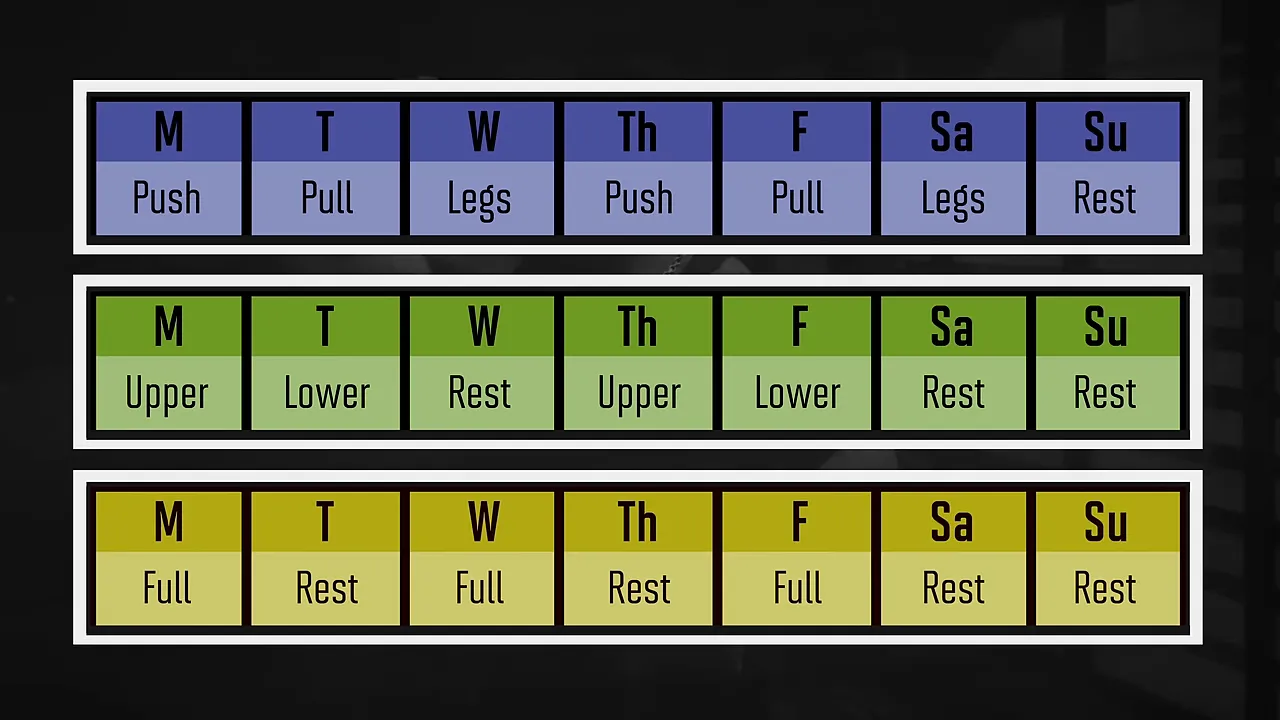
None of these names guarantees a good program. Their advantage is that they make balanced volume and manageable per-session workloads easier to organize.
Training split grade: C plus.
4. Effort: Sam Gets the Most Important Part Right
Now for the good stuff: Sam trains very hard.
For building muscle beyond the beginner stage, I think effort matters more than any of the previous points. You can optimize your exercise selection, split, and technique on paper, but if your sets aren’t challenging, those details won’t rescue your results.
Of the 460 sets I analyzed, 440 went to failure. There’s no question that Sam is willing to push himself.
You don’t need to take almost every set to failure
My only reservation is that he may take a good thing too far. Most people would likely struggle to recover from that much failure training.
Personally, about 30% of my sets go to failure. A typical three-set exercise looks like this:
- First set: stop with one or two reps left.
- Second set: stop with one or two reps left.
- Final set: take it to failure.
Leaving one or two reps in reserve is still very hard training. It’s not the same as stopping when you could do another 10 reps, which happens more often than people realize.
A combination of failure and near-failure work lets you regularly remind yourself what your limit feels like without paying the recovery cost on every set.
Sam seems to enjoy failure training and appears to recover from it reasonably well. He has had injuries, but that alone doesn’t establish whether failure training, very heavy loads, or something else caused them.
I’d personally dial back the frequency of failure. Still, I’d much rather see genuine effort than a perfectly organized program performed halfheartedly.
Effort grade: A.
5. Rep Ranges: A Strong Setup for Hypertrophy
Sam’s rep selection is another area where he does well. Here’s how his sets broke down:
- 0 to 3 reps: 11%
- 4 to 7 reps: 40%
- 8 to 12 reps: 40%
- The highest-rep category, labeled 13+: 9%
That puts 80% of his training between four and 12 reps. For someone primarily interested in muscle growth, I think that’s a very sensible distribution.
The evidence on rep ranges and hypertrophy supports muscle growth across a broad range of loads. Moderate reps aren’t magical, but they offer a useful practical balance.
Very high-rep sets can be exhausting, while lots of very low-rep work may create unnecessary joint strain. Spending most of your time in a moderate range avoids relying too heavily on either extreme.
I personally include a little more higher-rep work than Sam does. There’s also research supporting varied rep ranges rather than restricting all training to one range. But his overall approach is pretty much on target for hypertrophy.
Rep range grade: A.
6. Enjoyment: The Biggest Lesson Worth Copying
The strongest part of Sam’s training might also be the easiest to overlook: he clearly loves it.
He’s consistent. He chooses exercises he enjoys. He seems to have a genuinely good time in the gym. In this respect, I think he does better than almost any fitness influencer I know.
That doesn’t make discipline irrelevant. Hard workouts require effort, and there will always be days when training doesn’t sound appealing.
But making your workouts more enjoyable is not a distraction from serious training. It supports the consistency that makes serious training work over the long term.
This is also why I wouldn’t want someone to turn every session into a rigid optimization exercise that they hate. Better structure should support a sustainable routine, not strip away everything that makes you want to train.
Sustainability and enjoyment grade: A double plus.
My Overall Grade: B
Sam could improve his technique, track progression more clearly, and distribute his volume more evenly. I’d also prefer a more selective approach to failure training.
But his effort, sensible rep ranges, consistency, and enjoyment carry a lot of weight. Those aren’t minor bonuses. They’re central to getting results.
My overall grade is a B, not because every category averages neatly to that score, but because I rank effort and sustainability so highly.
The best approach for most lifters is to keep what Sam does exceptionally well while improving the structure around it: train hard, enjoy the process, prioritize the stretched position, control your negatives, log your lifts, and spread your volume intelligently. You don’t need to choose between loving training and applying the science.
Putting the Nutrition Side Into Practice
Training is the focus here, not a full assessment of Sam’s diet. For managing my own nutrition, I use MacroFactor, the nutrition app I helped create. I used it during my 2023 cut, when I lost 30 pounds, and continued using it to guide my 2024 bulk.
It brings macro tracking and nutrition coaching into one tool, with a two-week free trial available.
|