A great pull workout should do more than hammer your lats. It should train your back, give your traps and rear delts some focused attention, and finish with direct biceps work.
These six exercises fit together into a complete pull day, but you can also pick the movements that make sense for your current training split. The goal is to combine effective exercise selection with consistent progression, intentional technique, and a little room for individual preference.
Key Takeaways
- Combine lat work, pull-ups, rows, shrugs, rear-delt isolation, and curls for a complete pull day.
- Track pull-up progress with consistent form while accounting for changes in body weight.
- Use controlled momentum selectively on rows, while staying in command of the lowering phase.
- Experiment with grips and curl positions without treating EMG findings as proof of superior muscle growth.
Table of Contents
- The Pull Workout at a Glance
- 1. One-Arm Half-Kneeling Lat Pulldown
- 2. Pull-Up
- 3. Kroc Row
- 4. Cable Shrug
- 5. Reverse Pec Deck
- 6. Overhead Cable Biceps Curl
- Putting the Pull Day Together
The Pull Workout at a Glance
Start with five minutes on the treadmill or StairMaster, followed by a few quick dynamic stretches to get your joints moving comfortably. Then work through these exercises in order:
- One-arm half-kneeling lat pulldown: 3 sets of 12 to 15 reps.
- Pull-up: 1 all-out set of as many reps as possible.
- Kroc row: 3 sets of 10 to 12 reps.
- Cable shrug: 3 sets of 10 to 12 reps.
- Reverse pec deck: 3 sets of 10 to 12 reps.
- Overhead cable biceps curl: 3 sets of 10 to 12 reps.
The exercise order is deliberate. We start with focused lat work, follow it with a hard set of pull-ups and heavier rowing, then move to more targeted work for the upper traps, rear delts, and biceps.
1. One-Arm Half-Kneeling Lat Pulldown
Prescription: 3 sets of 12 to 15 reps.
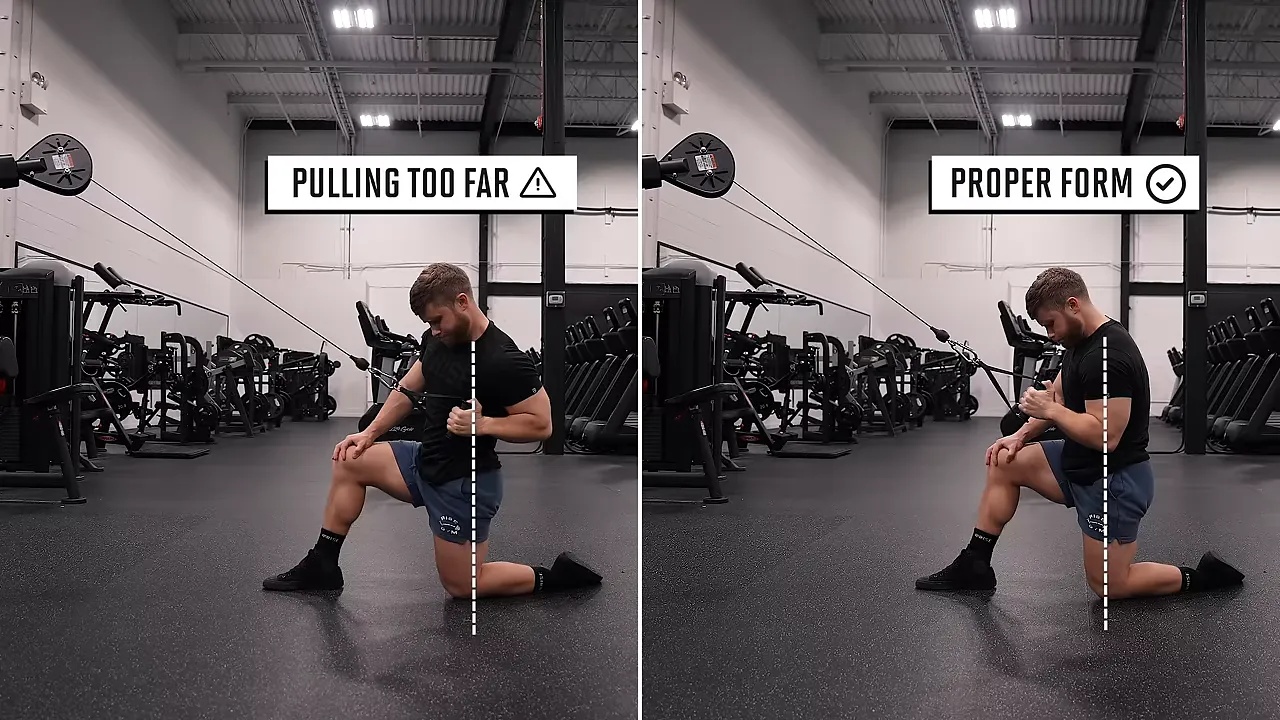
Take a half-kneeling stance and brace your nonworking hand against the knee of your forward leg. That extra support creates a more stable base, helping you direct your effort into the lats rather than fighting to hold your position.
As you pull, try to keep your forearm and the cable in a straight line. If they meet at noticeably different angles, check three things:
- The cable may be set too high.
- The cable may be set too low.
- You may be pulling your upper arm too far behind your body.
Finish the pull with your upper arm roughly in line with your torso. There is no need to keep driving the elbow backward once you reach that point, because the lats lose leverage as the arm moves behind the torso.
Front Pulldown or Sideways Pull-In?
I used to start my pull workouts with sideways-facing lat pull-ins, bringing the cable toward my body from out to the side. That trains the lats through shoulder adduction. Pulling down to the front emphasizes shoulder extension. Both movements can train the lats effectively.
Over time, I have found that some people get a better mind-muscle connection by pulling down to the front. One possible explanation is that the teres muscles contribute more strongly during pull-ins for certain people, but both the lats and teres major contribute to these shoulder movements. I suspect much of the difference comes down to the individual.
I can feel my lats working well with either version, although I have been favoring the front pulldown. Without a direct hypertrophy comparison to settle the question, my recommendation is simple: use the version that you feel targets your lats better. If both feel equally good, you can periodically rotate them.
2. Pull-Up
Prescription: 1 all-out AMRAP set. AMRAP means as many reps as possible, while maintaining consistent form.
Normally, I would include multiple sets of pull-ups on a pull day. Here, your lats have already done three sets on the cables, so we are keeping it to one hard set.
Pull-ups seem to be a favorite among calisthenics enthusiasts, while plenty of bodybuilders are less excited about them. Training should be enjoyable, but I also think pull-ups are worth including rather than avoiding simply because they are harder than pulldowns. My compromise: just one set, but make it count.
Technique Cues
- Take a grip about 1.5 times shoulder width.
- Lift your chest as you pull.
- Think about bringing your elbows down and in toward your sides.
- On a straight bar, aim to get your chin over the bar. With other handle arrangements, aim to bring your chest to roughly hand level.
How to Track Progress
Each week, try to match or beat your previous rep count using the same technique. Your body weight matters when interpreting that number:
- When bulking: Matching your reps as you gain weight can still represent progress, because you are lifting a heavier body.
- When cutting: Aim to add reps as your body weight falls. My target would be one extra rep per week, since the resistance is gradually decreasing.
Those are progression targets, not a reason to loosen your technique just to claim another rep.
If bodyweight pull-ups are not there yet, use an assisted pull-up machine or a resistance band. Loop the band securely around the bar and place your foot into the bottom loop so it provides assistance during the movement.
3. Kroc Row
Prescription: 3 sets of 10 to 12 reps.
The Kroc row is a looser version of a one-arm dumbbell row, performed with a slightly more upright torso and some controlled body movement. It is named after world-record-holding powerlifter Janae Marie Kroc.
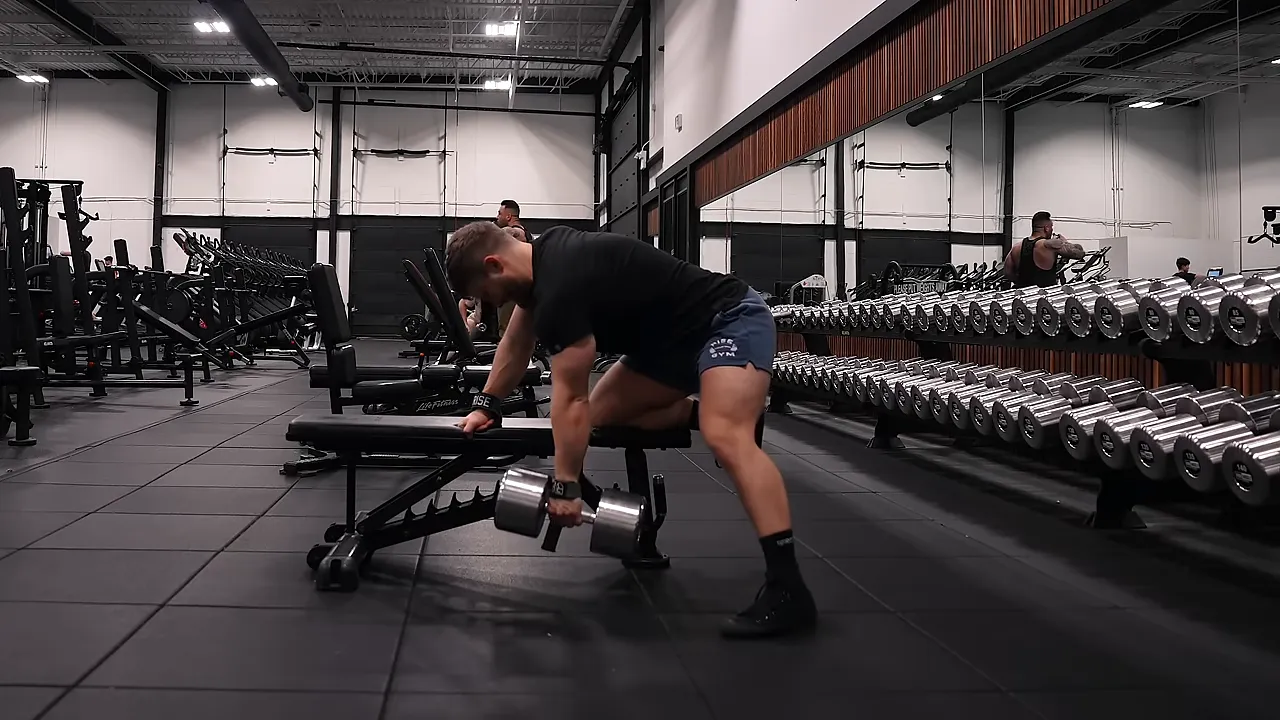
This exercise brings up an important point about technique: strict form is useful, but making every movement perfectly rigid is not always necessary.
For beginners, I absolutely recommend learning the basics with strict, repeatable technique. That gives you a reliable foundation and makes progression easier to track. Once you have mastered those basics, though, a little controlled body English on selected exercises can be useful, especially when it lets you challenge the target muscles more effectively.
The key word is controlled. You should remain in command of the weight, particularly during the lowering phase. Allowing some natural movement is not the same thing as throwing a dumbbell around.
Why a Little Momentum Can Help
Many back exercises are relatively easy near the bottom and much harder near the top. If you end every set as soon as you cannot achieve a perfect top-end squeeze, you may stop while your back still has plenty left to give elsewhere in the range.
A small amount of momentum can help you move through that difficult portion and take the set closer to muscular exhaustion. That is the rationale for using controlled cheating here as an intensity technique, not a blanket recommendation to cheat on every exercise.
If you are not comfortable with this approach, a stricter dumbbell row with a lighter weight is completely fine. The priority is productive training you can control, not forcing a particular style.
4. Cable Shrug
Prescription: 3 sets of 10 to 12 reps.
Cable shrugs are a quick, convenient upper-trap option because you do not need to load and unload plates. The cable setup also gives you a useful direction of resistance.
The upper-trap fibers do not all run straight up and down. They fan out more horizontally than many people realize, which is why I like thinking about shrugging up and in rather than only straight up.
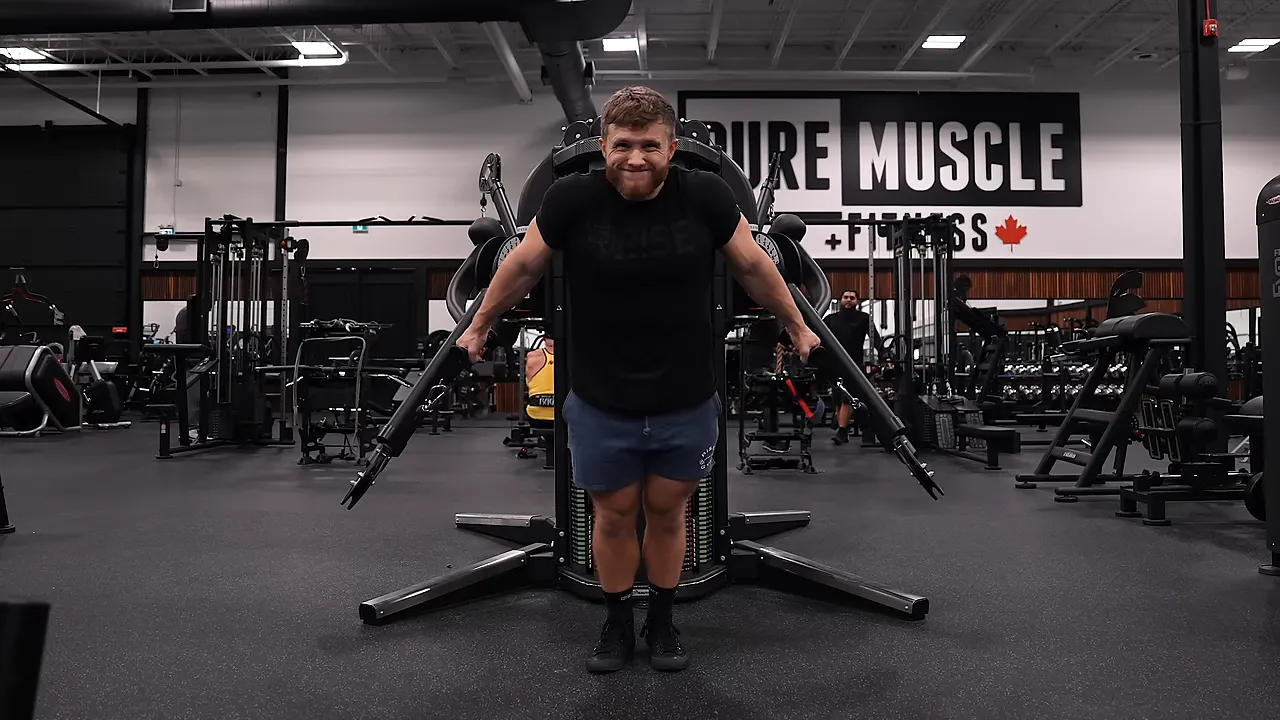
That is also why I generally recommend a slightly wider grip for barbell shrugs. It encourages that same up-and-in action rather than a purely vertical movement.
5. Reverse Pec Deck
Prescription: 3 sets of 10 to 12 reps.
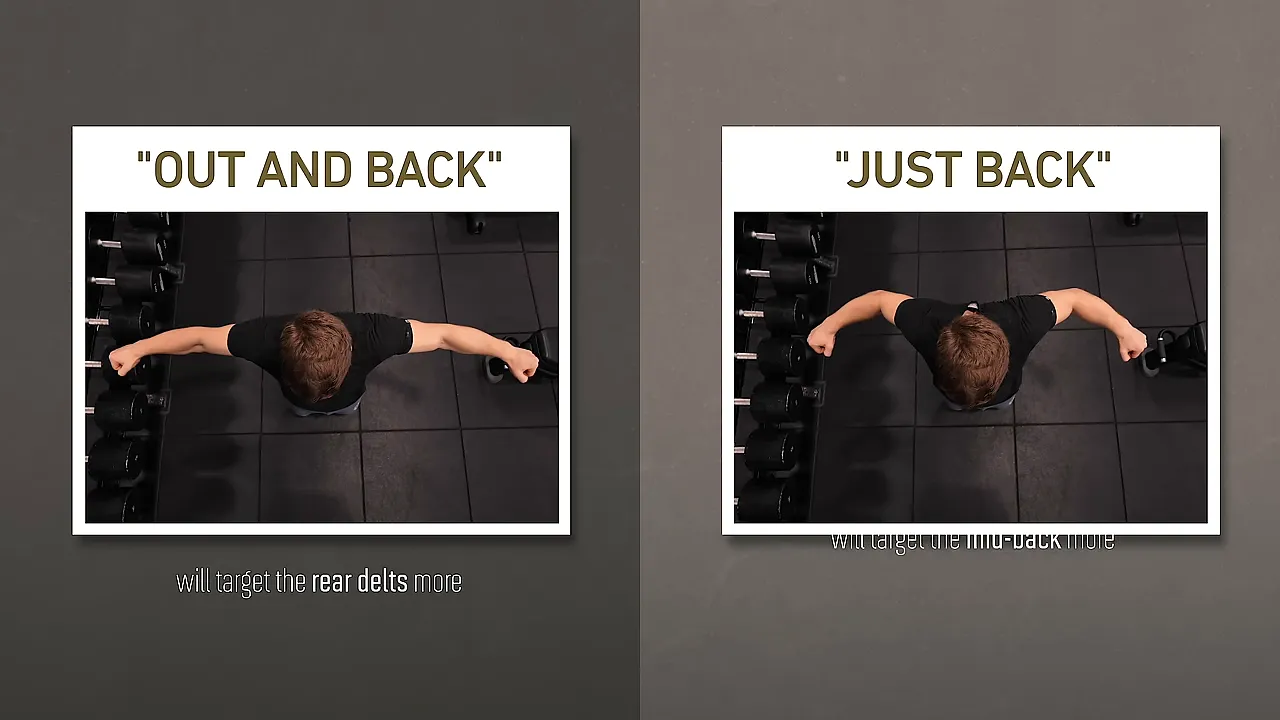
The most important cue here is to sweep your arms out and back, not just back.
If you focus only on pulling backward, it is easy to turn the exercise into more of a mid-back movement, with the middle traps doing a lot of the work. That is not inherently wrong, but we have already trained those muscles with pull-ups and Kroc rows. Here, I want to give the rear delts more focused attention.
The rear delts can get overshadowed by larger back muscles during compound pulling exercises, so being intentional with the arm path matters.
Experiment With Hand Position
You can also try changing your hand position across the three sets:
- Set one: Palms facing each other, using a neutral grip.
- Set two: Palms facing down, using a pronated grip.
- Set three: A slightly more internally rotated position, but only if your shoulders comfortably allow it.
Personally, I tend to feel the best rear-delt connection with the second or third position. That does not mean those positions will be best for everyone.
A 2013 study by Brad Schoenfeld and colleagues found higher average rear-delt EMG readings with a neutral grip than with a pronated grip. But the individual results varied substantially. Some participants showed greater activity with internal rotation, while others showed greater activity with neutral rotation.
The useful takeaway is not that one grip is universally superior. It is that individual responses can differ enough to make experimentation worthwhile. If you have only ever used one hand position, try the others and see how they feel.
6. Overhead Cable Biceps Curl
Prescription: 3 sets of 10 to 12 reps.
For this curl, kneel beside a cable station with your working arm raised out to the side and overhead. Curl the handle toward your head while keeping that elevated upper-arm position.
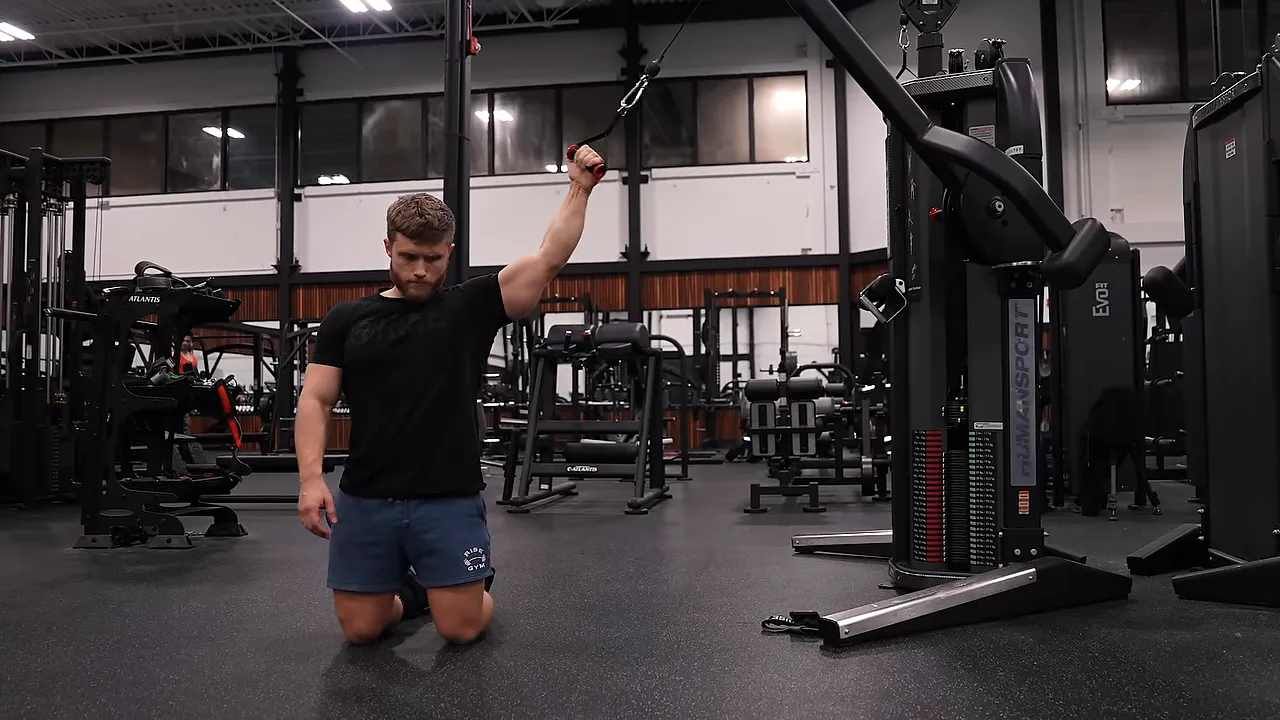
I have not always included overhead curls because I used to find them awkward. What got me interested again was a comparison involving natural pro bodybuilders Alberto Nuñez and Brian Minor at the N1 training lab.
They compared curling with the arm down against curling with the arm elevated. In both lifters, the elevated-arm position appeared to bias the long head of the biceps more. You can find the N1 curl comparison here.
The long head sits toward the outside of the upper arm and contributes to the biceps peak. Since that has been a weak point for me, the comparison was interesting enough to make me experiment with overhead curls again.
Interesting Evidence, Not a Guaranteed Growth Advantage
I do not want to overstate this finding. It involved two lifters, muscle recruitment can vary between individuals, and EMG readings do not establish which exercise will produce more growth over time.
More broadly, there are important limitations to using EMG research to make hypertrophy claims. A higher signal does not automatically prove greater activation, and even greater activation does not guarantee greater muscle growth.
That caveat applies to the reverse pec deck findings, too. I am using this evidence as a reason to explore individual differences in technique, not as proof that one exercise or grip beats every alternative.
Overhead curls are worth experimenting with, not something you need to treat as magic.
Do You Need More Direct Biceps Work?
This is usually the only direct biceps exercise I do on this day. If you find you need more direct volume to progress, you can add another couple of curl sets with your arms down at your sides or slightly behind your torso.
That gives you an additional shoulder position without simply repeating more of the same overhead work.
Putting the Pull Day Together
The bigger picture is straightforward: train the lats with a stable cable movement, work hard on your pull-ups, challenge the back with rows, then give the upper traps, rear delts, and biceps their own focused work.
Keep your technique consistent enough to track progress, stay in control of the load, and experiment where the evidence leaves room for individual preference. Science-based training does not mean everyone has to use exactly the same grip or move like a statue on every rep.
If you want these workouts organized into a progressive plan, my Ultimate Push Pull Legs System lays out 12 weeks of training. This workout comes from the first phase, which lasts six weeks, with two additional phases designed to build on it and keep progression moving.
|


