A great leg day needs to do more than leave you struggling to walk. It should train your quads, hamstrings, glutes, and calves with exercises that complement each other, while keeping fatigue manageable enough to make every set count.
This is the second leg workout in my push-pull-legs split. It starts with a small dose of heavy strength work, moves into targeted hypertrophy training, and finishes with abs. You’ll do six lower-body exercises plus one core exercise, with a clear purpose behind each.
Key Takeaways
- Keep the heavy deadlift set challenging without compromising the rest of your leg workout.
- Combine compound lifts with targeted isolation exercises to train the lower body more completely.
- Use controlled technique and purposeful range of motion rather than chasing heavier loads.
- Adjust leg raise difficulty so your abs approach failure without excessive swinging.
Table of Contents
- The Leg Day Workout
- Warm Up Before Loading the Bar
- 1. Deadlift: One Heavy Top Set
- 2. Stiff-Legged Deadlift: Lighter Weight, Higher Hips
- 3. Leg Press: High-Volume Quad Work
- 4. Glute-Ham Raise: Controlled Hamstring Work
- 5. Slow-Eccentric Leg Extension: Cover What the Leg Press Misses
- 6. Seated Calf Raise: Four Sets, With Some Scientific Nuance
- 7. Roman Chair Leg Raise: Finish With Abs
- Make Each Exercise Earn Its Place
The Leg Day Workout
Here’s the full session. These are working sets, not warm-up sets.
- Deadlift: 1 set of 5 reps at RPE 8 to 9.
- Stiff-legged deadlift: 2 sets of 8 reps.
- Leg press: 4 sets of 10 to 12 reps.
- Glute-ham raise: 3 sets of 8 to 10 reps.
- Slow-eccentric leg extension: 3 sets of 8 to 10 reps, lowering for 3 seconds.
- Seated calf raise: 4 sets of 15 to 20 reps.
- Roman chair leg raise: 3 sets of 10 to 20 reps, close to failure.
The exercise selection balances hip-dominant work with knee-dominant work. The deadlift variations emphasize the posterior chain, the leg press supplies most of the quad volume, and the isolation exercises fill in what the bigger lifts don’t cover as well.
Warm Up Before Loading the Bar
Start with 5 to 10 minutes on a treadmill or StairMaster, followed by some quick lower-body dynamic stretching. The goal is to get your knees and hips moving comfortably before you lift.
Then build up gradually to your deadlift working weight with a warm-up pyramid. Don’t jump straight from general movement to your heavy top set. Increase the load across your warm-up sets so you’re ready for the weight without exhausting yourself before the work begins.
1. Deadlift: One Heavy Top Set
For the first exercise, perform one heavy set of five deadlifts. You can use a conventional or sumo stance.
Aim for an RPE of 8 to 9, meaning you finish with roughly one or two reps left in the tank. Since we’re only doing one working set, it needs to be challenging. But it shouldn’t be an all-out grinder that compromises everything else in the session.
That’s the balance: enough effort to make the low volume productive, without letting the strength work take over a hypertrophy-focused leg day.
How to Progress the Deadlift
If increasing deadlift strength is a priority, you can use linear periodization. In this setup, the number of reps decreases as the weight increases:
- Week 1: 1 set of 5 reps.
- Week 2: 1 set of 4 reps.
- Week 3: 1 set of 3 reps.
- Week 4: 1 set of 2 reps.
- Week 5: A heavy single.
- Week 6: Deload with 1 set of 4 reps at a lighter load.
Add weight as the reps decrease, keeping the heavy work around the intended effort level rather than turning every week into a maximum-effort test.
If you only care about muscle growth, keep things simpler. Stick with five reps and aim to either increase the weight or improve some aspect of your technique from week to week.
Deadlift Substitutions
You don’t have to force a deadlift variation you dislike. Depending on what you want to emphasize, these are reasonable alternatives:
- Trap bar deadlift: Allows a more upright torso and shifts more emphasis toward the quads.
- Barbell hip thrust: A more glute-dominant option.
- Bulgarian split squat: A more quad-dominant option. A slightly greater forward torso lean can shift some emphasis toward the glutes and hamstrings.
2. Stiff-Legged Deadlift: Lighter Weight, Higher Hips
After the heavy top set, strip the weight back and perform two sets of eight stiff-legged deadlifts.
As a starting point, use roughly 50 to 60 percent of your deadlift top-set weight. For example, I might drop from a 405-pound top set to 225 pounds for these back-off sets. That’s a ballpark, not a load you need to force.
Think of this as a conventional deadlift with a higher hip position:
- Keep your hips higher during the setup.
- Keep your knees straighter, rather than bending them as much as you would for a conventional pull.
- Initiate the movement by hinging at your hips.
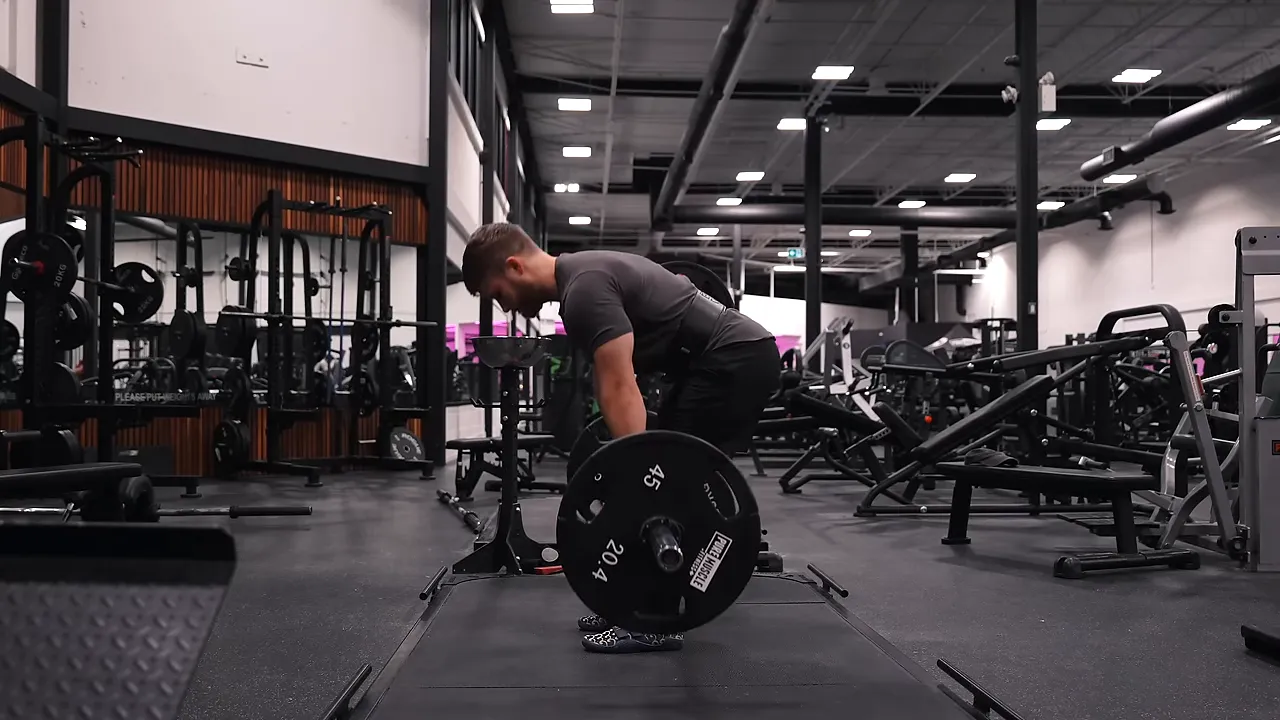
These can feel awkward at first. Start light and stay farther from failure until the technique feels comfortable. The percentage guideline matters less than being able to control the movement.
3. Leg Press: High-Volume Quad Work
Next up is four sets of 10 to 12 reps on the leg press. After the more hamstring- and glute-focused pulls, this is where we really push the quads.
Use a medium-width stance on the platform and prioritize quality depth on every rep. Lower as far as you comfortably can without allowing your lower back to round noticeably.
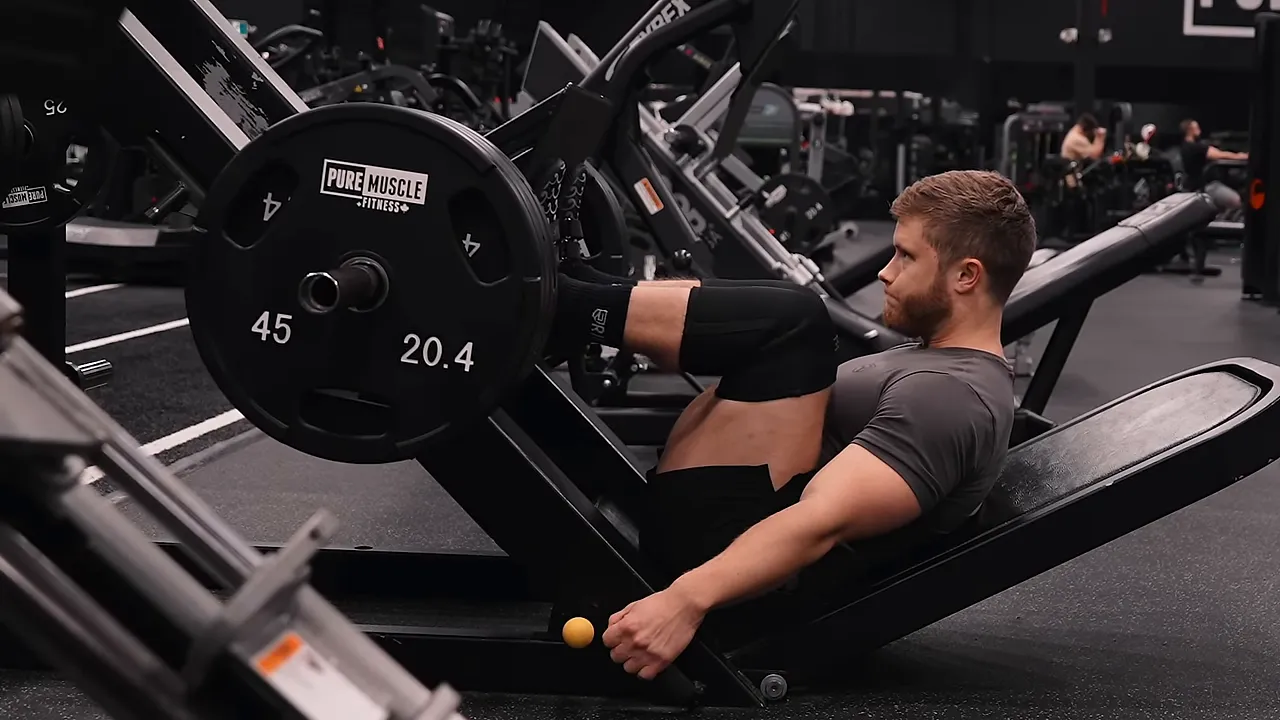
I like to maintain a slight knee bend at the top rather than fully locking out. This isn’t because a controlled lockout is inherently dangerous. It’s simply a technique preference that helps me keep the focus on my quads.
For more context on that distinction, Mike Israetel’s explanation of leg press lockouts is worth checking out.
Use a smooth, consistent cadence, without pausing between reps. Keep moving until you complete the prescribed 10 to 12 reps.
For this exercise, try to keep rest periods to no more than two minutes. That’s a workout-pacing recommendation, not a claim that two minutes is uniquely better for growth. With four demanding sets, very long rests can make the session drag and your focus fade.
4. Glute-Ham Raise: Controlled Hamstring Work
Perform three sets of eight to 10 reps on the glute-ham raise.
I like using a machine with a counterbalance because the assistance lets me control the movement better than I could with body weight alone. Less assistance isn’t automatically better if it means losing control of the exercise.
If your gym doesn’t have a dedicated machine, you have a couple of options:
- Use a lat pulldown setup: Secure your lower legs beneath the pads and use a stick, broom handle, or suitable bar for assistance.
- Perform partner-assisted Nordic hamstring curls: Have a partner hold your ankles down, control the lowering phase as much as you can, then use your hands to help push yourself back up.
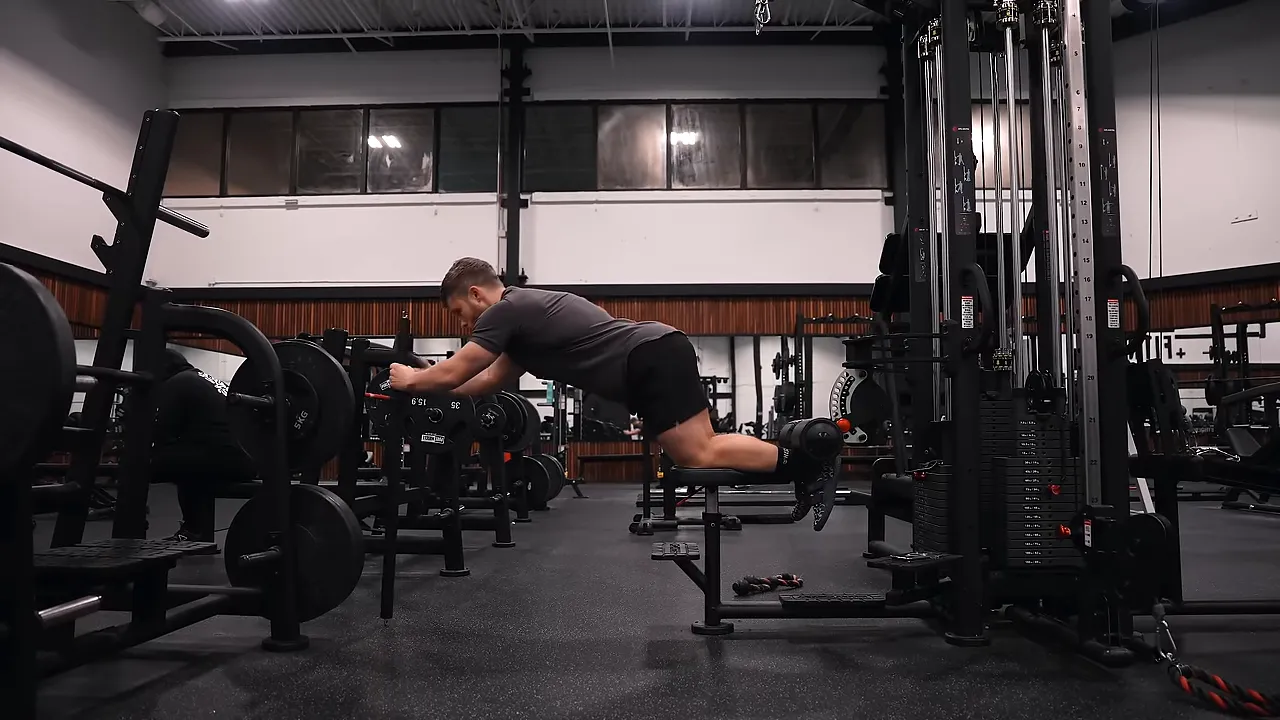
On the glute-ham raise, I tend to leave out roughly the top quarter of the movement, where hamstring tension drops off. Staying in that active portion helps me keep the focus on the hamstrings. It’s a small technique preference, not something to obsess over.
5. Slow-Eccentric Leg Extension: Cover What the Leg Press Misses
Now perform three sets of eight to 10 leg extensions, taking three seconds to lower every rep.
Why add leg extensions after four hard sets of leg presses? Because the leg press doesn’t train every part of the quadriceps equally well.
The rectus femoris is the only quadriceps head that crosses both the hip and knee joints. During compound movements such as leg presses and squats, movement at both joints limits how its length changes. That makes these exercises less effective at fully challenging this particular head.
Leg extensions add direct knee-extension work without the same simultaneous hip movement. That’s why I like including them at least once per week, even when the program already contains plenty of compound quad training.
The three-second lowering phase serves two purposes:
- It keeps the eccentric deliberate. The lowering phase is an important part of the hypertrophy stimulus, so don’t simply let the weight fall.
- It makes lighter loads challenging. Slowing the negative lets you train hard with less weight, which may make the exercise more comfortable on your knees.
The point isn’t to win a contest for the slowest rep. It’s to maintain tension and control throughout the set.
6. Seated Calf Raise: Four Sets, With Some Scientific Nuance
For calves, perform four sets of 15 to 20 seated calf raises.
Across the training week, I like including both a straight-knee calf exercise and a bent-knee calf exercise when both machines are available. But I’m less convinced that seated calf raises are essential than I once was.
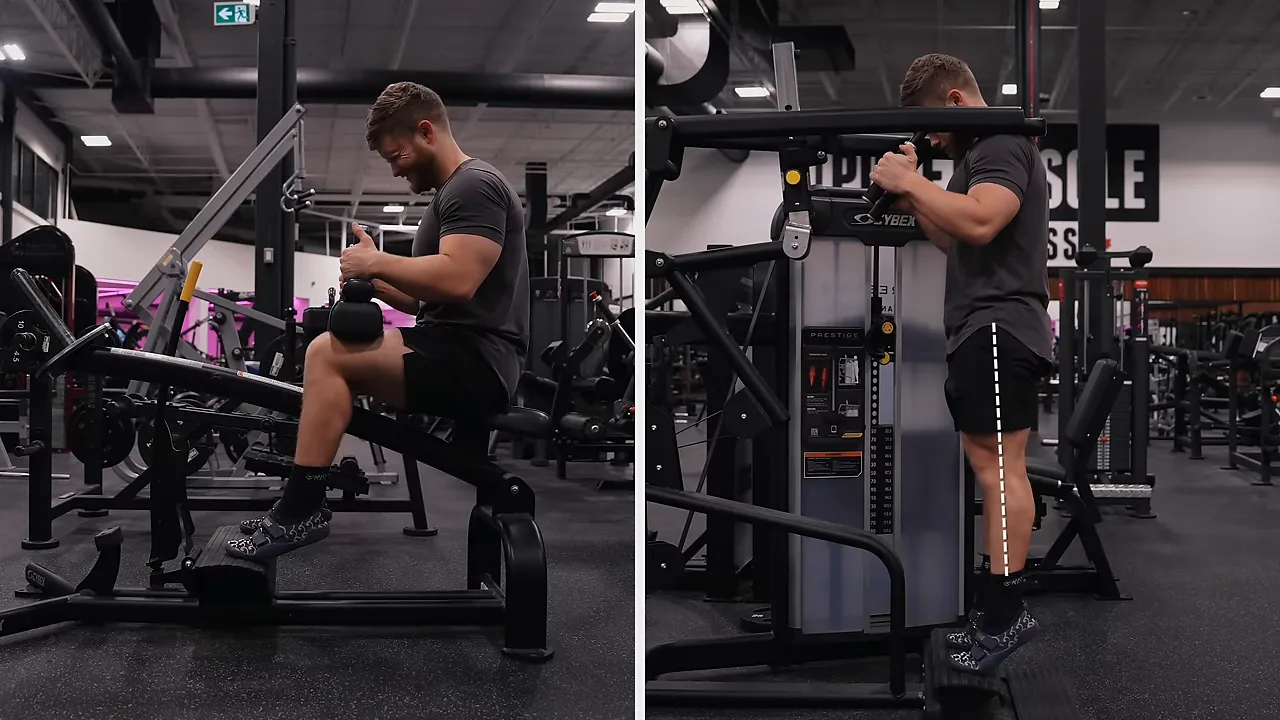
The usual rationale for seated raises is to emphasize the soleus. However, the research discussed here suggests that the soleus may be less responsive to training than the gastrocnemius.
A 2020 calf-training study found similar growth responses with high- and low-load training, with less growth in the soleus than in the gastrocnemius. That challenges the idea that higher reps are especially important for growing the slow-twitch-dominant soleus.
You could reasonably argue that the time spent on seated calf raises would be better spent doing straight-knee raises, which involve the gastrocnemius more. I think that’s a fair substitution.
Still, the evidence described here doesn’t directly establish which exercise produces better growth in both muscles. I’d want a long-term, direct comparison of seated and standing calf raises before treating seated work as unnecessary.
My practical position for this routine is:
- Include both knee positions if you have the equipment and want variety across the week.
- Substitute standing calf raises if that’s your preference.
- Don’t worry much if your gym doesn’t have a seated calf machine.
The higher reps in this session are mainly for variety, since the first leg day uses relatively lower reps. They aren’t based on a special high-rep requirement for calf growth.
7. Roman Chair Leg Raise: Finish With Abs
Finish with three sets of 10 to 20 Roman chair leg raises, pushing close to failure.
The rep range is intentionally broad. Ten controlled reps might be challenging for one person, while someone else may need closer to 20. The effort and execution matter more than landing on one exact number.
Think about curling your lower back and squeezing your abs, not just lifting your legs. End the set when you can no longer bring your legs toward chest level without excessive swinging.
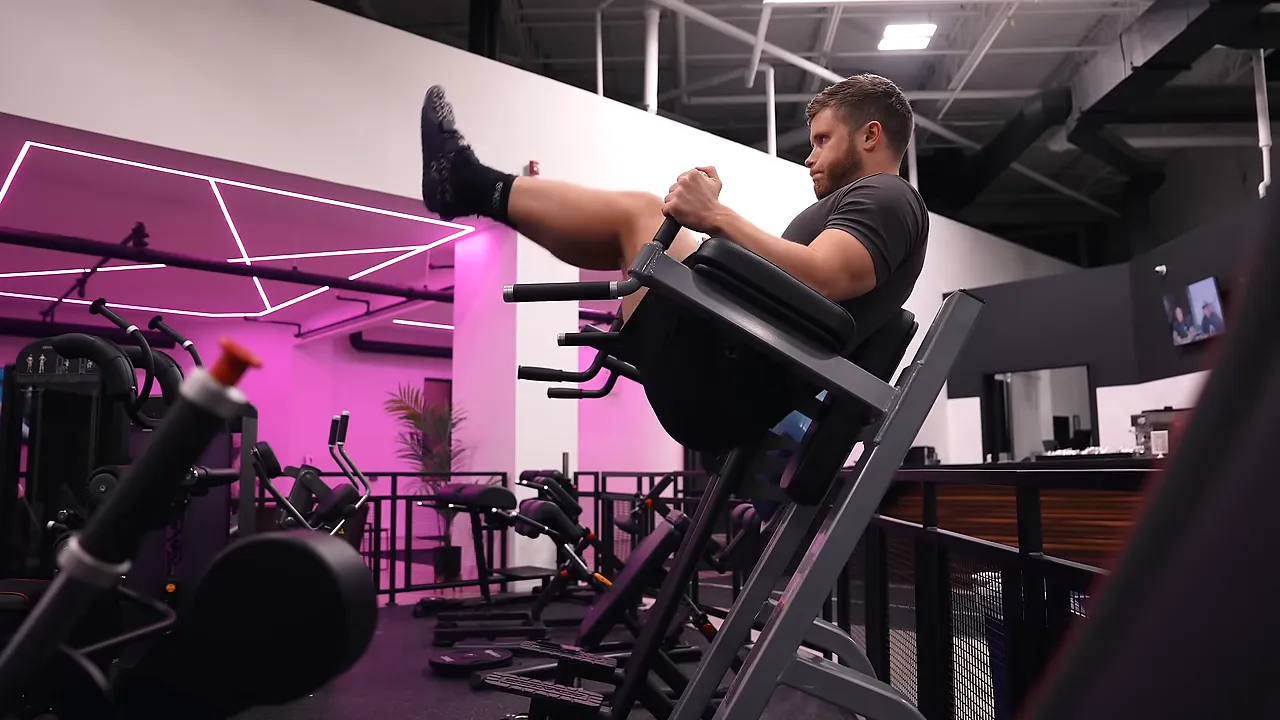
Adjust the difficulty to match your strength:
- If you can’t reach 10 good straight-leg reps: Bend your knees more, then gradually work toward straighter legs as your core gets stronger.
- If 20 reps feels easy: Lower your legs for a two- to three-second count on every rep.
If 20 slow, controlled reps still feels easy, your abs are doing pretty well.
Make Each Exercise Earn Its Place
The goal of this leg day is hard, purposeful training, not maximum exhaustion. Keep the deadlift challenging but manageable, use controlled range of motion on the leg press, and give the isolation work the same attention you give the heavy barbell work.
This session is one part of a larger push-pull-legs routine. If you want the exercises, progression, and weekly structure organized into a complete plan, my 12-week Push Pull Legs Hypertrophy System puts it all together.
|


