A minimalist workout should save time, not cut corners. The goal is to choose exercises that cover a lot of muscle, remove unnecessary setup, and put more effort into fewer high-quality sets.
This two-day full-body routine is designed to take under 45 minutes per session. It combines heavy work, moderate-rep sets, and a few time-saving intensity techniques to train your whole body without spending half your day in the gym. If you prefer training more often, you can redistribute the same basic work across three, four, or five days.
The catch? When you only have one or two working sets, those sets need to count. Good technique and an honest assessment of how close you are to failure become especially important.
Key Takeaways
- Prioritize efficient exercises and high-quality working sets to keep full-body workouts under 45 minutes.
- Use drop sets, myo-reps, and opposing-muscle supersets to add challenging work without lengthy sessions.
- Maintain controlled technique as fatigue builds, especially when extending sets beyond the initial effort.
- Adapt the routine to more training days by redistributing the work before adding volume.
Table of Contents
- How to Make Minimalist Training Work
- Full Body Day 1
- Full Body Day 2
- How to Adapt the Plan to 3, 4, or 5 Days per Week
- Make Every Working Set Count
How to Make Minimalist Training Work
There are three main ways this plan keeps workouts short:
- Choose efficient equipment. Dumbbells eliminate some plate loading, while machines can reduce the preparation needed for demanding compound lifts.
- Get more coverage from each exercise. A deep dumbbell press combines pressing with a substantial pec stretch, and a high incline press trains both the chest and shoulders.
- Extend selected sets instead of adding entire sets. Drop sets, myo-reps, and opposing-muscle supersets let you fit more hard work into less time.
For clarity, a drop set means reducing the load after reaching failure and continuing with more reps. Myo-reps keep the load the same but use very short rests between small clusters of additional reps. The exact instructions for each appear below.
The listed sets are working sets. Start Day 1 with two to three minutes of brisk treadmill walking and a few dynamic stretches, such as arm swings and leg swings. Keeping the warm-up efficient does not mean skipping preparation for heavy work.
Full Body Day 1
The first session starts with a press, a hip hinge, and a vertical pull, then rounds things out with single-leg work and targeted isolation exercises.
1. Flat Dumbbell Press
- Heavy set: 1 set of 4 to 6 reps.
- Lighter back-off set: 1 set of 8 to 10 reps.
I like starting with a heavier, strength-focused set, then reducing the weight for a more moderate-rep, hypertrophy-focused set.
Dumbbells make sense here for two reasons. First, you do not need to load and unload plates. Second, they allow a greater range of motion than a barbell, so you can get a substantial stretch on the pecs without adding a separate fly exercise.
That does not make barbell pressing a bad choice. In a longer workout, you could pair it with a stretch-focused cable fly. But when we are trying to minimize the number of exercises, a dumbbell press or dip gives us a lot of value from one movement.
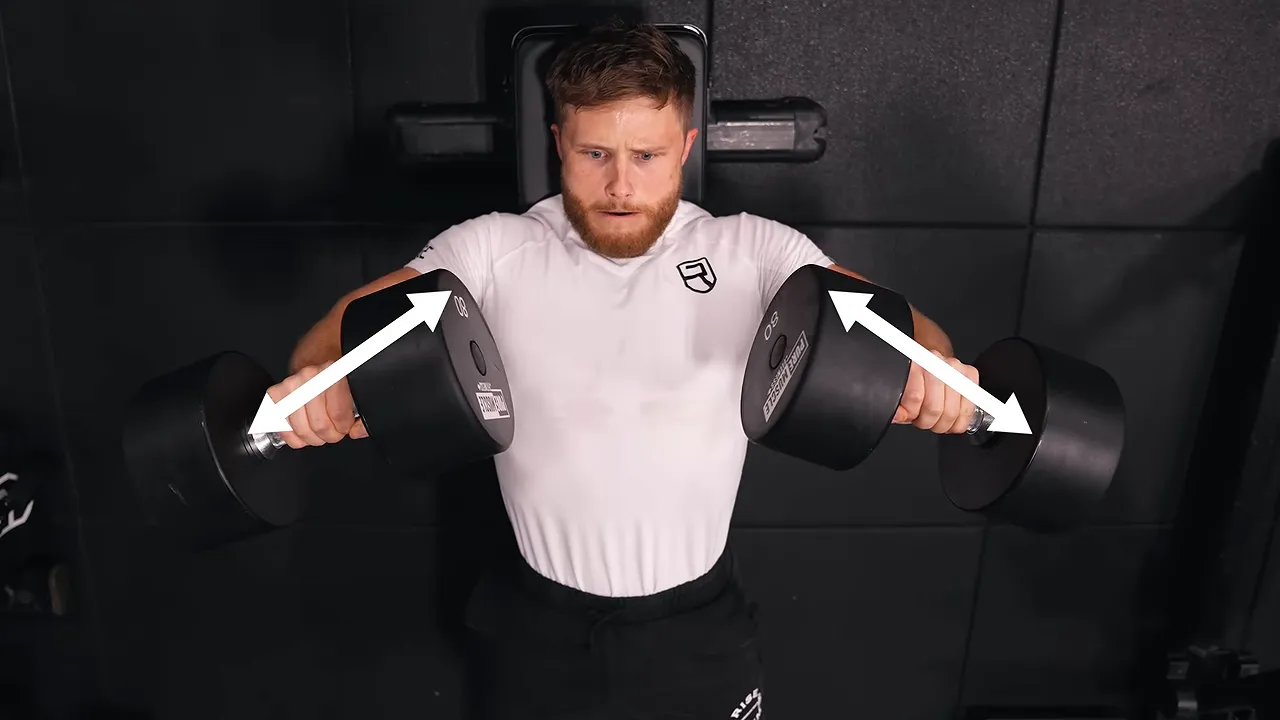
Lower the dumbbells with your elbows tucked roughly 30 to 45 degrees from your torso when viewed from above. As you press, you can let the elbows flare outward. If that causes shoulder discomfort, keep them tucked throughout the movement instead.
2. Dumbbell Romanian Deadlift
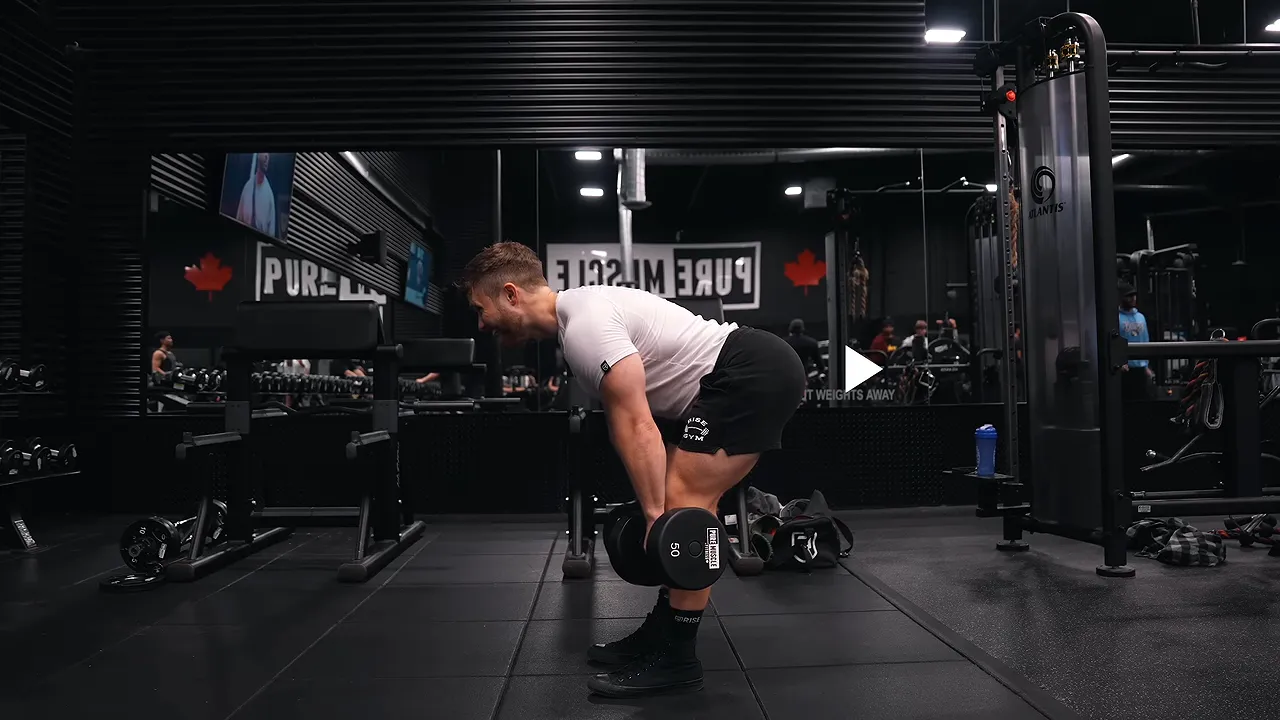
Prescription: 2 sets of 8 to 10 reps.
Again, dumbbells are mainly a time-saving choice. The basic mechanics are the same with a barbell.
Think about pushing your hips back, not lowering the weights to the floor. Let the dumbbells travel straight down under control, then reverse the movement once you feel a big hamstring stretch without rounding your lower back.
I prefer a smooth cadence without fully locking out at the top to keep tension on the hamstrings. If you want a little more emphasis on the glutes, you can finish by extending the hips and squeezing the glutes.
I also strongly recommend straps here. Your grip should not end the set before your hamstrings get the work they need.
3. Two-Grip Lat Pulldown
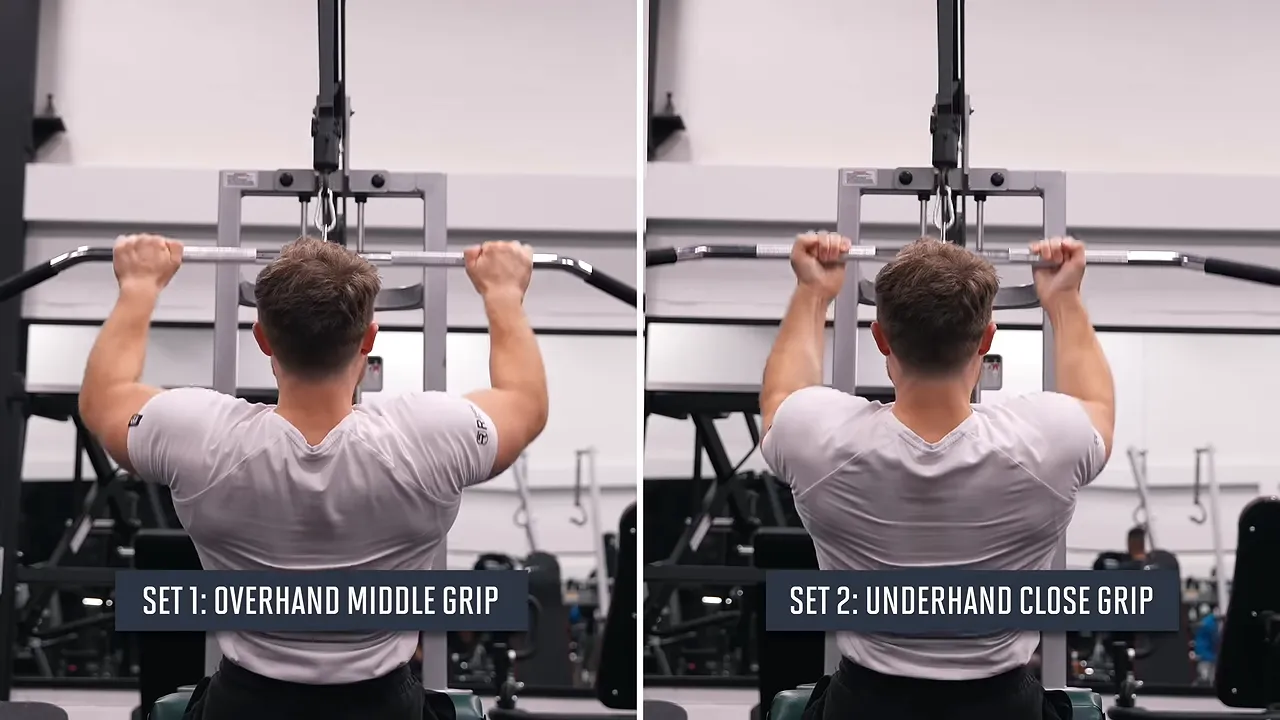
Prescription: 2 sets of 10 to 12 reps, using a different grip for each set.
- Set 1: Medium-width overhand grip to train the lats and mid-back.
- Set 2: Close underhand grip to involve the biceps more and change the pulling angle slightly.
After the second set, you can reduce the load and perform overhead cable curls at the same station. This adds direct biceps work without moving to another piece of equipment, helping ensure the biceps receive a challenging stimulus rather than only contributing to the pulldowns.
4. Dumbbell Step-Up
Prescription: 1 working set of 8 to 10 reps per leg.
This is the main quad- and glute-focused movement of the day. With only one working set per leg, execution matters a lot.
Make the front leg do the work. The back leg is there primarily for balance, so minimize pushing off the floor to help yourself up.
I prefer finishing all reps on one leg before switching. Alternating legs introduces a break between reps and can drag the set out.
Step-ups and lunges are also exercises where people often stop much farther from failure than they realize. Choose a load that genuinely brings you to failure, or within about one rep of it, while keeping the movement controlled. You may need more weight than you expect, but not at the expense of making the front leg carry the load.
Straps can help here, too, so grip fatigue does not become the limiting factor.
5. Overhead Cable Triceps Extension
Prescription: 1 set of 12 to 15 reps, followed by a drop set.
The dumbbell press already trains the triceps with the shoulders in a relatively neutral position. An overhead extension adds a different shoulder position rather than repeating something similar with a pressdown.
There is also research supporting this choice. A 2022 study comparing overhead extensions with neutral-arm extensions found about 40% greater triceps hypertrophy in the overhead condition, despite matched training volume.
I would not treat one study as the final word. Some people have questioned the size of the difference, although the MASS research review considered the study well designed and discussed several plausible explanations for the results. If I only have time for one triceps isolation exercise, I would favor the overhead extension.
Keep the upper arms steady, with the cable just behind your head. Extend the elbows by squeezing the triceps, then lower under control into a substantial stretch.
Once you reach failure, reduce the load by approximately 30 to 40% and continue to failure again.
6. Machine Lateral Raise
Prescription: 1 set of 12 to 15 reps, followed by a drop set.
I use a standing lateral raise machine because it lets me train through a large range of motion with consistent tension on the side delts. A seated machine, cable setup, or dumbbells can also work.
The important part is taking the side delts to failure with good form, not finding one specific machine.
I use straps on my machine to reduce how much my grip and thumbs have to support the handles. I also raise my arms higher than in a typical lateral raise. If that larger range is uncomfortable, stopping around shoulder height, with the arms parallel to the floor, is fine.
After reaching failure, reduce the weight by 30 to 40% and continue to failure again. This adds more hard work without the time cost of resting for another complete set.
7. Leg Press Toe Press
Prescription: 1 set of 12 to 15 reps, followed by a drop set.
This is a calf raise performed on a horizontal leg press machine. Although you are sitting down, the knees stay straight, making the basic movement pattern similar to a standing calf raise rather than a bent-knee seated calf raise.
I find that removing the load from my upper body helps me connect with the calves more effectively.
Take the initial set to failure, reduce the load by 30 to 40%, and continue to failure again. Do not turn the drop set into bouncing reps. Keep roughly a one-second pause at the bottom and a full squeeze at the top of every rep, even as fatigue builds.
Full Body Day 2
The second session leads with a squat, pairs chest and back work to save time, and finishes with hamstrings, biceps, and abs.
1. Hack Squat
- Heavy top set: 1 set of 4 to 6 reps, stopping about one rep short of failure.
- Lighter back-off set: 1 set of 8 to 10 reps.
- Rest between working sets: About 3 minutes.
One reason I favor the hack squat for a minimalist routine is that I can usually prepare for it faster than a barbell back squat. Depending on the load, my barbell squat warm-up can take a long time. With the hack squat, two or three quick warm-up sets can have me ready for working sets within five to ten minutes.
For the heavy set, choose a load that leaves approximately one rep in reserve, also called RPE 9. Focus on driving through your heels and maintaining pressure against the shoulder pads.
After resting, reduce the load. On the back-off set, put more attention into controlling the lowering phase and feeling the quads work.
Use full depth on both sets. I allow my knees to travel forward past my toes rather than trying to hold them back. That forward knee movement is not inherently unsafe and is part of how I reach depth on this exercise.
2. High Incline Smith Machine Press and T-Bar Row
Prescription: 2 sets of 10 to 12 reps for each exercise, performed as an alternating superset.
This is an antagonistic superset: pairing exercises for opposing muscle groups. While the pressing muscles work, the pulling muscles get a break, and vice versa.
Set the incline bench to approximately 45 to 60 degrees. This is higher than a typical incline press, allowing the exercise to cover both the pecs and shoulders rather than programming separate horizontal and vertical presses.
Use a slightly closer grip to take the triceps through a greater range of motion and shift some emphasis toward the upper pecs, an area many people want to bring up.
Pair the press with T-bar rows for the mid-traps, lats, rear delts, and some biceps involvement. I use a wider grip on one set and a closer grip on the other to vary the pulling angle.
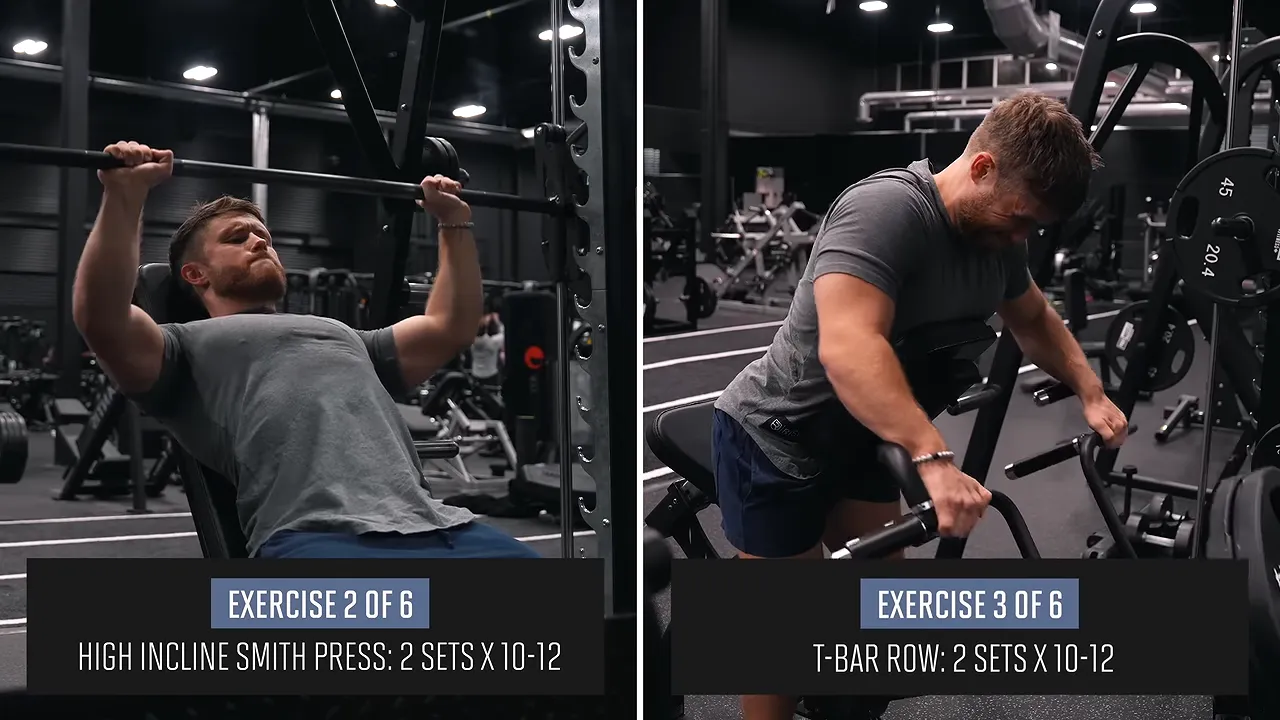
My gym has these machines close together, which makes the pairing convenient. If yours does not, turn around on the incline bench and use chest-supported dumbbell rows instead, keeping the same sets and reps.
Although supersets are often described as exercises done back to back without rest, I still take 30 to 60 seconds between exercises to catch my breath. In practice, the sequence looks like this:
- High incline Smith machine press, set 1.
- Rest 30 to 60 seconds.
- T-bar row, set 1.
- Rest 30 to 60 seconds.
- Repeat for the second set of each exercise.
You still save time, but you do not have to rush into the next movement while completely out of breath.
3. Seated Hamstring Curl
Prescription: 1 set of 10 to 12 reps, followed by a drop set.
A 12-week study comparing seated and lying leg curls found greater hamstring growth with the seated variation. The difference appears related to training the hamstrings at longer muscle lengths in the seated position.
When I have to choose only one curl variation, I generally favor seated curls. I also lean forward over the machine to emphasize the stretched position.
Take the working set to failure, reduce the load by 30 to 40%, and go to failure again.
4. EZ-Bar Biceps Curl
Prescription: 1 set of 12 to 15 reps, followed by myo-reps.
Think about curling the weight out and up, not simply lifting it vertically. I also use the cue of driving through my pinkies to emphasize the biceps' role in turning the palms upward.
Focus on squeezing the biceps to move the weight. Keep your grip secure but avoid unnecessarily crushing the bar, which can make the forearms feel like they are taking over.
After reaching failure with good technique, perform the myo-reps as follows:
- Keep the same weight.
- Rest for 3 to 4 seconds.
- Perform another 4 reps.
- Rest another 3 to 4 seconds and attempt another 4 reps.
- Continue until you can no longer complete a four-rep cluster.
The idea is to accumulate more challenging reps in a short period. Because the biceps are already fatigued, the mini-sets bring you close to failure quickly, without needing to repeat all the earlier, easier reps of a fresh set.
5. Cable Crunch
Prescription: 1 set of 12 to 15 reps, followed by a double drop set.
Kneel in front of the cable with the rope held over your head. Crunch down by contracting the abs and allow the back, including the lower back, to round as you do it.
Unlike the Romanian deadlift, where the goal is a hip hinge without lower-back rounding, this exercise uses spinal flexion to train the abs.
Finish with two reductions in load:
- Reach failure on the initial set.
- Reduce the weight by approximately 30% and continue to failure.
- Reduce the remaining weight by another 20 to 30% and continue to failure one last time.
How to Adapt the Plan to 3, 4, or 5 Days per Week
You do not need to rebuild the routine if you prefer more frequent, shorter sessions. Keep most exercises, sets, and reps the same, and change how you distribute them.
Two Days: Full Body Twice per Week
Perform Full Body Day 1 and Full Body Day 2 on separate days. One example is Monday and Thursday, leaving the other days free from lifting.
Three Days: Full Body, Upper, Lower
Keep Full Body Day 1 intact, then divide Day 2 into an upper-body session and a lower-body session.
- Monday: Full Body Day 1.
- Wednesday: Upper-body work from Day 2.
- Friday: Lower-body work from Day 2.
If those upper and lower sessions feel too short, you can add a set to selected exercises or include extra work for individual weak points.
Four Days: Upper/Lower Twice per Week
Split both full-body workouts into upper- and lower-body sessions. The weekly sequence is:
- Monday: Upper Body 1.
- Tuesday: Lower Body 1.
- Wednesday: Rest.
- Thursday: Upper Body 2.
- Friday: Lower Body 2.
- Saturday and Sunday: Rest.
Again, you can add some volume if the sessions are shorter than you want. The starting point is redistributing the existing work, not automatically multiplying it.
Five Days: Upper, Lower, Push, Pull, Legs
Use the same basic exercise pool in an upper/lower/push/pull/legs split:
- Monday: Upper body.
- Tuesday: Lower body.
- Wednesday: Rest.
- Thursday: Push.
- Friday: Pull.
- Saturday: Legs.
- Sunday: Rest.
The principle stays the same across every schedule: fewer wasted minutes, carefully chosen exercises, and hard sets performed well.
Make Every Working Set Count
Minimalist training is not about doing the least possible work with the least possible effort. It is about putting your available time toward the work that matters most.
Use efficient equipment, keep the target muscles responsible for moving the load, and resist the temptation to let technique unravel during drop sets or myo-reps. A short workout still needs focus.
If you would rather have the programming organized for you, my 12-week Essentials Program applies this approach across two-, three-, four-, and five-day options. It includes three training blocks, exercise substitutions, coaching videos, and a custom Excel spreadsheet.
|
Consult a physician before starting an exercise program. This information is educational and is not individualized medical advice.


