The problem with steroids is that they work. Really well.
That might sound like an irresponsible place to start, but an honest discussion about anabolic steroids has to acknowledge why people take them. They can build muscle dramatically faster than natural training alone. Pretending otherwise does nothing to help people understand the trade-off.
The issue is that the benefits are easy to show. Bigger arms, heavier lifts, a more impressive physique. The costs are often much less visible: changes to your heart, hormones, brain, and relationship with your own body.
I’m not the health police, and I have no problem with people who choose to enhance. But admitting to steroid use while showing only the gains is partial transparency. An informed decision requires the whole picture.
Key Takeaways
- Anabolic steroids build muscle rapidly, but their effects extend far beyond skeletal muscle.
- Potential costs include heart problems, hormone suppression, anxiety, and a more difficult relationship with body image.
- Medical monitoring can reduce some risks without making nonmedical steroid use safe.
- A training plateau does not prove you have reached your natural muscle-building limit.
Table of Contents
- How Much Muscle Can Steroids Build?
- Why Steroid Honesty Can Still Be Misleading
- What Happens After Testosterone Enters Your Body?
- Your Heart Can Grow, Too
- Steroids Affect Your Brain, Not Just Your Body
- Getting Bigger May Not Fix How You Feel About Your Body
- Hair Loss, Gyno, Hormone Suppression, and Acne
- Two Overlooked Risks: Injections and Injuries
- Do Steroids Shorten Your Life?
- What About Low Doses or “Sports TRT”?
- Why Teenagers Should Not Rush This Decision
- Have You Reached Your Natural Limit, or Just a Plateau?
- Put the Fundamentals Into Practice
How Much Muscle Can Steroids Build?
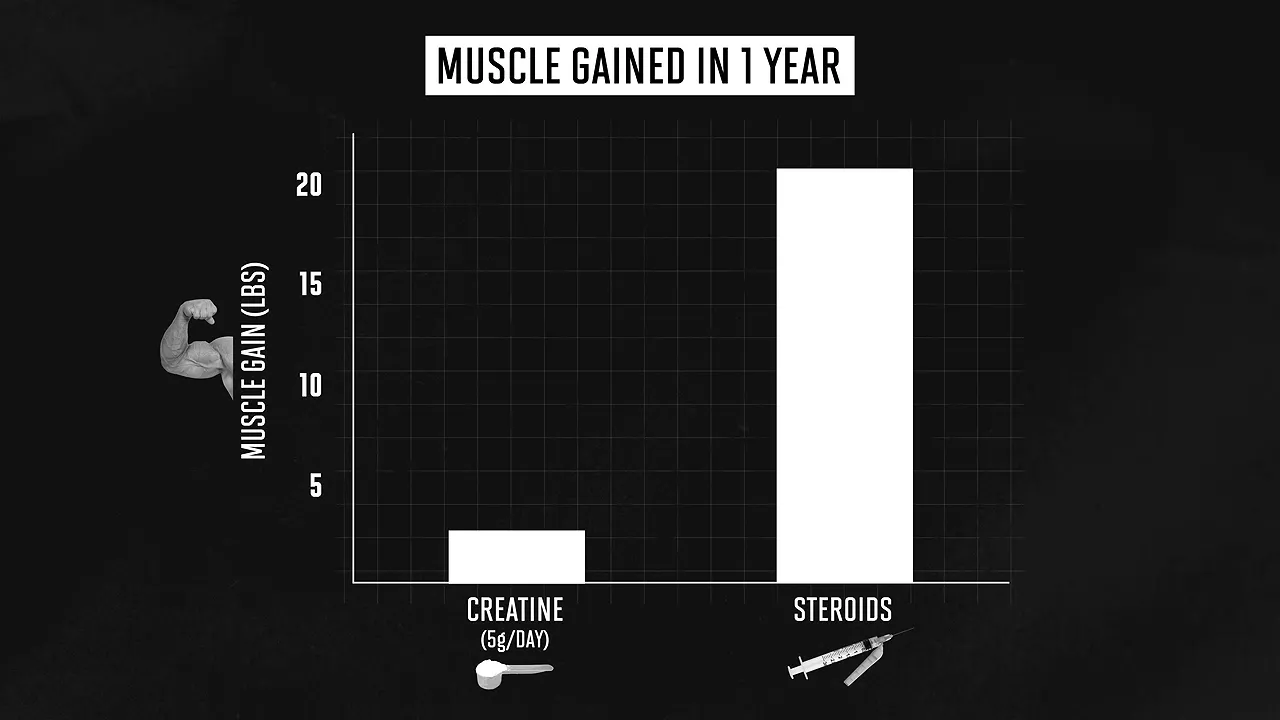
To put the scale of the effect into perspective, consider creatine. As a rough illustration, taking 5 grams daily alongside training for a year might add around 2 pounds of extra muscle compared with training without it.
With anabolic steroids at doses used for bodybuilding, the extra muscle gain could be closer to 20 pounds over that year. Genetics, dose, training history, and other factors make that number highly variable. It is not a promise, and these estimates are not a direct head-to-head trial. The point is the size of the difference.
A review of the research on steroids and hypertrophy helps explain why enhanced and natural bodybuilding are very different propositions.
My own bloodwork provides another useful comparison. As a lifetime natural bodybuilder, my total testosterone measured 485 nanograms per deciliter, comfortably within the normal range.
Bodybuilder Chase Irons, who is unusually open about his substantial steroid use, reported a result above his test’s measurement ceiling of 10,000 nanograms per deciliter. That is an extreme example, not a typical result for every steroid user. But it shows just how far beyond natural hormone levels enhancement can go.
This is not simply a slightly better version of being natural. At the extreme, it is a completely different hormonal environment.
Why Steroid Honesty Can Still Be Misleading
In theory, fitness influencers being open about drug use should help people set realistic expectations. If you know someone’s physique was built with anabolic steroids, you can stop treating it as the standard for your natural progress.
But I think that honesty has sometimes backfired. Instead of adjusting their expectations, some people decide to take steroids themselves.
That becomes especially concerning when the disclosure stops at “yes, I’m on gear.” If someone shares every new personal record and physique update but rarely discusses the anxiety, medical problems, or long-term risks, the message still looks overwhelmingly positive.
The gains are real. So are the effects that never make it into a gym selfie.
What Happens After Testosterone Enters Your Body?
Testosterone enanthate is one common injectable anabolic steroid. It consists of testosterone with an attached ester group, usually dissolved in a carrier oil. Formulations can also contain ingredients that help with solubility and preservation.
After an intramuscular injection, the oil forms a depot between muscle fibers. The drug gradually leaves that depot, and enzymes called esterases remove the attached ester, releasing testosterone.
Testosterone circulates in the blood, much of it attached to binding proteins. Available testosterone can enter muscle cells and interact with androgen receptors, influencing the expression of genes involved in muscle growth.
If the only effect were bigger skeletal muscles, the decision would be a lot simpler. Unfortunately, testosterone does not act exclusively on your biceps.
Your Heart Can Grow, Too
Your heart is also muscle, and anabolic steroid use can promote harmful changes in its size and structure.
One area of particular concern is the left ventricle, the chamber that pumps blood out to the body. More muscle here is not automatically better. Excessive thickening can interfere with the heart’s ability to relax, fill, and pump effectively.
That is very different from assuming that a bigger heart must be a stronger, healthier heart. Steroid-associated cardiac changes can contribute to impaired function and heart failure risk. This review of anabolic steroids and heart health discusses those concerns in more detail.
It is one of the clearest examples of why judging the effects of steroids by outward appearance alone misses the point. Someone can look incredibly fit while developing serious internal health problems.
Steroids Affect Your Brain, Not Just Your Body
To understand the less visible effects, I spoke with Dr. Mike Israetel, who combines a scientific background in sport physiology with firsthand experience using anabolic steroids.
Anxiety and aggression
Mike described anxiety as a major potential side effect. In his experience, both the dose and the particular compound matter. He singled out trenbolone as more anxiety-provoking than compounds commonly perceived as milder, such as methenolone, often called Primo. That comparison does not make the latter risk-free.
He also shared that his score on a validated anxiety questionnaire fell in a severe range at the time of our conversation. A questionnaire score is not the same thing as a clinical diagnosis, but his experience highlights a cost that is easy to overlook when the conversation focuses only on muscle.
The familiar phrase “roid rage” can also oversimplify what happens. Mike described disturbing aggressive thoughts, not simply a tendency to commit violent acts. Even when those thoughts never become actions, living with them can be deeply unpleasant.
Cognition and brain aging
Mike also raised concerns about cognitive function with long-term steroid use. There is research behind the broader concern that anabolic steroids may affect brain health.
A 2021 brain-imaging study examined more than 200 weightlifters, including steroid users and nonusers. The researchers found a larger brain-age gap among those using anabolic steroids: their brain scans appeared older than expected for their chronological age.
This is an association, not proof that every steroid user will experience the same cognitive changes. It also does not let us predict an individual’s intelligence from their drug use. But it is a serious warning that the trade-off may extend beyond physical health.
Libido can become a distraction
Derek from More Plates More Dates described another commonly reported experience: the first six to eight weeks can feel like going through puberty again, including a dramatic increase in libido.
That might initially sound appealing. In practice, he explained, an overwhelming sex drive can become distracting when you are an adult with work, responsibilities, and a life outside the gym.
Getting Bigger May Not Fix How You Feel About Your Body
Most people who take steroids want more muscle and a better relationship with their appearance. I get it. I want to look bigger and feel better about how I look, too.
But those are two different goals.
Steroids can make you bigger without making you more satisfied. They do not guarantee that you will look like an elite professional bodybuilder, and they may worsen an existing preoccupation with muscularity.
Coming off can make this even harder. Losing a noticeable portion of the size gained while using can leave someone feeling smaller than before, even if that comparison is more psychological than objective. Going back on becomes tempting, sometimes at a higher dose.
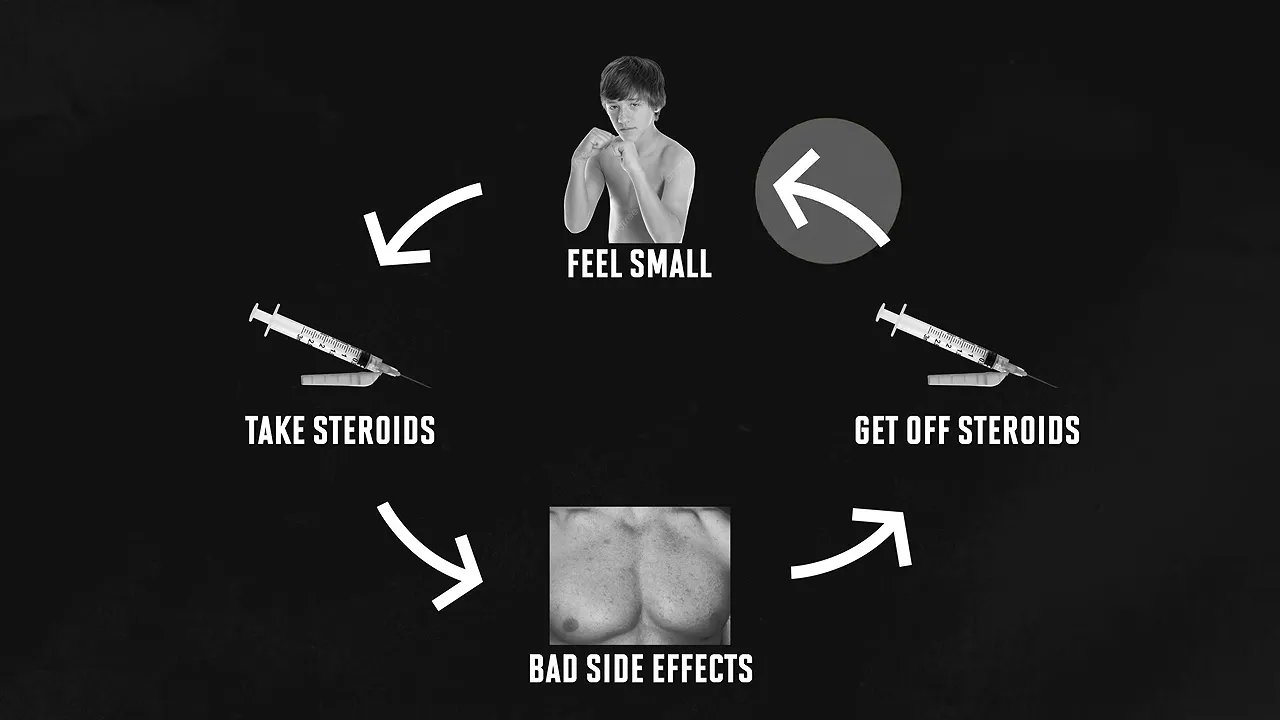
The pattern can become self-reinforcing:
- Feel too small and start taking steroids.
- Gain size but experience unwanted side effects.
- Stop using and lose some of that size.
- Feel small again and return to steroids.
A bigger physique is not a guaranteed solution to body dissatisfaction. That matters just as much as the physical side effects.
Hair Loss, Gyno, Hormone Suppression, and Acne
Testosterone also affects tissues outside the muscles and can be converted into other hormones. Several familiar steroid side effects follow from those processes.
Hair loss
Some testosterone converts to dihydrotestosterone, or DHT. In people susceptible to androgen-related hair loss, DHT can accelerate the shrinking of scalp hair follicles.
That does not mean every steroid user will go bald. It means enhancement can speed up hair loss in someone already predisposed to it.
Gynecomastia
Some testosterone also converts to estrogen. Changes in hormone balance can promote the development of breast tissue in men, known as gynecomastia or “gyno.” It can produce a puffy appearance around the nipples.
Some users take additional drugs to try to manage estrogen-related effects, but that adds another layer of medication and potential side effects. Established gynecomastia may require surgery for reliable removal.
Suppressed natural testosterone production
External testosterone signals that the body already has plenty available. That feedback suppresses the hormonal signals that normally stimulate the testes to produce testosterone.
The testes can shrink substantially as a result. The important issue is not just their size, but the suppression of natural hormone production.
Recovery after stopping is not guaranteed to be quick or complete. Some people experience prolonged suppression and may ultimately require long-term testosterone treatment. Research on recovery after anabolic steroid use explores why this can be more complicated than simply stopping injections.
Acne
Anabolic steroids can enlarge sebaceous glands and increase production of sebum, the oily substance that normally helps protect the skin. Excess production can contribute to acne.
Again, the response is often another drug to manage the side effect. That treatment can bring side effects of its own. The original decision can turn into a growing collection of medications rather than one isolated intervention.
Two Overlooked Risks: Injections and Injuries
Underground products add uncertainty
Mike described the inconsistent quality of steroids obtained through underground laboratories. Some products caused little obvious irritation, while others produced severe reactions.
He had personally been hospitalized for a severe, noninfectious inflammatory abscess after an injection. He also knew people whose abscesses required surgical drainage.
The distinction matters: a serious injection-site complication does not have to be an infection. Product quality and inflammatory reactions create risks beyond the hormonal effects of the drug itself.
Strength can outpace connective tissue
Derek highlighted another problem: muscle strength can increase faster than connective tissue can adapt.
Imagine adding 50 pounds to your bench press in six weeks. If the weight suddenly feels easy, the natural temptation is to keep pushing. But your tendons and other connective tissues may not be ready for that rapid increase in loading.
The same fast progress that makes steroids appealing can encourage decisions that contribute to serious injury.
Do Steroids Shorten Your Life?
It is difficult to say exactly how much anabolic steroid use might shorten any one person’s life. Dose, duration, compounds, other behaviors, and individual health all matter.
But the mortality evidence is concerning.
A 2024 report on mortality associated with anabolic steroid use described follow-up of 1,189 steroid users and roughly 60,000 comparison individuals. The steroid group’s average age at baseline was about 27, with follow-up lasting roughly 11 years.
- Steroid users: approximately 2.8% died during follow-up.
- Comparison group: approximately 1% died during follow-up.
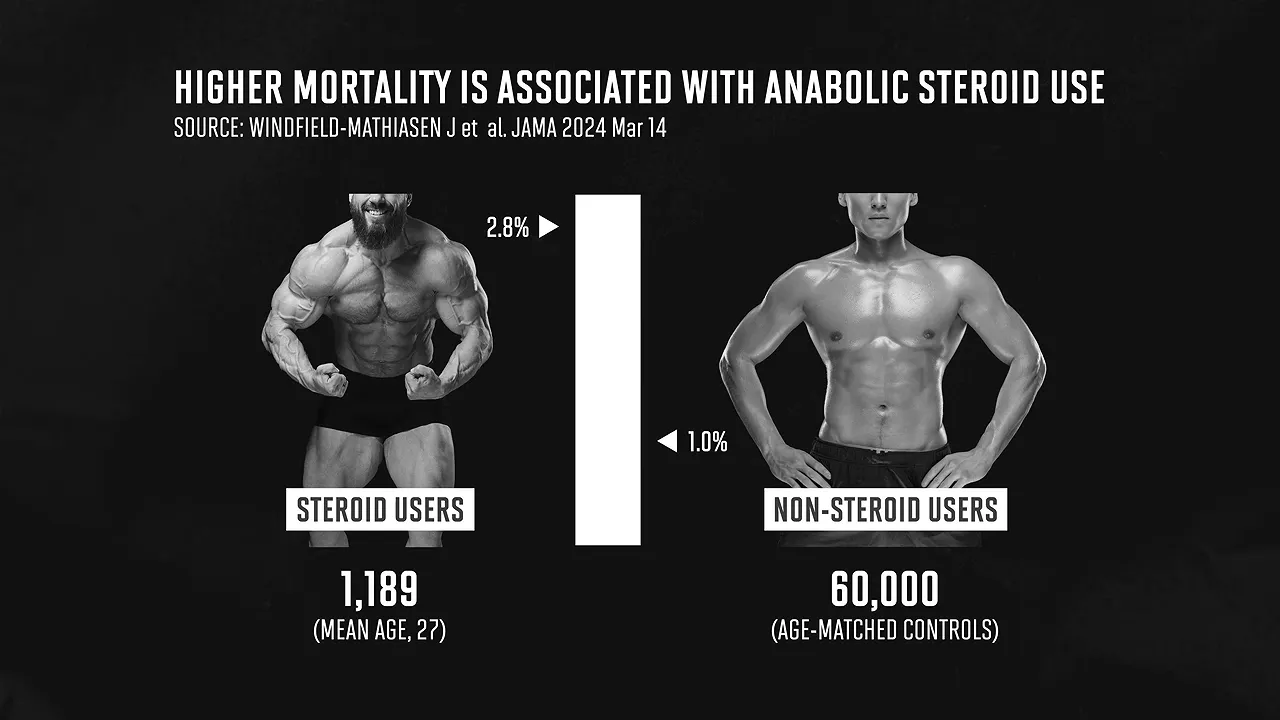
That is a striking difference in a relatively young population. Because this was observational research, the figures do not isolate the contribution of every possible factor or predict the outcome of a particular regimen. They do show why dismissing steroid use as merely a cosmetic choice is a mistake.
What About Low Doses or “Sports TRT”?
A common response is that all of this applies only to people taking huge amounts. What if someone uses a little testosterone and calls it “sports TRT”?
Derek’s concern is that testosterone replacement therapy and a small bodybuilding cycle are often treated as interchangeable terms. They are not the same thing.
He emphasized that a total testosterone result within a laboratory’s normal range does not, by itself, prove that someone is recreating their natural hormonal environment. A single number is not the whole picture.
Genuine treatment for a diagnosed medical condition deserves to be distinguished from using testosterone to improve a physique. Calling enhancement “TRT” does not resolve the risk-benefit question.
Safer does not mean safe
Mike framed risk as a spectrum. Medical involvement, bloodwork, blood-pressure monitoring, and appropriate cardiac assessment can help identify problems. Avoiding unnecessarily high exposure also matters.
But those precautions are not a guarantee, and a coach is not a substitute for a physician. There is no bloodwork checklist that turns nonmedical anabolic steroid use into a risk-free activity.
His analogy was racing a car at more than 200 miles per hour. Better engineering and protective equipment can make it safer. They do not make it safe.
That is the distinction worth keeping: risk management can reduce danger without eliminating it.
Why Teenagers Should Not Rush This Decision
One of the most concerning changes is how young some people are when they start considering steroids.
Mike raised two developmental concerns. Anabolic steroid exposure can accelerate growth-plate closure, potentially limiting final adult height. He also emphasized that the brain continues developing into young adulthood.
His personal threshold for even beginning a serious discussion about medically supervised enhancement was around age 25. That is his judgment, not a scientifically established birthday after which steroids become safe.
My own rule of thumb is to build at least 10 years of consistent natural training first. By then, you have had time to learn how your body responds to training and nutrition, and you are more likely to be in your mid-20s or older.
Neither threshold is a green light. The point is to avoid making a potentially lifelong decision before you have properly explored what you can accomplish naturally.
Have You Reached Your Natural Limit, or Just a Plateau?
I have been tempted to enhance at several points in my bodybuilding career. The pressure is real, especially as social media standards keep moving.
A physique that once sparked debates about whether it was naturally achievable can start to seem ordinary next to an endless stream of enhanced physiques. Your body does not have to get worse for your perception of it to change.
Instead of enhancing, I decided to question an assumption: have I actually reached my natural limit, or have I stopped training and eating as diligently as I could?
To investigate that, I began a year-long experiment with McMaster University in Canada to see how much muscle I could still build deep into my natural lifting career.
My commitments included:
- Tracking every training set.
- Taking the last set of every exercise to true technical failure, the point where another repetition with proper technique is not possible.
- Completing all planned workouts and sets.
- Logging food every day in MacroFactor.
- Consistently hitting my calorie and protein targets.
That describes my experiment, not a requirement that everyone train exactly the same way. At the time of this update, the full results were not available, but I had already noticed solid progress and received more comments about added size at my local gym than I had in years.
The lesson is not that everyone has unlimited natural growth left. It is that a plateau is not proof that you have exhausted your potential.
Before deciding that only steroids can help, give consistent training and nutrition a fair test. For many people, the next step is not a different hormonal environment. It is doing the fundamentals more diligently.
Put the Fundamentals Into Practice
For nutrition, MacroFactor is the tool I use to keep that commitment measurable. You log your food and body weight, and its algorithms use that information to estimate your energy needs and update calorie and macro targets each week.
It does not replace the work. It helps you make informed adjustments instead of guessing whether you are eating enough to support your goals.
Steroids are exceptionally effective at building muscle. That is exactly why an honest conversation about them has to include more than muscle. Before accepting the risks, make sure you understand the full trade-off and have not mistaken inconsistent execution for a natural limit.
This is educational information, not medical advice. I am not a physician. Speak with a qualified medical professional about hormone treatment, steroid use, or related health concerns.
|