If you want the best lifting advice, should you ask the biggest person in the gym?
I took that question to Pure Muscle + Fitness, a gym packed with bodybuilders who make me look pretty small. My plan was simple: ask whether they would take science-based training advice from someone with a lot less muscle, then look for something useful to offer.
The response was overwhelmingly positive. But the interesting part wasn't just that these massive lifters were willing to listen. It was how often their training already lined up with the principles I care about most.
There were small technique adjustments, a ridiculous bench press, some excellent examples of controlled lifting, and a few situations where my best advice was essentially: keep doing what you're doing.
Key Takeaways
- Science-based training combines research with individual experience, performance, and recovery.
- Pulley height can shift a cable lateral raise's challenge toward the stretched position.
- Controlled negatives and meaningful range of motion matter more than adding weight through deteriorating form.
- Technique changes should serve the target muscle and goal, not enforce one universal lifting style.
Table of Contents
- Science and Experience Aren't Opposing Teams
- Cable Lateral Raises: Change Where the Exercise Is Hardest
- A 550-Pound Bench Press: Sometimes a Cue Can Get in the Way
- Machine Rows: Control the Return Without Losing the Effort
- Assisted Pull-Ups: Leave Your Ego Off the Machine
- Front Squats: An Example That Didn't Need Fixing
- Back Thickness: Extend a T-Bar Row With Kelso Shrugs
- Training Frequency: Respect the Limits of General Advice
- Single-Arm Pulldowns: Small Details Can Still Matter
- The Biggest Lesson Wasn't a Technique Tip
Science and Experience Aren't Opposing Teams
Antoine Vaillant gave a pretty sensible answer to the opening question: learn from the big lifter, learn from the person who understands the science, and then test what works for you.
That attitude came up repeatedly. You don't have to agree with someone's entire training philosophy to pick up one useful adjustment. And being extremely advanced doesn't mean you've run out of things to learn.
The same humility needs to go both ways. If I'm offering advice to an elite bodybuilder or powerlifter, I shouldn't assume every difference between their technique and my preferred technique is a mistake.
The goal of science-based lifting is better results, not making every exercise look more scientific. Research helps guide decisions, but so do a lifter's experience, performance, goals, and response to training.
Cable Lateral Raises: Change Where the Exercise Is Hardest
With Morgan MacDonald, the first useful adjustment was to the pulley height on a cable lateral raise.
Most people set the cable at the bottom of the machine. That isn't automatically wrong, but it affects where the exercise creates the greatest resistance around the shoulder.
Here's the key idea: the cable creates its greatest turning effect when its line of pull is perpendicular to your arm. In other words, the cable and arm form roughly a 90-degree angle.
With a low pulley, that position tends to occur farther into the raise, when the side delt is more shortened. Raising the pulley to roughly hand height can shift more of the challenge toward the bottom, where the delt is more lengthened.
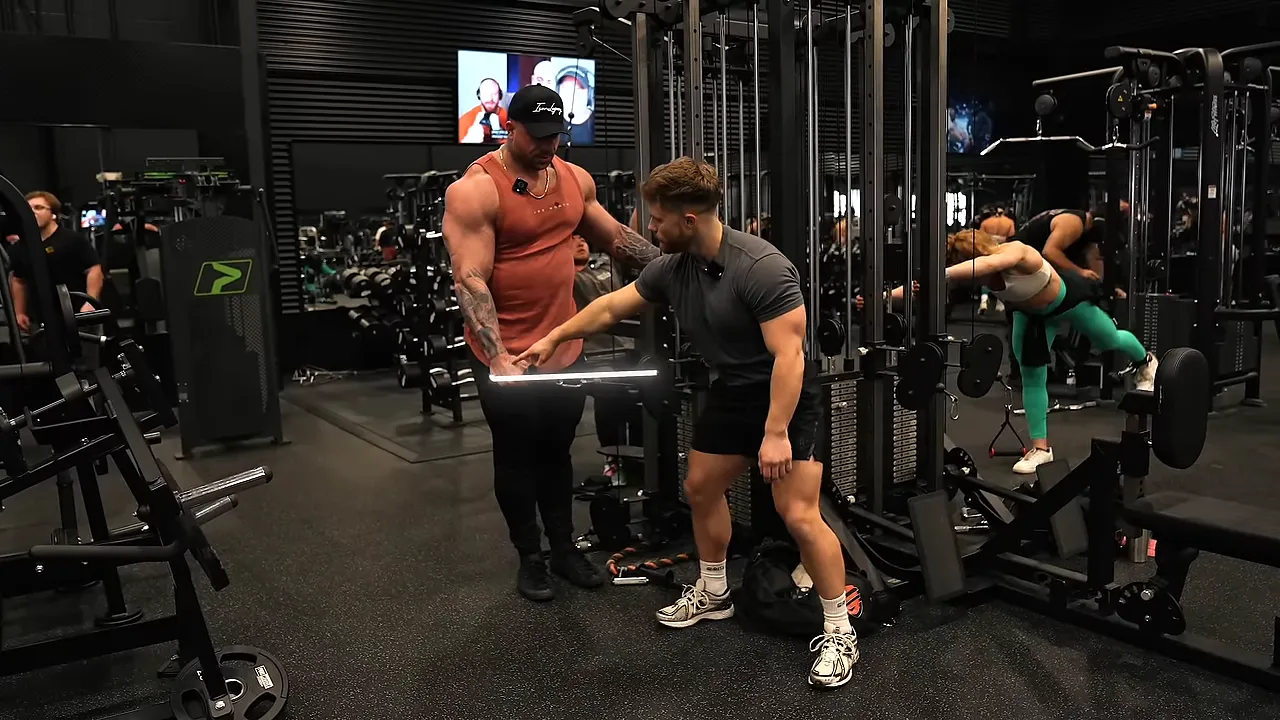
To try the adjustment:
- Set the pulley around the height of your hand in the starting position.
- Position yourself so the cable provides meaningful resistance near the bottom of the raise.
- Step slightly farther from the stack if needed to refine the starting angle.
- Raise your arm under control rather than turning the movement into a swing.
I'm interested in loading muscles in their stretched positions. That doesn't mean the stretch is the only thing that matters, or that a low-pulley lateral raise is useless. It means the resistance profile is worth thinking about.
Morgan already emphasized the stretched position in his training. This was a small setup change that fit what he was trying to accomplish, not an overhaul of his shoulder workout.
A 550-Pound Bench Press: Sometimes a Cue Can Get in the Way
Next came Dima, an exceptionally strong bench presser who was aiming for a junior world record.
He worked up from 495 pounds to 550 pounds. For context, that second lift was more than I'd ever deadlifted. So, yes, I was going to be pretty careful about declaring that his bench needed fixing.
His style was very direct: get set and move a huge amount of weight. It reminded me of elite deadlifters who seem to grab the bar and rip it off the floor. Their approach might not resemble a detailed technique tutorial, but their performance is hard to argue with.
The potential adjustment I noticed was leg drive. A cue worth exploring would be to push into the floor and away from yourself while pressing the bar up and back.
But there was an important catch. Dima explained that consciously thinking about small adjustments can distract him from the lift itself.
That's a real consideration. A cue can sound mechanically sensible and still make someone perform worse if it disrupts a well-practiced movement.
A possible improvement is something to test, not something to force. Especially with an elite performer, you need to weigh the theoretical benefit against what actually happens when they use it.
And one part of that session is absolutely not a recommendation: removing bench safeties. A huge lift isn't a reason to abandon appropriate safety precautions.
Machine Rows: Control the Return Without Losing the Effort
Valérie Ratelle demonstrated one of my favorite back exercises on a plate-loaded rowing machine. She had deliberately arranged the loading to give her resistance at the bottom and emphasized getting a good stretch.
Honestly, I had to get incredibly nitpicky to find anything to discuss. Her execution was excellent.
- She brought her shoulder blades together as she rowed.
- She let them move apart as she returned to the stretched position.
- She controlled the lowering phase instead of letting the weight fall.
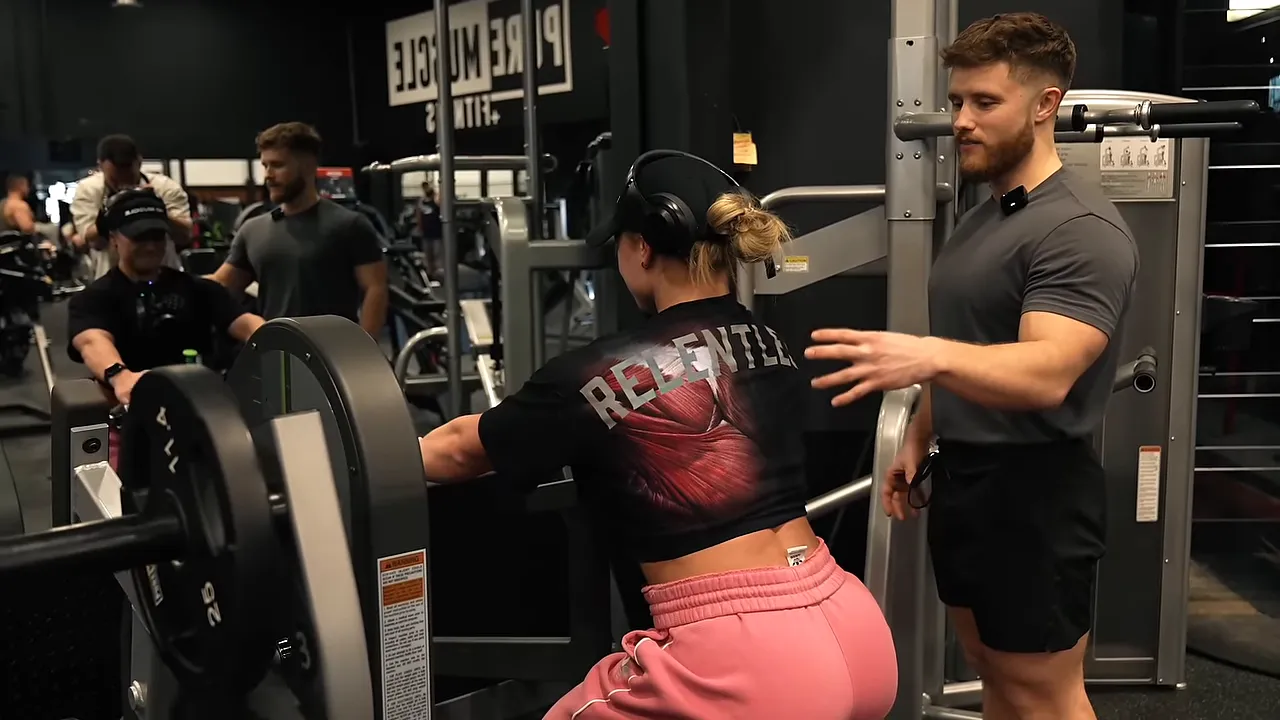
A lot of people think only about getting the weight up. Once they've completed the pull, they more or less drop back into the starting position. But the lowering phase is part of the repetition, not just a reset between the important bits.
Valérie maintained tension and control through that return. That's the quality I want to preserve as the load increases.
More Weight Doesn't Always Mean More Progress
If you add weight but shorten the movement, use more momentum, and lose control, the number on the machine has improved. Your ability to perform the same exercise hasn't necessarily improved.
There is an opposite extreme, though. You can become so obsessed with perfect form that the movement loses all its effort and intent.
Good technique should support hard training, not replace it. Be precise, but keep some oomph in the movement. Valérie was a great example of both qualities existing together.
Assisted Pull-Ups: Leave Your Ego Off the Machine
Eiren Gauley wanted to bring up his back width. He also weighed about 345 pounds, which makes a pull-up a very different proposition from what it is for a much lighter lifter.
He used an assisted pull-up machine, and his technique was excellent. The two main things I look for were both there:
- A substantial range of motion, including the stretched position at the bottom.
- Control on the negative, without using a big hip swing to keep moving.
Some lifters treat assistance like an admission that they aren't strong enough. I think that's the wrong way to evaluate it.
I'm much lighter than Eiren and can do plenty of bodyweight pull-ups, but I sometimes connect with my lats better when I use assistance. It can make it easier to stay stable and focus on the muscle I'm trying to train.
The point isn't to prove that you don't need the machine. The point is to get a productive back-training stimulus.
Upright or Chest to the Bar?
Eiren arched back somewhat as he pulled, aiming to bring his chest toward the bar. That's not inherently a technique error. It changes the emphasis.
As you lean back and squeeze your shoulder blades together, you bring more mid-back involvement into the exercise. Staying more upright can put a greater emphasis on bringing the upper arms down toward your sides, with relatively less emphasis on that shoulder-blade squeeze.
For someone prioritizing lat width, the more upright version is worth exploring. For someone using pull-ups as a broader back exercise, some backward lean may fit the goal perfectly well.
Different execution doesn't automatically mean worse execution. First ask what the exercise is supposed to accomplish.
Does a 345-Pound Bodybuilder Need 400 Grams of Protein?
Eiren reported eating roughly 6,500 to 7,000 calories per day, with protein just under 400 grams. Amazingly, he described that calorie intake as lower than usual.
My general protein guideline for building muscle is around 0.7 to 1 gram per pound of body weight per day. At his size, roughly 340 to 350 grams would already put him around the upper end of that range.
He could probably consume somewhat less protein without sacrificing muscle-building results. That isn't a demand to change a diet that suits him. It's a reminder that more protein doesn't necessarily produce more growth indefinitely, a point explored in this meta-analysis of protein supplementation and resistance training.
Front Squats: An Example That Didn't Need Fixing
Manon Dutilly wanted to improve her legs. After a little clarification across a language barrier, she showed me her front squat.
There really wasn't much to criticize:
- Her walkout was efficient.
- Her front-rack position was solid.
- She kept her elbows up and her chest tall.
- She reached excellent depth.
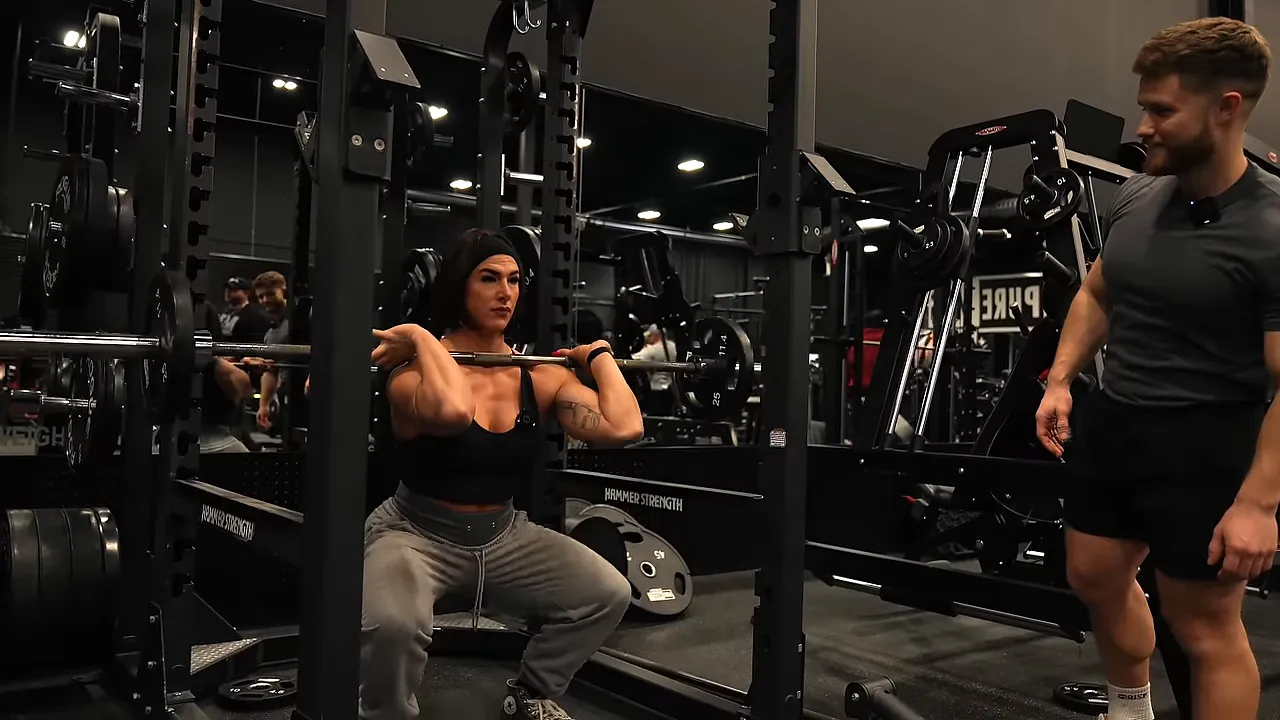
A common front-squat issue is letting the elbows drop and the upper body fold forward. Another is loading so much weight that the movement becomes a half squat. She wasn't doing either.
Her programming also sounded reasonable for the goal: two leg sessions per week, with about 10 sets per session, or roughly 20 weekly sets.
That isn't a universal prescription for everyone. It simply meant that, based on what she showed and told me, I didn't have an obvious change to recommend.
Sometimes an honest assessment ends with: that looks great.
Back Thickness: Extend a T-Bar Row With Kelso Shrugs
Hassan Mostafa was interested in improving his mid traps and back thickness. For that, I suggested a T-bar row that transitions into a Kelso shrug.
The idea is to keep training the muscles that move the shoulder blades after you can no longer complete full rowing repetitions.
- Perform your T-bar rows with the elbows flared roughly 45 degrees from your torso for a mid-trap emphasis.
- Continue until you can no longer complete another full row.
- Leave your arms straight rather than trying to bend the elbows again.
- Squeeze your shoulder blades together to lift the weight through a smaller shrugging movement.
- Let the shoulder blades move apart under control and repeat while you can maintain the intended movement.
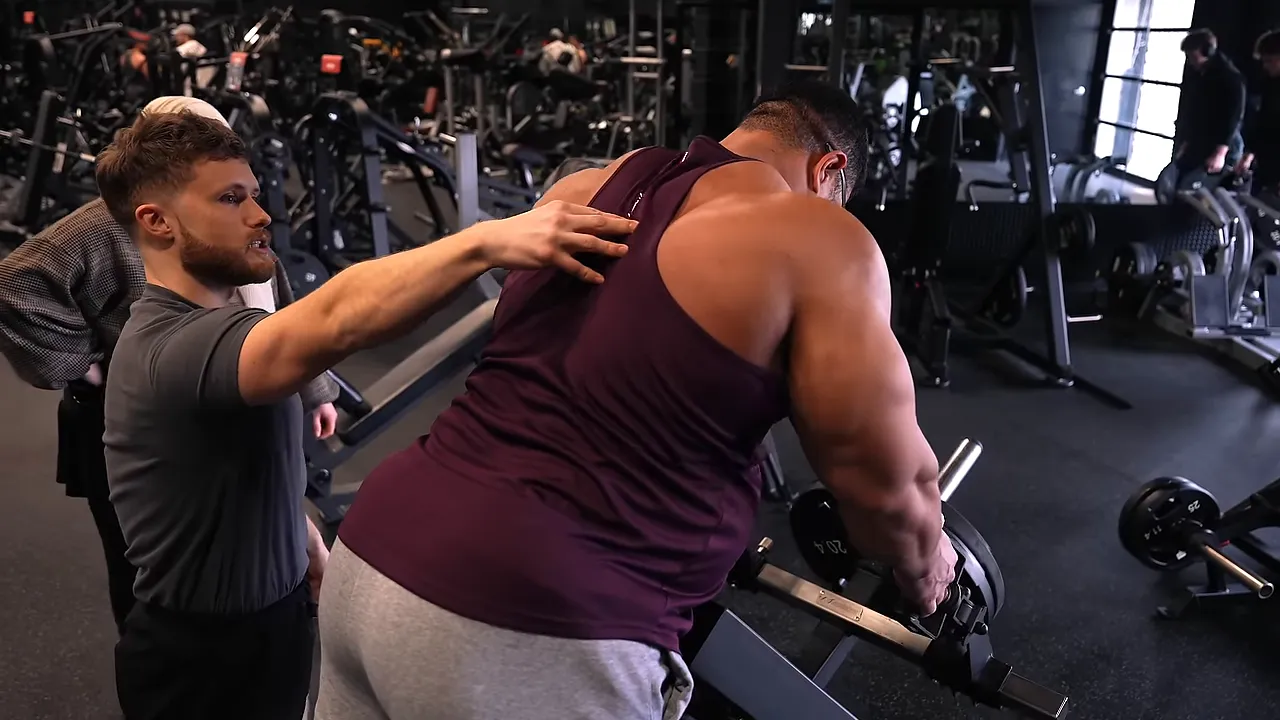
This isn't an upward shrug toward your ears. Think about squeezing the shoulder blades together while your chest stays supported.
Keeping the elbows very tucked during the rowing portion would shift the emphasis more toward the lats. The somewhat flared position fits Hassan's goal of targeting his mid back.
This is an extended-set technique: you've exhausted your ability to perform the full row, but you can still perform the simpler shoulder-blade movement. It gives you a way to get additional work for the mid traps without pretending those smaller movements are full rowing reps.
Training Frequency: Respect the Limits of General Advice
When I asked Quinton about weak points, he said he was hypercritical of pretty much everything. Standing next to him, I was having a much harder time finding anything that looked underdeveloped.
One area he was emphasizing was his lats. He trained four days per week, hitting most body parts once weekly and biceps twice.
My first question was about recovery. Did he genuinely need six or seven days before training his lats again, or could he be ready after three or four?
He explained that he and his coach were experimenting with a lower-volume, very high-intensity approach. With how hard he was training, he felt he needed the longer recovery period to deliver another good session.
That's important context. Much of the training-frequency research doesn't involve people anywhere near his level of muscular development.
I was open to the possibility that someone that advanced, using very heavy loads and training extremely hard, could need longer between sessions. That was a plausible explanation for his experience, not proof of a universal rule that bigger lifters must train less frequently.
Use research to guide your questions, then pay attention to the individual answers. A recommendation should account for whether the lifter can recover and perform, not just whether their split resembles your favorite schedule.
Single-Arm Pulldowns: Small Details Can Still Matter
Quinton's single-arm pulldown was another example of an advanced bodybuilder already doing the fundamentals exceptionally well.
He drove his elbow down, kept his torso stable, controlled the return, and avoided turning the movement into a big shoulder-blade squeeze. Those choices matched his goal of emphasizing the lats.
Two smaller details were worth discussing.
Keep the Wrist From Curling
On one side, his wrist curled a little more as he pulled. When he adjusted that, he reported feeling a noticeably stronger contraction.
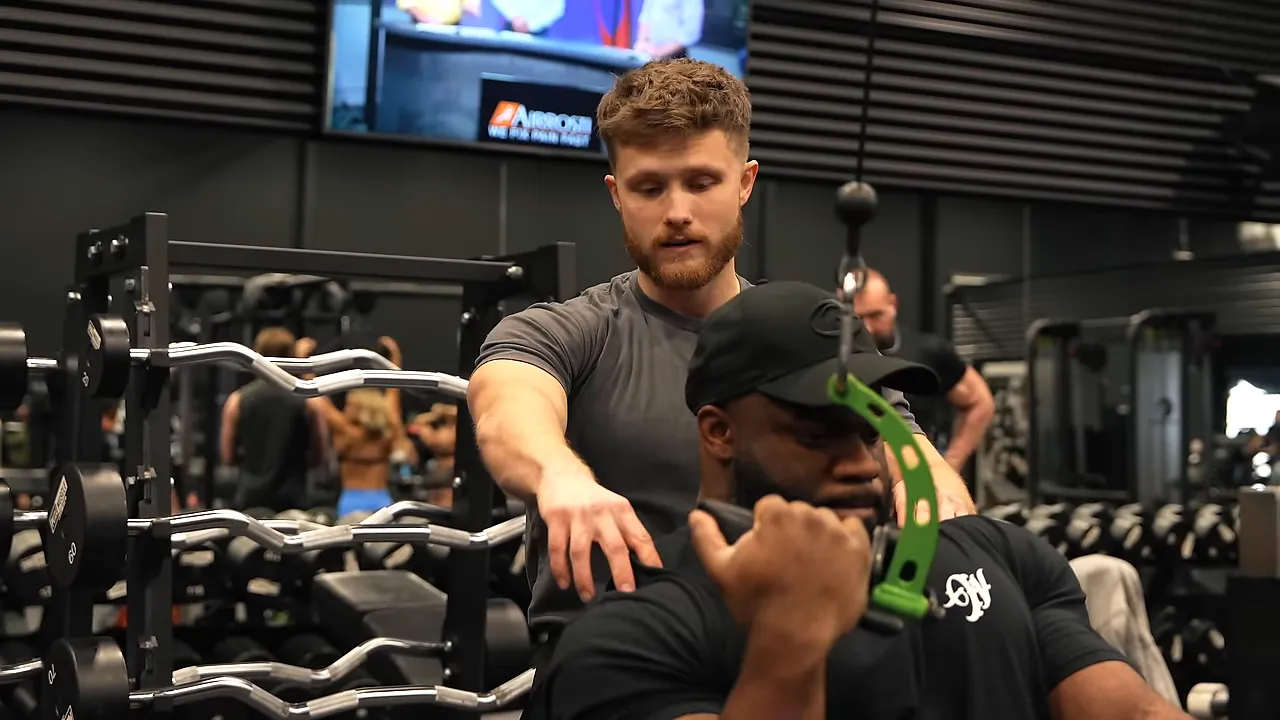
I described unwanted joint movement as tension leaking away from the intended task. That doesn't mean a little wrist movement switches your lats off. It's a practical cue: keep the hand and wrist stable enough that you can focus on moving the upper arm.
For him, a tiny adjustment made an immediate difference in how the exercise felt.
Don't Chase Extra Range Behind Your Torso
If your goal is lat emphasis, there's no need to force the elbow far behind your body at the bottom of a pulldown.
As the upper arm travels farther behind the torso, the movement becomes less useful for the intended lat-focused action and can shift toward other back muscles. Extra motion isn't automatically extra productive range of motion.
Think about driving the elbow down rather than dragging it as far backward as possible. Keep the shoulders square and avoid rotating your body to manufacture another few inches.
The Biggest Lesson Wasn't a Technique Tip
I went in asking whether people much bigger than me would accept science-based advice. They did. But I also came away with plenty of examples of when not to change something.
There was a useful cable-height adjustment, a back-training intensity technique, and a small wrist correction. There were also excellent rows, pull-ups, and front squats that didn't need to be rebuilt.
The common thread was openness. These lifters were willing to hear an idea, try it, and decide whether it helped. I needed to be equally willing to recognize their expertise and leave good training alone.
Learn from research. Learn from experienced lifters. Test changes against your goals and results. That's a much better approach than deciding the biggest person always knows best, or that the person citing science always does.


