Science-based lifting is supposed to mean using research to make better training decisions. Pick effective exercises, track your progress, and train hard enough to stimulate muscle growth without creating more fatigue than you can recover from.
That is basically how I have trained for the last 10 years. I am not giving up on it.
But some of the criticism of science-based training is fair. The label has become associated with super slow negatives, endless technique tweaks, perfectly identical reps, and a handful of supposedly “optimal” exercises. A lot of those ideas are less scientific, and less important, than they appear.
I have contributed to that confusion, especially with how I have presented exercise rankings. So here is the distinction I want to make: using science to guide your training is valuable. Treating every coaching preference as a scientifically proven requirement is not.
The biggest priorities are much simpler: train hard, do enough volume, and keep showing up. The details can help, but they should not get in the way of the work.
Key Takeaways
- Training effort and sufficient weekly volume matter more than small technique tweaks or exercise rankings.
- Control the lowering phase without assuming that slower negatives automatically produce more muscle growth.
- Keep most working sets within one to three reps of failure.
- Build a sustainable routine first, then refine the details without chasing perfect training.
Table of Contents
- Slow Negatives Are Not Automatically Better for Muscle Growth
- Technique Tweaks Need an Evidence Check
- Perfect Technique Can Become a Distraction
- “Optimal” Exercises Are Tools, Not Magic
- Training Hard: Get Close Enough to Failure
- Training Volume: How Many Sets Do You Actually Need?
- Your Training Does Not Need to Be Perfect to Work
Slow Negatives Are Not Automatically Better for Muscle Growth
The negative, or eccentric phase, is the part of a lift where you lower the weight. One of the most common pieces of science-based lifting advice is to slow that phase down.
But does a slower negative actually build more muscle?
Consider three comparisons:
- Preacher curls: One group used a one-second negative and another used a four-second negative. After seven weeks, muscle growth was similar.
- Squats: Two-second negatives produced similar growth to four-second negatives.
- Single-leg extensions: A leg trained with a one-second negative grew similarly to a leg trained with a three-second negative.
These studies do not support the idea that stretching a normal one- or two-second negative into three or four seconds automatically increases hypertrophy. You can explore the research on eccentric duration for more context.
Why slowing down can still be useful
I asked Dr. Mike Israetel about this because he often coaches slower negatives. His reasoning was more nuanced than simply claiming they produce more growth.
He sees slower lowering as a way to improve control, help a lift feel safer, and make it easier to feel the target muscle working. That can be especially useful when someone is learning an unfamiliar exercise or technique.
But when I asked how long his own negatives typically take, his answer was roughly one to two seconds. That is not especially slow. It is simply controlled.
We were much closer on this than I expected. The goal is to control the weight, not win a competition for the slowest rep.
A practical tempo guideline
A review of resistance training technique I coauthored concluded that total repetition durations of roughly two to eight seconds leave considerable room for personal preference. That is the whole rep, not just the negative.
For the lowering phase specifically, my practical guidance is:
- Less than one second: Slow down if you are dropping the weight rather than controlling it.
- Roughly one to seven seconds: There is room for preference, although one to two seconds is often enough.
- Eight seconds or longer: You are probably taking the slow-negative idea too far and would benefit from speeding things up.
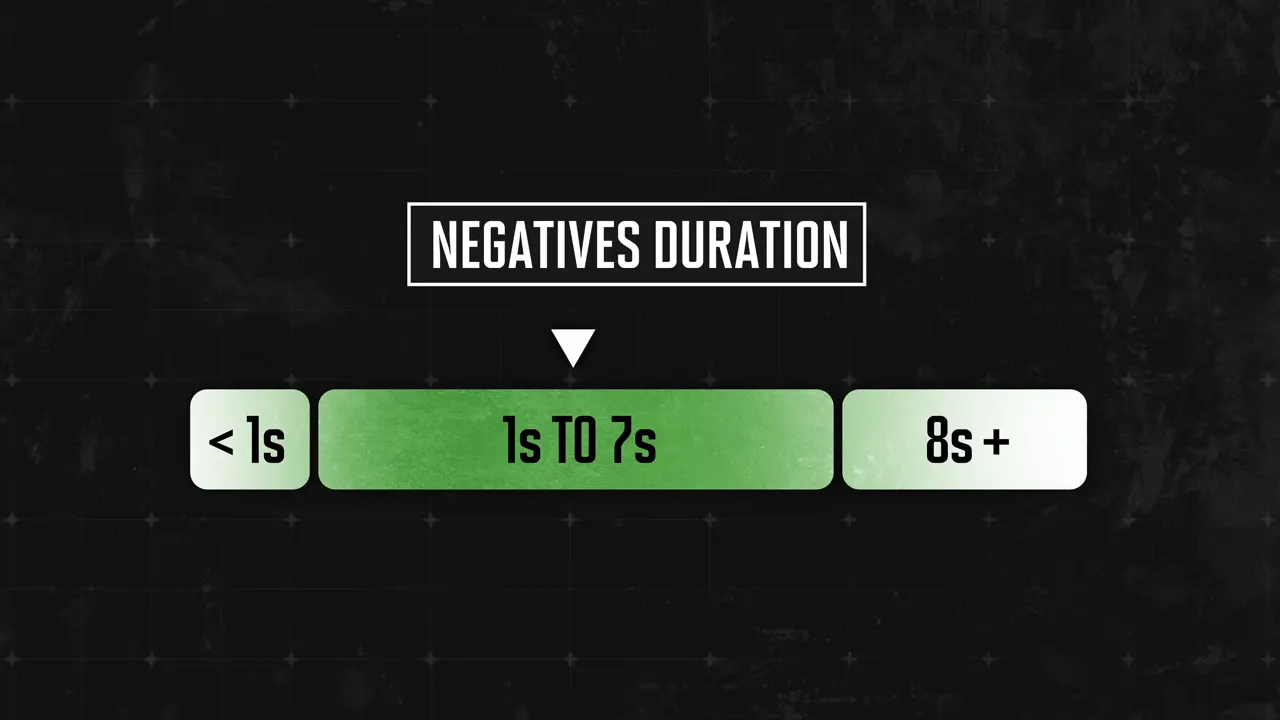
I am not quitting slow negatives. I am quitting the idea that you need really slow negatives to maximize muscle growth.
Technique Tweaks Need an Evidence Check
I use small exercise modifications myself. I set the seat back on leg extensions, emphasize the stretched half of calf raises, and raise the cable height for cable lateral raises.
But social media takes this much further. There is always a new grip, angle, stance, or setup that supposedly unlocks gains you have been missing.
Those recommendations do not all deserve the same confidence. I would separate them into three categories:
- Supported by direct evidence: Research has actually tested the relevant technique modification and measured muscle growth.
- Supported by indirect evidence: Biomechanics or related research gives us a plausible reason it might help, but the hypertrophy benefit has not been directly established.
- Unsupported or probably unimportant: There is little scientific basis for expecting a meaningful advantage.
This distinction matters. An educated guess can be useful coaching advice, but it is still a guess. It should not be presented with the same certainty as a directly tested finding.
More importantly, even useful technique tweaks usually have a relatively minor impact compared with effort and training volume. A clever cable setup will not compensate for consistently stopping your sets too early or barely training the muscle.
Refine your exercises if you enjoy it. Just keep those refinements in their proper place.
Perfect Technique Can Become a Distraction
Picture two people doing curls. One stays almost perfectly still. The other uses some body movement to help finish the reps.
Most people would call the first approach more science-based. But looking more controlled does not, by itself, prove that a technique produces more hypertrophy.
At the time I made this argument, direct research comparing strict reps with looser cheat reps was missing. I was helping run a study at Lehman College to investigate that question. Until direct evidence answers it, claiming that perfectly strict form is scientifically superior goes beyond what we know.
That does not mean technique is irrelevant. It means we should distinguish basic execution principles from an obsession with perfection.
Get the important basics right
On a squat, I would prioritize:
- Keeping the bar approximately over the middle of your foot so you stay balanced.
- Maintaining a relatively neutral spine without panicking over a little pelvic movement at the bottom.
- Squatting as deeply as you comfortably can.
There is direct research on squat depth and lower-body muscle growth, and deeper squatting appears beneficial for quad and glute development.
By comparison, your exact toe angle, stance width, or thumb position will probably make a much smaller difference to your gains. Those adjustments can make the lift more comfortable, which is useful. But they are not secret switches for muscle growth.
The same applies to lat pulldowns. You do not need to discover the one perfect grip width and elbow path before your back can grow.
- Take a comfortable grip.
- Secure yourself under the thigh pads.
- Pull the bar toward your chest.
- Control the return.
- Push the set hard.
There is nothing wrong with trying a closer grip or leaning back slightly to change the emphasis. Coaching should combine science with experience. We just need to be honest about where the direct evidence ends and the practical judgment begins.
Your last rep does not have to look exactly like your first
Suppose your first pulldown rep reaches your chest. By rep 10, the bar stops about an inch short.
Do you have to end the set immediately because the rep looks different?
In my opinion, no. That small reduction in range of motion does not necessarily mean the target muscle has nothing productive left to do. Stopping at the first tiny deviation could leave several challenging reps unfinished.
This is something I appreciate about Sam Sulek’s pulldown style: he continues working after a full rep is no longer possible. When you push genuinely hard, the final reps may look a little less tidy.
Some imperfection at the end of a hard set is different from letting your technique become progressively sloppier over time.
You still want reasonably consistent execution from week to week. Otherwise, adding weight or reps might reflect more momentum and less range of motion rather than greater performance from the target muscle. You can still make gains with loose technique, but your logbook may exaggerate how much you are progressing.
“Optimal” Exercises Are Tools, Not Magic
Exercise selection is probably the area most strongly associated with science-based lifting. It is also an area where I need to clarify my own messaging.
In my back exercise rankings, I placed the half-kneeling one-arm cable lat pulldown in S tier and the bent-over barbell row in B tier. Understandably, some people interpreted that as meaning the cable exercise would build a bigger overall back.
That was not what I meant.
If I had to choose just one of those exercises for the rest of my life, I would choose the barbell row. It trains a broader range of back musculature, while the one-arm pulldown is a more targeted tool for the lats.
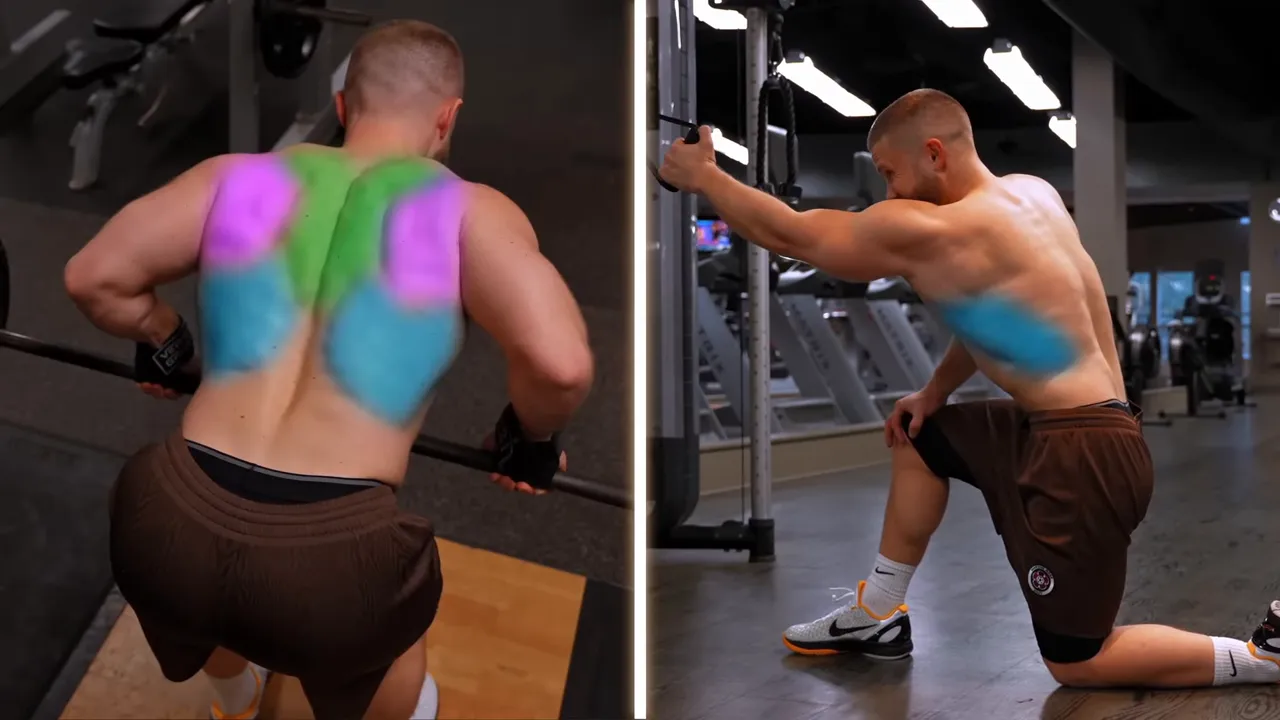
Choose the exercise for the job
- Limited time and a need for broad back training: The barbell row offers a lot of bang for your buck, especially if strength is also a priority.
- Extra lat work after your compound exercises: The one-arm cable pulldown can add targeted volume with very little additional whole-body fatigue.
- A row with a bigger stretch and a more standardized range of motion: I like the deficit Pendlay row.
- A row with more stability and less fatigue from supporting your torso: A chest-supported machine row can be a great option.
My lower ranking for the barbell row reflected my preference for other tools doing a similar job, not a belief that the barbell row is ineffective.
I should have made that clearer.
Exercise rankings contain more judgment than people realize
The direct hypertrophy research on exercise selection is much thinner than many people assume. When I made those back rankings, I was not drawing on head-to-head studies measuring back growth from every exercise.
Much of the reasoning came from biomechanics, muscle activation research, and personal experience. And surface EMG has not been validated as a predictor of long-term hypertrophy. A higher muscle activation reading is not proof that an exercise will produce more growth.
A better interpretation of my rankings is “slightly more effective for the intended job” versus “slightly less effective,” rather than “scientific” versus “bro science.”
The useful questions are whether an exercise loads the muscle well, provides tension through a useful range, allows progression, and feels good for you.
A suitable exercise performed close to failure can build muscle without being the single most optimal choice on paper. Exercise selection matters, but effort and sufficient volume generally deserve more attention.
Training Hard: Get Close Enough to Failure
This is where hypertrophy science becomes much more useful.
A meta-analysis on proximity to failure pooled 15 studies examining muscle growth from training to failure versus stopping short. The practical picture is that getting closer to failure matters, but constantly reaching failure can create recovery demands that are not always worth it.
For most working sets, I think finishing about one to three reps shy of failure is a good target. These remaining possible reps are commonly called reps in reserve, or RIR.
The problem is estimating them accurately.
You might think you stopped with three reps left when you actually had five or six. If that happens repeatedly, your sets may be less stimulating than you think.
That is why I tend to get slightly closer to failure than I probably need to:
- I usually leave about one or two reps in reserve on most sets.
- On the final set, I often go to failure if it is an exercise I can safely fail on.
This is not a command to fail every set of every lift. It is a way to keep effort high without automatically turning every set into the most fatiguing version possible.
Think of effort as your training quality. The number of hard sets you perform is your training quantity. For maximum gains, you need both.
Training Volume: How Many Sets Do You Actually Need?
For this discussion, training volume means the number of hard sets you perform per muscle per week.
To give those numbers some context:
- Low volume: Fewer than 10 weekly sets per muscle. Five chest sets per week would fit here.
- Moderate volume: Roughly 10 to 19 weekly sets.
- High volume: Roughly 20 to 29 weekly sets.
- Ultra-high volume: Around 30 or more weekly sets.
A volume meta-analysis covering 35 studies found that higher volume was associated with greater muscle growth, with the modeled relationship extending as high as 42 sets per muscle per week.
That is an enormous amount of work. It is also important not to mistake the upper end of a research model for a universal recommendation.
More work brings diminishing returns
The relationship is not linear. Adding more sets can provide additional growth, but the benefit gets smaller as volume rises. You are doing increasingly more work for increasingly smaller potential returns.
There is another important limitation: most of these studies lasted roughly six to 10 weeks. Higher volume can work well over that timeframe, but we do not know with the same confidence how those very high volumes compare over much longer periods.
For most people, my practical sweet spot remains eight to 20 hard sets per muscle per week.
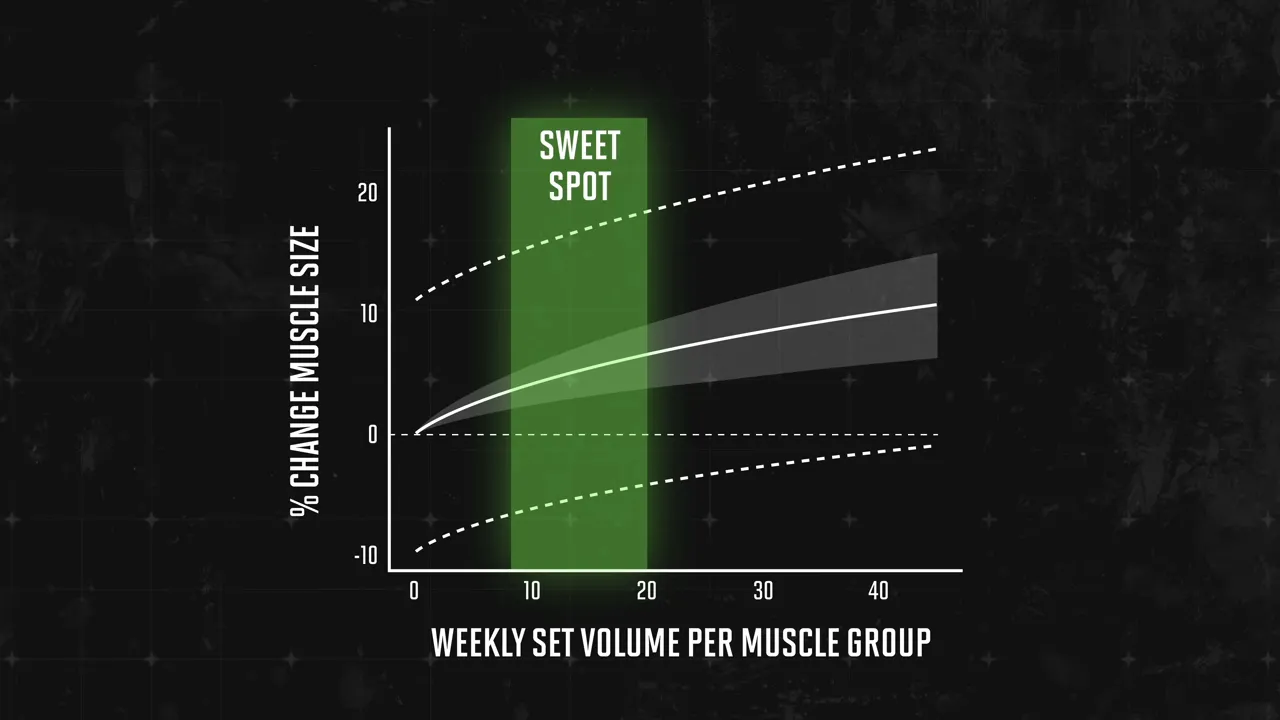
Use high volume strategically
If you want to bring up a lagging muscle, a short specialization phase can make sense.
For example, you could increase chest training toward 30 weekly sets for a month or two while reducing volume for other muscle groups. The reduction elsewhere is important. You are reallocating your recovery capacity, not simply piling more work onto an already demanding program.
That is very different from recommending 30 sets for every muscle, all the time.
Low volume still counts
If you do not have all day to train, there is good news: even about four hard sets per muscle per week can produce growth.
That may not maximize every last bit of hypertrophy, but it can absolutely get the job done when those sets are challenging. There is a big difference between the minimum effective amount and the amount you might do when chasing maximum possible gains.
Do not let an ambitious volume target convince you that a smaller, sustainable routine is pointless.
Your Training Does Not Need to Be Perfect to Work
I enjoy figuring out the details of training. There is nothing wrong with being curious about rep tempo, exercise mechanics, or the best way to arrange a program.
The problem starts when curiosity turns into paralysis by analysis.
You do not need every variable solved before you can make progress. A program that looks optimal on paper but makes you dread the gym may be less useful than a slightly less optimized program you consistently enjoy.
It is fine to occasionally loosen your adherence to a prescribed effort rating and train more by feel. It is fine to choose a workout because it is fun. A few cheat reps at the end of an appropriate exercise do not automatically put you in conflict with smart training.
Smart training is mostly about doing challenging work consistently, not making every rep look scientifically perfect.
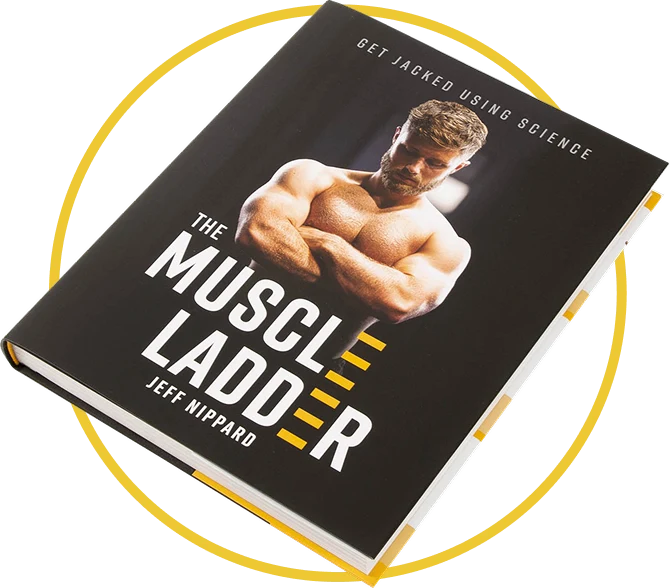
That is why my book, The Muscle Ladder, begins with sustainability and then mindset. Those principles form the rails of the ladder. Technique, exercise selection, effort, volume, and the other training variables make up its 10 rungs. The hardcover includes full-color images and diagrams, along with 20 training programs.
The details matter more when you have a structure you can actually maintain. Get the basics working first. Then refine them without losing sight of why you train.
|
The previously announced 2025 MacroFactor Transformation Challenge is now closed.


