More work does not automatically mean more muscle. Some training takes up time and energy without adding much, if anything, to your results. In bodybuilding, we call that junk volume.
Volume is the amount of training you do, usually measured as the number of hard sets. Effective volume provides a useful stimulus for muscle growth. Junk volume adds work without enough benefit to justify the fatigue and recovery cost.
I think the evidence makes a pretty clear case that junk volume is real, and that it holds a lot of lifters back. The three most common forms are excessive volume in a single workout, sets that are too easy, and ultra-high-rep sets. Avoiding them is not about finding an excuse to train less. It is about making your training count.
Key Takeaways
- Additional sets offer diminishing returns, so distribute demanding weekly workloads across multiple sessions.
- Keep most hypertrophy sets within zero to three reps of failure.
- Adjust training volume based on your effort, progress, and recovery.
- Ultra-high-rep sets can add fatigue without providing an extra muscle-building benefit.
Table of Contents
- 1. Excessive Volume per Workout
- 2. Sets That Are Too Easy
- 3. Ultra-High-Rep Sets
- How to Cut Junk Volume Without Cutting Your Results
1. Excessive Volume per Workout
Imagine you are training chest with the flat dumbbell press. After warming up, you perform eight to ten controlled reps, finishing within one or two reps of failure. Your pecs are lengthening and shortening under load, generating mechanical tension. That is a productive working set.
A second hard set can provide more stimulus. So can a third. But does doing ten sets produce ten times as much growth as doing one?
Probably not. The benefit of each additional set diminishes. Eventually, you can reach a point where more sets mostly add fatigue rather than a meaningful amount of extra growth.
How many sets per muscle per session?
James Krieger’s analysis of training volume and muscle growth pooled results from nine studies. The average trend showed a clear benefit from adding sets up to roughly six sets per muscle per workout. Beyond that, the curve largely flattened and even dipped slightly.
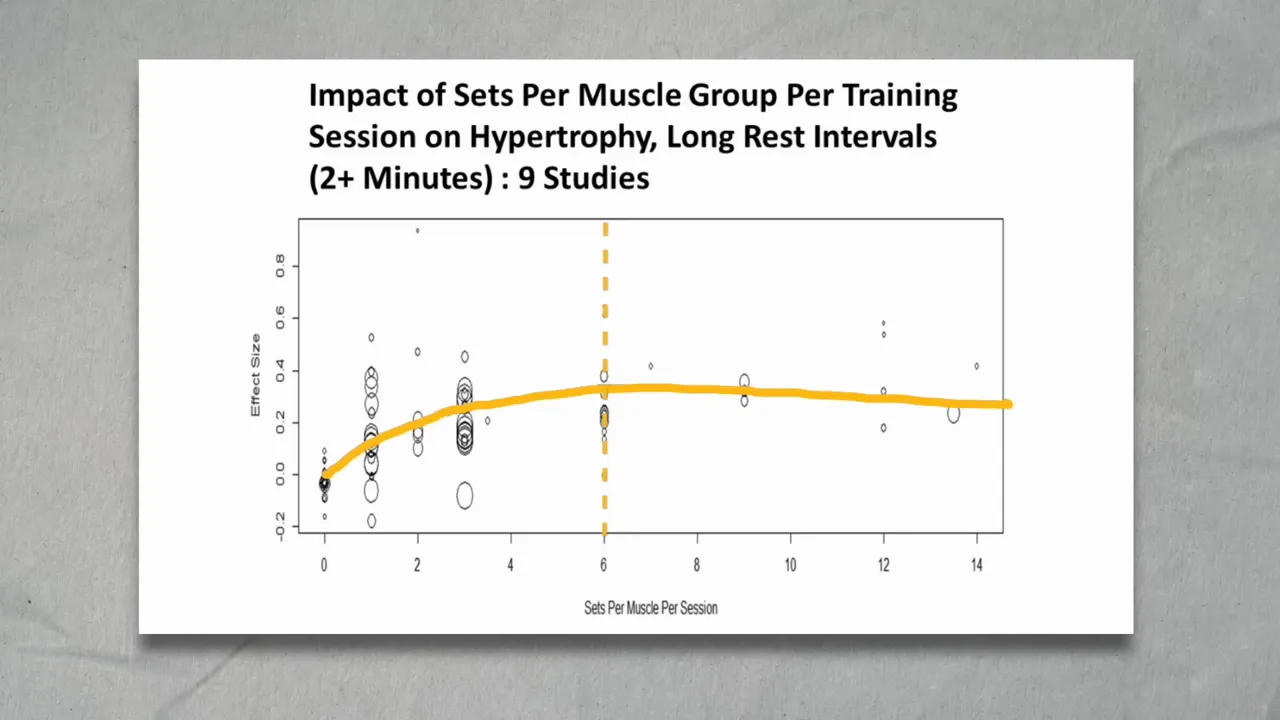
That is different from weekly volume. I still consider roughly 10 to 20 sets per muscle per week a useful sweet spot for many lifters. The question here is how much of that work you should put into a single session.
For chest, doing 10, 12, or 14 sets in one workout may not provide much more growth than doing six to eight good sets. At some point, the extra work could become counterproductive because it makes recovery harder.
Those sets do not all need to come from one exercise. A chest session could include:
- Three hard sets of flat dumbbell presses.
- Three hard sets of incline cable flyes.
That is six working sets for the same muscle, even though you used two exercises. Adding three sets of machine presses and another three sets of push-ups does not reset the clock. For many people, some of that extra work will deliver very little additional benefit.
If you feel you need more volume to keep progressing, you have two useful options: distribute the extra sets across another workout, or keep volume where it is and improve your technique, execution, and effort per set.
Six sets is a starting point, not a universal cutoff
There is a lot of variation in the data. The trend line describes an average, not a rule that applies identically to everyone.
Some people may continue benefiting from 10 or 12 sets for a muscle in one session, possibly more. Others may reach diminishing returns sooner. Use the average as a starting point, then adjust based on your progress and recovery.
There are three important qualifications:
- Effort changes how much volume you can tolerate. If you take every set to absolute failure, your useful volume ceiling will likely be lower. The six-set guideline assumes hard sets close to failure, not every set pushed to the absolute limit.
- It is not a minimum. You do not need six sets every time you train a muscle. Smaller doses can work very well when your weekly total is sufficient.
- Different muscles may respond differently. Based on my coaching experience, the back, glutes, and quads often seem to tolerate and benefit from more volume.
For example, you could train biceps with three sets of EZ-bar curls on Monday, three sets of incline curls on Wednesday, and four sets of hammer curls on Friday. That gives you 10 weekly sets without needing a large amount of work in any one session.
For the back, glutes, and quads, I would speculate that a useful per-session upper range may be closer to 10 to 12 sets, compared with roughly six to eight for other muscles. That is a coaching-based estimate, not a muscle-by-muscle threshold established by the analysis.
Why spreading your sets out can help
This is one reason I generally prefer distributing training across the week rather than cramming all the work for a muscle into one day.
Take a traditional chest day with 20 sets. I doubt the second half of that workout adds much noticeable growth for most people. It may not be doing absolutely nothing, but that does not make it an efficient use of your time or recovery.
Splitting those same 20 sets into 10 on Monday and 10 on Thursday would reduce the amount of work performed deep into diminishing returns. Ten sets may still exceed the most productive range for some lifters, but spreading the work out is a step in the right direction.
There is an important distinction between the research and my practical interpretation here. Research comparing training frequencies shows that body-part splits can still work well when weekly volume is matched. A bro split is not automatically ineffective.
My concern is efficiency as training demands increase. If you need more weekly volume to continue progressing, stacking every additional set onto one day becomes less appealing. An upper/lower split, push/pull/legs split, full-body routine, or hybrid approach gives you more opportunities to distribute that work.
2. Sets That Are Too Easy
For casual lifters, I think this is probably the most common form of junk volume. You can have a reasonable number of exercises and sets on paper, but if those sets are nowhere near challenging enough, the routine may not provide the stimulus you think it does.
The problem is that people are not always very good at judging how many reps they have left.
Your usual 10-rep weight might not be a 10-rep challenge
In a study examining self-selected training loads, participants chose a bench press weight they would normally use for 10 reps. The researchers then asked them to perform as many reps as they could with that weight.
The results were revealing:
- 22% completed 10 to 12 reps. Their usual set of 10 would leave approximately zero to two reps in reserve.
- 31% completed 13 to 15 reps. Their usual set would leave approximately three to five reps in reserve.
- 47% completed 16 to 20 or more reps. Their usual set would leave approximately six to ten or more reps in reserve.
Reps in reserve, or RIR, means how many additional reps you could complete before reaching failure. If you stop at 10 but could have reached 18, you have about eight reps in reserve.
I would not call every set performed three to five reps from failure junk. That work can still build muscle, especially across multiple sets. But if it dominates your routine, I think you may struggle to keep progressing beyond the beginner or early intermediate stage.
Consistently stopping six to ten or more reps short is a different story. For a lifter trying to maximize hypertrophy beyond the newbie phase, that is the kind of low-effort work I would put in the junk-volume category.
Keep most hypertrophy work within zero to three reps of failure
My practical recommendation is to perform most muscle-building sets within zero to three reps of failure.
That does not mean every set needs to be an all-out effort. Remember that taking everything to failure also reduces how much volume you can recover from. The goal is to train hard enough to produce a strong stimulus without treating every set as a test of your absolute limit.
I also think it is useful to take some sets all the way to failure. Two approaches are:
- Taking the last set for a muscle to failure, as Dr. Brad Schoenfeld recommends.
- Taking sets to failure during the final week of a training block, as Dr. Mike Israetel recommends.
The larger point is simple: adding sets is not a good substitute for making your existing sets sufficiently challenging. Before deciding that your program needs more volume, make sure your effort is where it needs to be.
3. Ultra-High-Rep Sets
The final category is sets of roughly 40 to 50 reps or more.
Like easy sets, ultra-high-rep sets are not necessarily worthless. The issue is that they can be a poor trade-off when your goal is maximum muscle growth.
Research on very light resistance training suggests that a load can be too light to maximize hypertrophy, even when you take the set to failure. In the research discussed here, growth was impaired at around 20% of one-rep max.
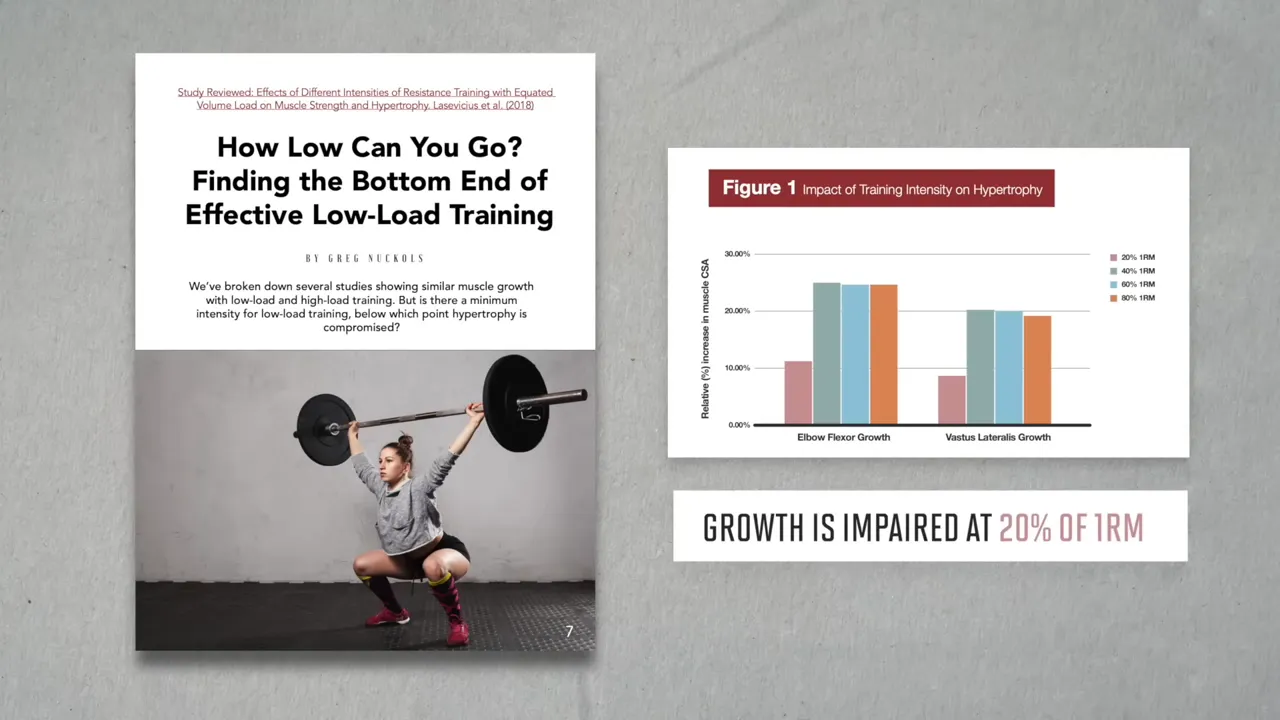
Your one-rep max is the heaviest weight you can lift for one repetition. Twenty percent of that is a very light load. The takeaway is not that all high-rep training is bad, but that pushing the load extremely low can reduce its effectiveness for growth.
If you are regularly performing sets of 50 or more reps, I would generally increase the weight and bring the set below about 30 reps.
The other downside is recovery. Ultra-high-rep work can create a lot of soreness and fatigue without providing an additional hypertrophic benefit. If that soreness impairs your performance in future sessions, you can end up compromising results despite working very hard.
That is what makes this category especially frustrating: a set can be brutally difficult and still be an inefficient choice. Effort matters, but so does how you apply it.
How to Cut Junk Volume Without Cutting Your Results
The solution is not simply to do less. It is to match your workload to the amount of productive training you can perform and recover from.
- Check volume per muscle, not just per exercise. Presses, flyes, machine presses, and push-ups all contribute to the same chest session.
- Spread demanding weekly workloads across multiple sessions. Avoid treating one marathon workout as the only way to reach your weekly set target.
- Make your working sets genuinely hard. Keep most hypertrophy work within zero to three reps of failure.
- Adjust volume to your response. Use the average recommendations as a starting point, then assess your progress and recovery.
- Increase the load when reps become excessive. Regularly doing 50-plus reps is usually a reason to use more resistance, not celebrate the rep count.
More volume can help, but only when it remains productive. Before adding another exercise or another handful of sets, ask whether you need more work or better work.
For a deeper discussion of the evidence and its practical application, my conversation with researcher James Krieger explores junk volume in more detail.
The goal is to create enough stimulus to grow, recover from it, and repeat. Filling your workout with extra fatigue is not the same as building more muscle.
|


