The argument against sumo deadlifts sounds pretty straightforward: take a wider stance, shorten the distance the bar travels, and lift more weight. Easy mode, right?
Not quite. Sumo does usually reduce the barbell’s vertical range of motion, but that alone doesn’t tell us how difficult the lift is, which muscles are working, or whether you’ll actually be stronger using it.
Sumo isn’t cheating, and it isn’t a universal shortcut to a bigger deadlift. To understand why, we need to separate the competition rules from the biomechanics, then look at what happens when strong lifters get to choose their stance.
Key Takeaways
- Sumo is legal in powerlifting and does not provide a universal strength advantage.
- A shorter bar path does not automatically mean less effort or an inferior training stimulus.
- Sumo emphasizes the quads more, while conventional places greater demands on the spinal erectors.
- Practice both stances before choosing the one that feels stronger and more comfortable.
Table of Contents
- Sumo vs. Conventional: What Actually Changes?
- Is Sumo Legal in Powerlifting?
- If Sumo Is a Cheat Code, Why Doesn’t Everyone Use It?
- Does Sumo’s Shorter Range of Motion Make It Easier?
- Barbell Range of Motion Isn’t the Same as Joint Range of Motion
- Which Muscles Work Harder in Each Deadlift?
- Should You Deadlift Sumo or Conventional?
Sumo vs. Conventional: What Actually Changes?
The basic difference is where your feet sit relative to your hands:
- Conventional deadlift: Your legs are inside your hands, with your feet typically a little narrower than shoulder width.
- Sumo deadlift: Your legs are outside your hands, using a wider stance.
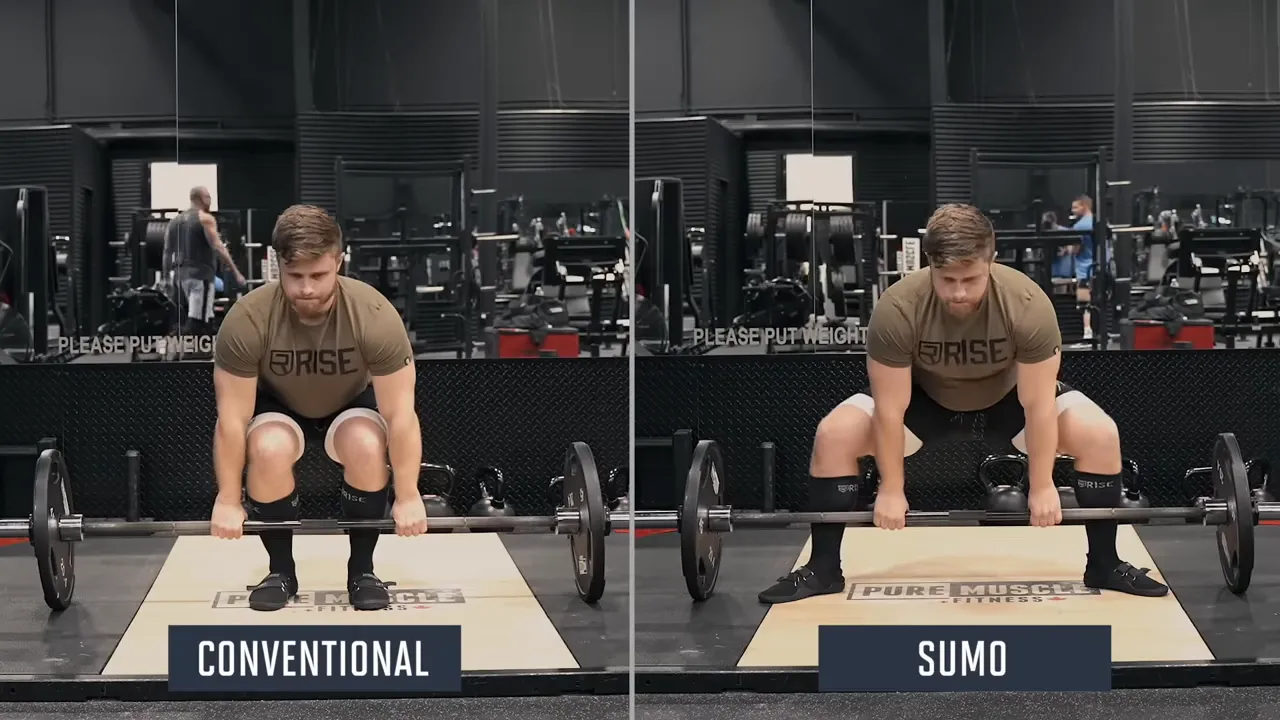
Both lifts combine knee extension and hip extension. Your quads straighten your knees, while your glutes and hamstrings help straighten your hips. Your forearms work to hold the bar, and your spinal erectors work to resist excessive rounding of your back.
These aren’t completely different exercises just because one involves spreading your feet farther apart. They share most of their major demands, with some meaningful differences in how those demands are distributed.
Is Sumo Legal in Powerlifting?
If we mean cheating literally, this is a pretty short discussion.
The International Powerlifting Federation’s technical rules do not impose a deadlift stance-width restriction that disqualifies sumo. It’s a legal technique, and that’s standard across virtually all powerlifting federations, tested and untested.
But I don’t think most people calling sumo cheating are arguing about the rulebook. They’re arguing that it makes the lift easier, almost like doing a half squat instead of reaching full depth.
That’s a more interesting claim. If sumo really gives everyone an obvious advantage, we should expect the people most motivated to lift the most weight to use it.
If Sumo Is a Cheat Code, Why Doesn’t Everyone Use It?
Consider the IPF World Powerlifting Championships. These are high-level lifters trying to maximize their totals, both for themselves and for their countries. They have a strong incentive to choose whatever legal technique helps them lift more.
In the men’s 93-kilogram, or roughly 205-pound, class in the competition data examined here, the majority pulled conventional. If switching to sumo automatically added weight to the bar, that would be a strange decision.
For comparison, consider arching on the bench press, another technique that sometimes gets labeled cheating. Every lifter in that same comparison used some degree of arch. That makes sense: arching appears to help a very broad range of lifters move more weight.
Deadlift stance doesn’t show the same universal pattern. Some lifters are stronger with sumo. Others are stronger with conventional.
Body weight reveals a trend, not a rule
When we expand the deadlift data across weight classes, an interesting pattern appears:
- In the second-lightest men’s weight class, about 75 percent of lifters used sumo.
- In the men’s superheavyweight class, that relationship reversed: about 25 percent used sumo and 75 percent used conventional.
- The women’s middle weight classes showed a less obvious pattern, closer to an even split, but the extremes again favored sumo among lighter lifters and conventional among heavier lifters.
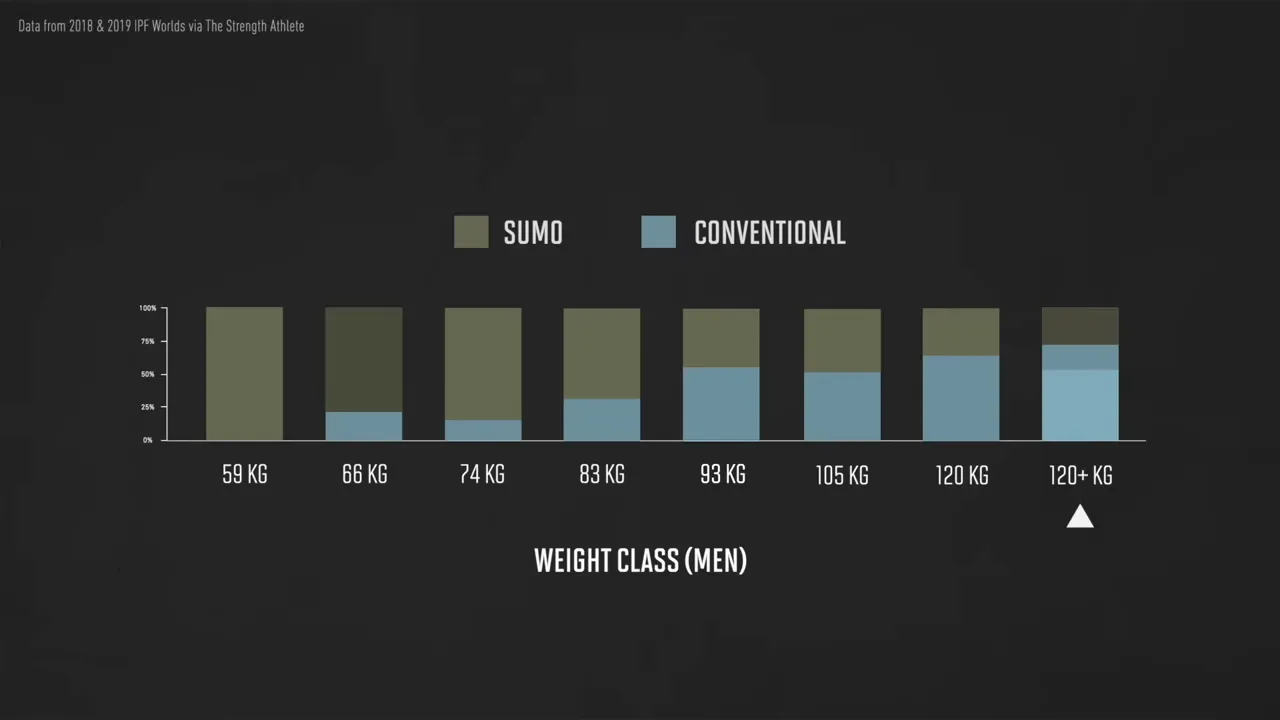
There are several possible explanations. Mobility might play a role. So might skeletal proportions. The biggest lifters also tend to be taller, and their limb ratios may be less favorable for sumo.
Those are possible explanations, not settled conclusions. The competition data describe what lifters chose; they don’t prove why they chose it.
Still, the practical point is clear: sumo’s advantage depends on the person. It is not the kind of across-the-board performance boost we would expect from a universal shortcut.
Does Sumo’s Shorter Range of Motion Make It Easier?
This is probably the strongest-sounding argument against sumo. A wider stance usually means the bar travels less distance. Surely that makes it an inferior muscle-building or strength exercise?
Before accepting that conclusion, I wanted to know how much distance we were actually talking about.
How much shorter is the bar path?
I measured my own deadlift in both stances:
- Conventional: The bar traveled 19 inches vertically.
- Sumo: The bar traveled 16 inches vertically.
- Difference: Three inches, or roughly a 15 percent reduction.
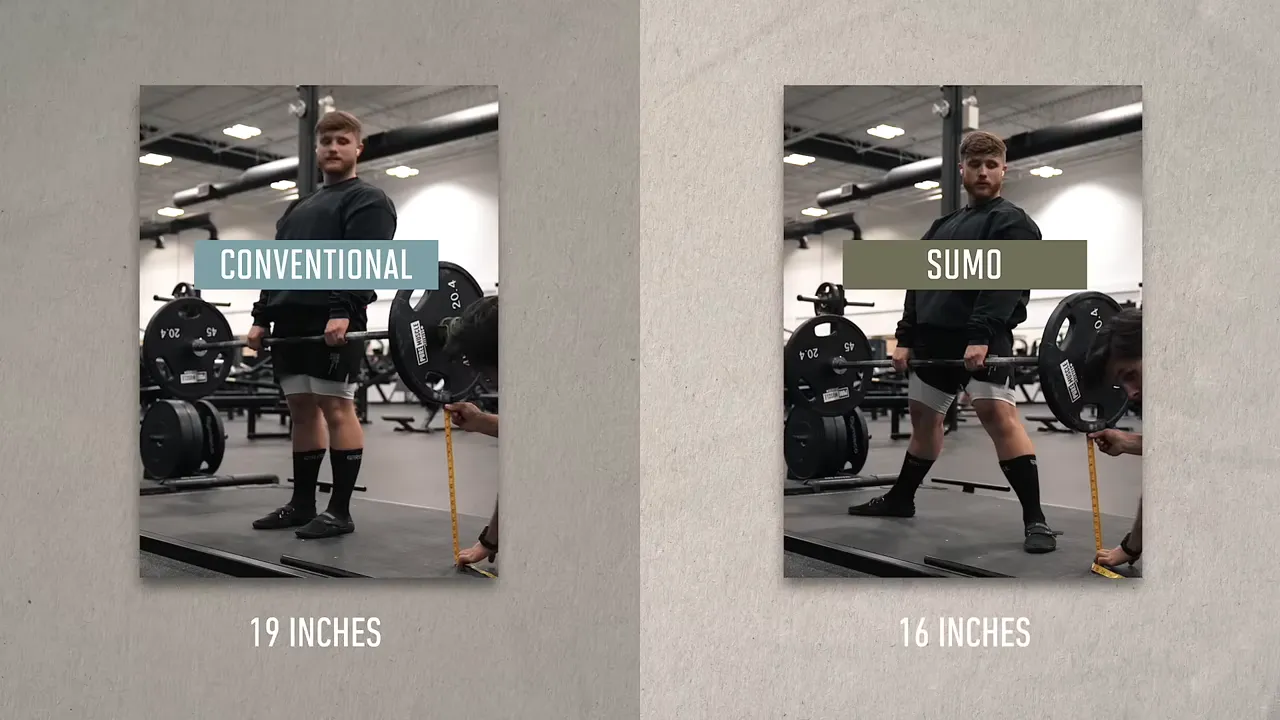
Then, in the name of highly sophisticated gym science, I paid a tall guy to let me measure his deadlift too.
His conventional bar path was 22.5 inches, compared with 21 inches for sumo. That’s a difference of only 1.5 inches, or about seven percent.
These are informal measurements from two people, not a controlled study. But they illustrate something useful: the reduction can vary between individuals, and it may be smaller than the online debate makes it sound.
A shorter bar path doesn’t automatically mean a lower effort
For me, sumo reduces the bar’s travel by about 15 percent, but I can also lift about 15 percent more weight with it. Once I adjust the load, my rating of perceived exertion, or RPE, ends up being about the same.
That doesn’t mean the percentages form a precise equation for difficulty. The point is that you can adjust the weight to match relative intensity. A challenging sumo set doesn’t become an easy set just because the bar traveled a few fewer inches.
And remember, not everyone gets a strength boost from switching. Some people will need less weight with sumo, not more.
Which part of the movement are you shortening?
Compare a full-depth squat with a half squat. The bottom portion is generally where the squat becomes most difficult. Cutting out that portion changes the challenge substantially, even if you add more weight.
Sumo isn’t equivalent to simply removing the hardest part of a conventional deadlift.
Deadlifts commonly fail in two places: the bar won’t leave the floor, or it reaches around knee height and the lifter can’t finish the lockout. With either stance, you still have to break the bar off the floor and complete the lift.
The range-of-motion research review discussed here suggests that challenging the difficult portion of a movement may matter more than simply maximizing total movement distance. A shorter bar path, by itself, isn’t enough to establish that an exercise provides a worse training stimulus.
We don’t apply this argument consistently
Think about bench-press grip width. Moving your hands wider than a close, shoulder-width grip reduces the bar’s range of motion. Yet we don’t normally call every bench press wider than shoulder width cheating.
The same applies to lat pulldowns. Widening your grip reduces the distance the handle travels, but that doesn’t automatically invalidate the exercise. It may change the muscular emphasis somewhat, and you can still train hard with it.
Range of motion matters. But treating vertical bar travel as the only thing that matters is an oversimplification.
Barbell Range of Motion Isn’t the Same as Joint Range of Motion
Here’s the biggest issue with judging a deadlift by how far the bar moves: the bar’s movement doesn’t tell you how much each joint moves.
Even though the bar travels less distance in sumo, the knees typically go through a larger range of motion. You begin with more knee bend, then extend the knees through a greater range to stand up.
In conventional, the knees generally start straighter and move through a smaller range. So if we’re judging the exercise by knee movement, sumo actually has more, not less.
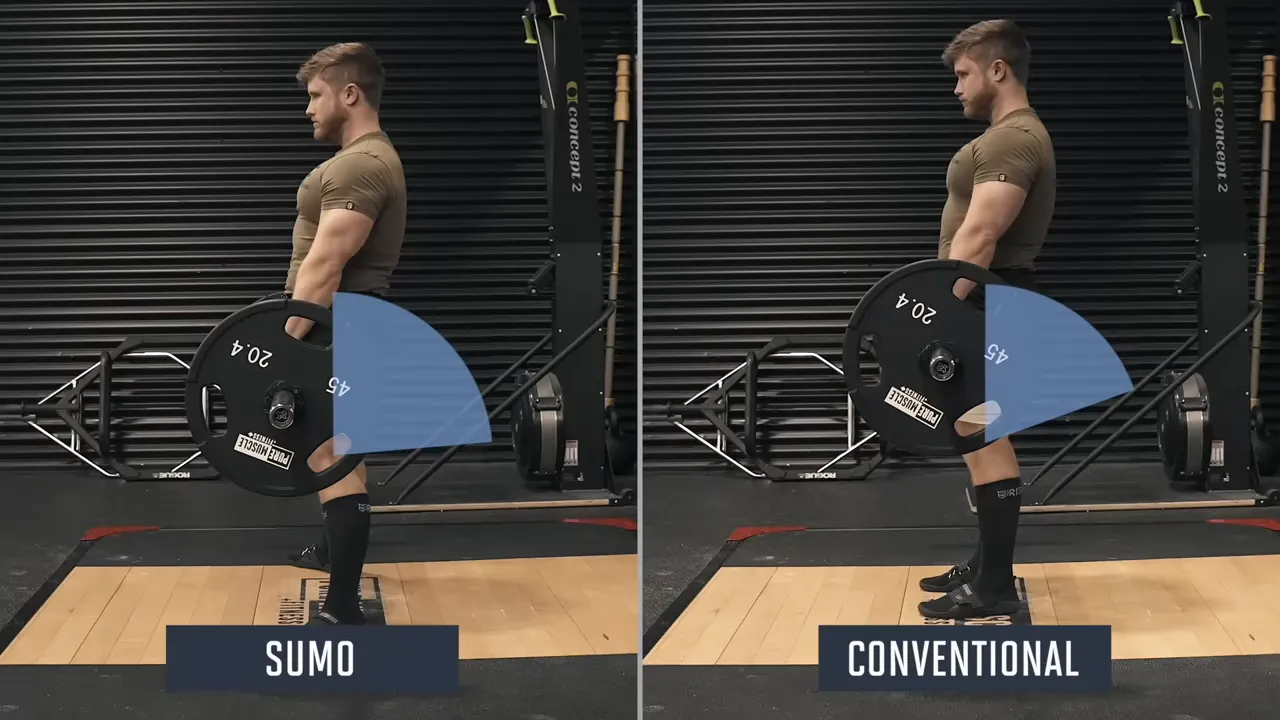
That helps explain why the quads have to work harder in sumo.
The hip requires a three-dimensional analysis
From a side view, conventional appears to involve more hip range of motion. But the hip is more complicated than a simple hinge.
The knee functions primarily as a hinge for this comparison. The hip is a ball-and-socket joint that allows movement in three dimensions. Sumo changes the position of the legs in ways a side-on image doesn’t fully capture.
That’s why a three-dimensional biomechanical analysis by Escamilla and colleagues is useful. The researchers found no significant difference in hip-extension moments between sumo and conventional at the measured points in the lift.
In other words, the apparent difference from a two-dimensional side view didn’t translate into a significant difference in the hip-extension demands measured in that study.
Which Muscles Work Harder in Each Deadlift?
The biomechanics line up with the electromyography research comparing sumo and conventional deadlifts, which found no significant difference in hamstring or glute activation between the two styles.
The main distinctions are:
- Sumo places more demand on the quads. This fits with the greater knee bend and knee-extension range.
- Conventional places more demand on the spinal erectors. The muscles running along your back have more work to do.
- Both substantially involve the glutes and hamstrings. Sumo does not simply take the posterior chain out of the exercise.
I think the extra back demand may help explain why some people perceive conventional as harder. Stressing your back more can feel different from stressing your quads more, and that difference may influence your overall impression of the lift.
But that’s a possible explanation for a subjective experience, not proof that conventional is objectively harder for everyone.
Across biomechanics, relative intensity, and muscle activation, the differences are much smaller than the cheating argument suggests. Neither stance gets you out of doing a demanding deadlift.
Should You Deadlift Sumo or Conventional?
Body weight can offer a rough starting point. Based on the competition patterns discussed earlier, men under about 180 pounds, or 81 kilograms, and women under about 140 pounds, or roughly 64 kilograms, might be more likely to favor sumo. Heavier lifters might be more likely to favor conventional.
Those are tendencies, not cutoffs. Your individual leverages and comfort matter more than which side of a body-weight threshold you happen to fall on.
The only reliable way to find your better stance is to give both a fair trial:
- Learn both techniques. Don’t compare a familiar stance with one you’ve barely practiced.
- Allow at least a month or two. A new deadlift style can take time to feel natural.
- Compare strength and comfort. Choose the stance that lets you lift strongly and feels better for you.
- Keep both if you like both. You can gradually get stronger at each over time.
There’s no requirement to turn your deadlift stance into a team sport. Sumo is legal, it trains the major deadlifting muscles, and it isn’t automatically easier. Conventional is an excellent option too.
Pick the one that suits you, train it hard, and get stronger. A wider stance isn’t a moral failing.


