I gave 113,000 people a 30-question muscle and fitness IQ test covering muscle growth, strength training, and fat loss. The average score was 61%, or about 18 out of 30.
Honestly, I think that’s pretty solid. More than 87,000 people passed, but only 158 earned a perfect score. Results formed a roughly bell-shaped distribution, with most scores clustering around 60% to 70%.
Some answers were encouraging. More than 98% correctly identified a calorie deficit as the most important factor for losing fat. Others exposed some surprisingly common misunderstandings: fewer than half identified the least active muscle in a cable row, and only about 16% answered the refeed question correctly.
The test had three levels, with 10 questions each. Below are all 30 answers, along with the reasoning that makes them useful beyond a quiz score. A few are straightforward facts. Others are coaching judgments where the wording and context really matter.
|
Key Takeaways
- A calorie deficit drives fat loss, while building muscle and losing fat simultaneously remains possible.
- Mechanical tension drives muscle growth, and reaching failure is not required to stimulate it.
- Consistent exercises, progressive overload, and sufficient rest support productive muscle-building training.
- Training volume, strength standards, and repetition estimates require context rather than rigid interpretation.
Table of Contents
- Easy Level: Muscle Growth and Fat Loss Fundamentals
- Medium Level: Applying the Science to Your Training
- Hard Level: Strength, Recovery, and Programming Details
- Knowing the Answers Is Only Useful If It Improves Your Training
Easy Level: Muscle Growth and Fat Loss Fundamentals
1. What matters most for losing fat?
Answer: A calorie deficit. More than 98% got this right.
Meal frequency, meal timing, and carbohydrate intake can influence how easy it is to maintain a deficit, but none replaces the underlying requirement: over time, you need to take in less energy than you expend.
A high-carbohydrate diet can still produce fat loss. So can a diet with most of its calories concentrated at one time of day. The key is your net energy balance over time, not whether your eating pattern follows a particular set of rules.
2. Do you need to train to failure to stimulate hypertrophy?
Answer: No. About 90% answered correctly.
The important distinction is between stimulating muscle growth and maximizing it. You can stimulate growth without reaching the point where another repetition is impossible, even when you stop fairly far from failure.
I still think failure and non-failure training both have a place. But the claim that a set cannot build any muscle unless you reach failure is simply wrong.
3. Can you build muscle and lose fat at the same time?
Answer: Yes. About 96% recognized that body recomposition is possible.
Simultaneous muscle gain and fat loss show up regularly in training research. For example, this body recomposition study illustrates that losing fat and gaining lean mass are not mutually exclusive outcomes.
Separate bulking and cutting phases still make sense for some lifters. I use them myself. That doesn’t mean recomp is an unrealistic goal for everyone else.
4. Who has the hardest time achieving body recomposition?
Answer: A lean, advanced trainee. About 86% got this one right.
The more advanced you become, the harder it is to add muscle at all. As you approach your genetic potential, a calorie surplus can become the most practical way to support further gains, making simultaneous fat loss less feasible.
Compared with that lean, advanced lifter, a beginner, someone carrying more body fat, or someone using anabolic steroids generally has circumstances that make recomp easier to achieve.
5. Which supplement has the strongest support for muscle and strength gain?
Answer: Creatine monohydrate. About 87% chose correctly.
Among the options, creatine monohydrate has the strongest scientific backing. The International Society of Sports Nutrition’s creatine position stand provides a detailed review of that evidence.
BCAAs were the second most popular answer, selected by more than 6,000 people. However, a review of isolated BCAA supplementation concluded that it does not enhance muscle protein synthesis beyond consuming complete, high-quality protein. If your protein intake is sufficient, I don’t generally recommend adding BCAAs.
6. What is the most practically efficient rep range for building muscle?
Answer: About 6 to 15 reps. Roughly 92% selected this range.
This is not the same as saying there is one magical hypertrophy zone. A broad range of repetitions can build muscle, as explained in this review of rep ranges and hypertrophy.
The question is about practical efficiency. Very heavy, low-rep training can require more sets to accumulate enough work. A lot of very high-rep work can be demanding to recover from. For most muscle-building training, 6 to 15 reps is a useful middle ground.
Including some lower- and higher-rep sets still makes sense because different loading ranges can support somewhat different adaptations.
7. Which muscle is least involved in a seated cable row?
Answer: The anterior, or front, deltoid. Only about half got this right.
A row involves several muscles with different jobs:
- Lats: Help extend the shoulder, bringing the upper arm back toward the torso.
- Middle traps: Help bring the shoulder blades together.
- Biceps: Contribute to bending the elbow.
I suspect some people chose the traps because they pictured only the upper traps. But the trapezius is a large muscle that extends down the middle of the back.
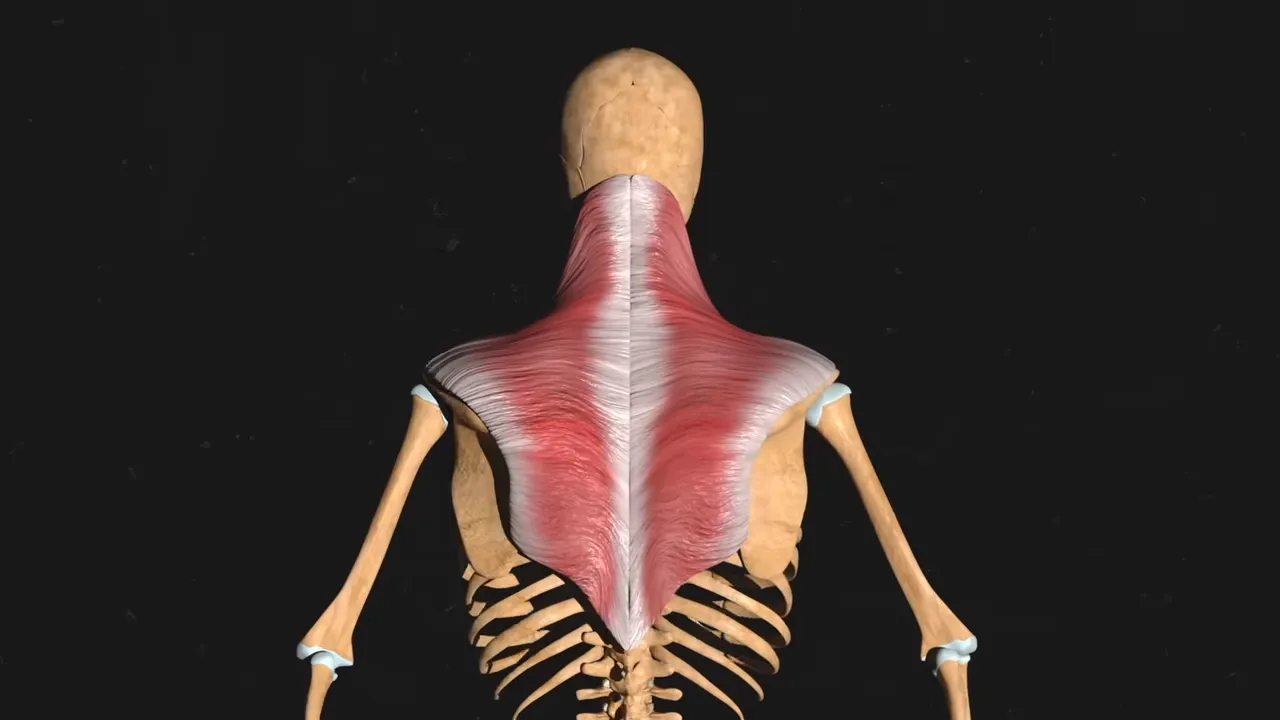
Even if you modify a row to emphasize the lats by driving your elbows down and minimizing shoulder-blade movement, the traps still contribute to stabilization. The front delts, by contrast, are much more associated with pressing, fly movements, and front raises than with rowing.
8. What is the eccentric phase of a biceps curl?
Answer: Lowering the weight back down. About 77% answered correctly.
The eccentric, often called the negative, is the phase in which the working muscle lengthens under load. During a curl, that happens as you lower the weight and straighten your elbow.
Maintaining some control during this phase matters for muscle growth. Don’t treat the return portion of each rep as something to get out of the way.
9. What contributes most to muscle growth?
Answer: Mechanical tension. This question split people mainly between tension and muscle damage.
Mechanical tension is the primary driver of hypertrophy. Muscle damage and metabolic stress may have secondary roles, but chasing damage or a burning sensation is not the same as delivering an effective growth stimulus.
The practical implication is to prioritize productive resistance training rather than trying to make every session as painful or soreness-inducing as possible.
10. What does RPE stand for?
Answer: Rating of perceived exertion.
In strength training and bodybuilding, coaches commonly connect RPE to how many repetitions you could still perform:
- RPE 10: No reps in reserve, meaning you reached failure.
- RPE 9: About one rep in reserve.
- RPE 8: About two reps in reserve.
It is a way to describe how difficult a set felt relative to your capacity, rather than judging effort from the weight alone.
Medium Level: Applying the Science to Your Training
11. Are shorter or longer rest periods better for hypertrophy?
Answer: Longer rest periods generally have the advantage. Only about 53% chose correctly.
A 2017 systematic review on rest intervals found an advantage to resting longer than 60 seconds compared with resting less than 60 seconds. A likely explanation is that longer rests allow you to perform more training volume.
Shortening rest periods makes a workout feel harder, but feeling exhausted is not the same thing as creating a better muscle-building stimulus. Recovery between sets helps you maintain performance.
12. What does not count as progressive overload?
Answer: Increasing exercise variation. About 88% got this right.
Progressive overload means gradually increasing the demands placed on a muscle. Common examples include:
- Lifting more weight for the same number of reps.
- Performing more reps with the same weight.
- Adding a set at the same load and rep count.
Changing exercises does not guarantee any of those things. A new movement may feel difficult simply because it is unfamiliar.
That’s why I recommend keeping at least a few core exercises consistent from week to week and aiming to get progressively stronger on them over time.
13. Is muscle soreness useful?
Answer: It can provide a rough clue that you trained the intended muscle. About 78% chose correctly.
Suppose hip thrusts leave your lower back extremely sore while your glutes feel untouched. That may be a reason to review your technique and consider whether you are involving your glutes as intended.
But soreness is not required for growth. Running a marathon can make you very sore without building much muscle. Soreness also does not automatically indicate bad form: unfamiliar training can cause it even when your technique is good.
Use soreness as feedback, not as a score for workout quality.
14. How often should a developing lifter train her glutes?
Answer: Two to three times per week in the scenario given. About 96% got this right.
The example involved a late beginner to early intermediate lifter seeking full-body strength and size, with extra emphasis on glutes. Each glute workout included multiple exercises for multiple sets.
Once per week could work if total volume were sufficient. However, spreading that work across two or three sessions is likely to allow higher-quality training. Doing the same substantial glute workload five to seven days per week would raise much greater recovery concerns.
The answer depends on the amount of work in each session, not frequency in isolation.
15. How many reps should you leave in reserve for hypertrophy?
Answer: About zero to three reps in reserve. Only about 44% answered correctly.
RIR stands for reps in reserve: how many more repetitions you could complete before failure. It does not mean your rep range.
Nearly 29,000 people selected 6 to 12, which I suspect was partly a terminology mix-up. For maximizing muscle growth, zero to three RIR is a useful target range for hard sets. That remains consistent with the earlier point: you don’t have to reach failure to stimulate growth.
16. Which muscle is least activated by a standard barbell back squat?
Answer: The hamstrings, compared with the quads and glutes. About 75% chose correctly.
EMG studies have found relatively low hamstring activation during squats. The biomechanics help explain why: three of the four hamstring heads cross both the hip and knee.
As you stand up, knee extension lengthens those hamstrings at the knee while hip extension shortens them at the hip. Those effects partly offset each other, so overall muscle length changes relatively little.
The quads, meanwhile, work hard to extend the knees, while the glutes contribute strongly to extending the hips.
17. How many weekly chest sets make sense for an intermediate lifter?
Answer: Fourteen sets per week was the best option. About 64% selected it, while roughly 28% chose 24 sets.
The example involved someone with almost four years of lifting experience who took most sets close to failure. The question also specified avoiding serious recovery problems.
Given those conditions, I favor 14 sets. Pushing much beyond roughly 20 weekly sets can increase the risk of recovery issues, especially when effort is consistently high.
James Krieger’s evidence-based review of training volume suggested 12 to 16 weekly sets per muscle group as a practical range for many people. That is a useful starting point, not a universal prescription. Needs vary between people and muscles.
18. How much protein should a lifter eat in a calorie surplus?
Answer: About 1.6 to 2.2 grams per kilogram of body weight daily, or 0.7 to 1 gram per pound. Roughly 69% answered correctly.
For an average lifter whose main goal is gaining muscle in a surplus, around 1 gram per pound is already near the upper end of common evidence-based recommendations.
I think a case can be made for somewhat higher intakes in certain situations, particularly advanced lifters dieting or pursuing body recomposition. But that is different from saying everyone needs substantially more protein to grow.
19. What is a Meadows row?
Answer: A row performed by gripping the end of a barbell, named after John Meadows. About 55% recognized it.
John was a mentor to so many people in bodybuilding, myself included. In this variation, you brace your non-working arm against your leg, grip the end of the barbell with the working hand, and drive your elbow outward.
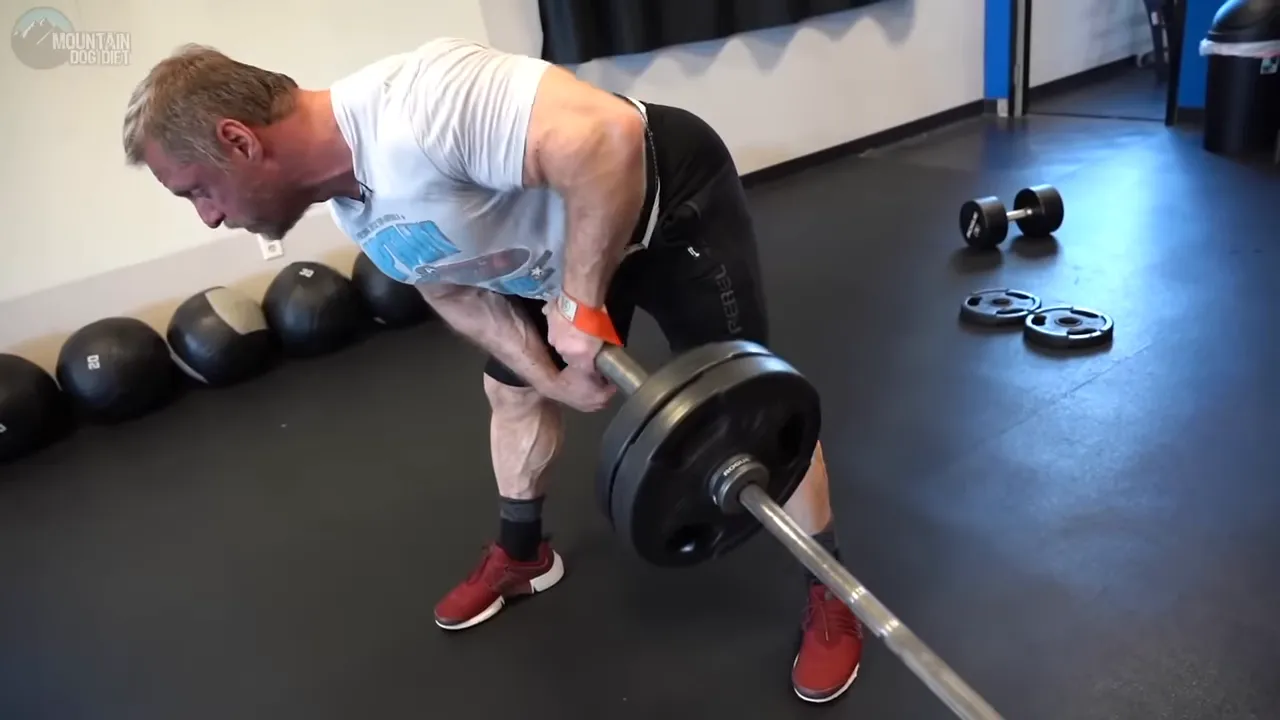
That elbow path emphasizes the middle traps, rhomboids, and rear delts.
20. What is shoulder abduction?
Answer: Raising your arm out to the side. About 47% identified the movement correctly.
My slightly ridiculous memory trick is to imagine aliens abducting your arm away from your body. The same idea applies to hip abduction: moving your leg outward, away from the midline.
Hard Level: Strength, Recovery, and Programming Details
21. Does a lifting belt significantly reduce core activity?
Answer: No. That was the least likely outcome of using a belt properly. About 43% got it right.
For a maximum-effort deadlift set of four to six reps, a belt may help you lift more weight, move the weight faster, and increase intra-abdominal pressure. Many people can lift roughly 5% to 10% more with a belt, although the benefit varies.
The idea that a belt simply switches off your core is not supported by the studies discussed. Bracing outward against the belt helps create a more rigid torso through increased internal pressure. It does not mean your core stops working.
22. What is a realistic bench press after five years of serious training?
Answer: For the example lifter, 125 kilograms, or about 275 pounds. Roughly 66% chose that option.
This was a coaching judgment, not a promise about what every lifter should achieve. The example described an 80-kilogram, or 176-pound, lifter with average strength genetics who had trained seriously for almost five years, benched twice weekly, used good technique, and followed structured progressions.
Using my strength standards, an intermediate to advanced bench press falls around 1.5 to 2 times body weight. For this lifter, that is roughly 120 to 160 kilograms, or 265 to 350 pounds.
A 100-kilogram bench is certainly realistic, but I think it undersells the potential described in the question. A 165-kilogram bench is also possible, but exceeding twice body weight within that time frame is more likely to require favorable genetics. Among the choices, 125 kilograms was the best fit.
23. When is internal cueing most appropriate for hypertrophy?
Answer: An EZ-bar biceps curl was my preferred option. About 42% agreed.
Internal cueing directs attention toward a muscle, such as thinking about squeezing your biceps. External cueing directs attention toward the movement or task.
For a squat, that might mean the difference between focusing on flexing your quads and focusing on driving through the middle of your foot while lifting your chest.
Research generally finds that an external focus improves force production and performance. For that reason, I usually favor external cues on heavy compound lifts such as squats and bench presses. Excessive focus on squeezing one muscle can limit the load you can use.
For a curl, however, an internal focus may be useful. A study comparing attentional strategies found greater increases in biceps thickness when participants focused on contracting the muscle rather than simply getting the weight up.
I do think reasonable arguments exist for internal cues on compound movements in some circumstances. This is a context-dependent recommendation, not a rule that overrides every other coaching consideration.
24. Is the soleus predominantly slow-twitch or fast-twitch?
Answer: Strongly slow-twitch dominant.
The soleus and gastrocnemius make up the calf muscle group commonly called the triceps surae. The soleus is highly type I, or slow-twitch, dominant, which fits its role in long-duration, low-intensity tasks such as standing and walking.
You could use that as an argument for emphasizing higher repetitions. However, research on matching rep ranges to fiber type is mixed, so I still recommend a variety of rep ranges for calf development rather than treating fiber type as a complete training prescription.
25. What can acutely reduce muscle protein synthesis?
Answer: Cold-water immersion after exercise. Only about 23% selected it. Half blamed a high-sugar meal.
A study on post-exercise cooling found reduced myofibrillar muscle protein synthesis. Another seven-week training study found that cold-water immersion blunted muscle hypertrophy.
If maximizing muscle growth is your priority, routinely using cold baths after lifting is probably not the best strategy.
The other choices were distractions. Some research has even suggested that stretching between sets might benefit growth. And despite sugar getting blamed for pretty much everything, I’m not aware of evidence showing that a high-sugar meal itself meaningfully raises or lowers muscle protein synthesis.
26. How many reps can you perform at 80% of your one-rep max?
Answer: Roughly 7 to 10 reps on an all-out squat set. About 43% chose correctly, with almost as many selecting four to six.
AMRAP means as many reps as possible. At 80% of a daily squat one-rep max, around eight repetitions is a reasonable average expectation.
If you only manage four to six, your estimated max for that day may be too high. If you get 12 to 15 or more, it may be too low.
However, repetition capacity at a given percentage varies substantially between people. Resources such as the Reactive Training Systems RPE framework offer useful ballpark estimates, not exact predictions of your performance.
27. What is NEAT, and why does it matter during a cut?
Answer: Non-exercise activity thermogenesis. About 54% identified it correctly.
NEAT is the energy you expend through everyday movement outside formal exercise, such as carrying groceries, walking around, and fidgeting.
As you diet and get leaner, you can subconsciously reduce this activity. You might park closer to the store, fidget less at your desk, or move with a little less enthusiasm without realizing it.
That reduction contributes to metabolic adaptation during weight loss. Maintaining a daily step target or making a deliberate effort to move more may help offset part of it.
28. What is daily undulating periodization?
Answer: Varying rep ranges between sessions within the same week.
For example, you might train chest, shoulders, and triceps with sets of 8 to 10 reps in one session, then use sets of 4 to 6 reps in the next session that week. Repeating that weekly pattern is daily undulating periodization, or DUP.
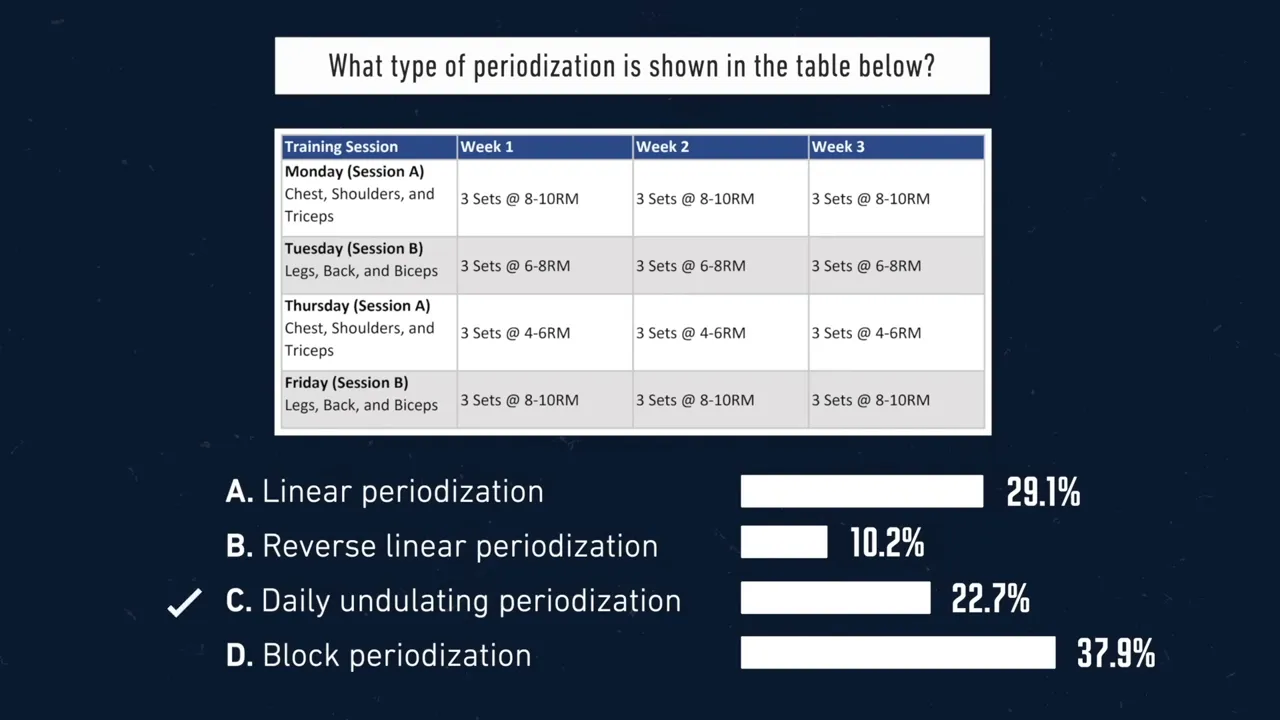
The important distinctions are:
- Daily undulating: Rep ranges change between sessions within a week.
- Linear: Rep targets decrease from week to week in the example being compared.
- Reverse linear: Rep targets increase from week to week.
- Block: Training is organized into longer phases, typically lasting at least several weeks.
Most people selected block periodization, but the short schedule shown did not establish that longer-term structure. The clearly identifiable feature was the within-week change in repetitions.
29. What did the bodybuilding refeed study actually find?
Answer: Better dry lean mass retention in the refeed group. Only about 16% got this right.
The 2020 study by Campbell and colleagues compared continuous dieting with a dieting approach that included 48-hour refeeds over seven weeks.
About two-thirds selected “all of the above,” which would have included better fat loss and higher testosterone. But the relevant finding was better retention of dry lean mass. There was no fat-loss difference between the groups.
Rather than treating refeeds as a special fat-burning trick, I think it makes more sense to consider them a strategy that may help preserve lean mass and improve diet adherence.
30. What keeps muscle protein synthesis elevated the longest?
Answer: An hour of weight training, compared with the listed protein or leucine servings. About 72% answered correctly.
Protein feedings produce relatively short-lived increases in muscle protein synthesis. Resistance exercise produces a more prolonged response, illustrated in Stuart Phillips’s review of muscle protein turnover.
This reinforces an important hierarchy: training provides the major stimulus for muscle growth, while sufficient protein supports and enhances the response. Adding more protein is not a substitute for productive resistance training, and its benefits do not keep increasing indefinitely.
Knowing the Answers Is Only Useful If It Improves Your Training
The biggest gaps weren’t necessarily about obscure anatomy or terminology. They often came from confusing something that feels productive with something that actually supports progress: shorter rests, more soreness, constant exercise changes, or simply doing more sets.
The fundamentals are less flashy. Apply mechanical tension, keep track of your progress, train hard enough, allow yourself to recover, and match your nutrition to your goal.
And when a recommendation gets more specific, pay attention to the conditions. Fourteen weekly sets is not a magic number. Eight reps at 80% is not a guarantee. Refeeds are not a fat-loss shortcut. Understanding those distinctions is more valuable than memorizing the answer key.


