What is the least amount of time you can spend in the gym and still make gains?
Most fitness advice, including plenty of my own, takes a maximalist approach: train for however long it takes to maximize progress. Imagine a one-hour workout delivered 98 percent of your potential results, while a two-hour workout delivered 100 percent. The maximalist would take the two hours.
But for a lot of people, that trade-off makes no sense. Fitness is part of their life, not their entire life. Others simply do not enjoy lifting yet, and a demanding routine creates another barrier to getting started.
Minimalist training means getting a substantial return from a smaller investment of time. It is not about doing careless workouts. It is about understanding how little training can still work, then making that training count.
Key Takeaways
- A few heavy weekly working sets can produce meaningful strength gains.
- Low-volume muscle-building routines work best when sets combine high effort with excellent execution.
- Drop sets, noncompeting supersets, and streamlined warm-ups can make workouts more time-efficient.
- Maintaining existing muscle generally requires much less training than building it.
Table of Contents
- Why Minimalist Training Deserves More Attention
- How Little Training Do You Need for Strength?
- How Much Lifting Is Enough for Health Benefits?
- How Many Sets Do You Need to Build Muscle?
- Can Advanced Lifters Succeed With Low Volume?
- Maintaining Muscle Requires Even Less Work
- Five Ways to Make Minimalist Workouts More Effective
- Minimalist Training Is About Priorities, Not Doing Nothing
- A Structured Option for Shorter Workouts
Why Minimalist Training Deserves More Attention
My brother loves golf and outdoor activities, but he does not particularly like lifting weights or going to the gym. When he started experiencing hip pain and noticed that his strength was lacking at work, I wrote him a very simple routine.
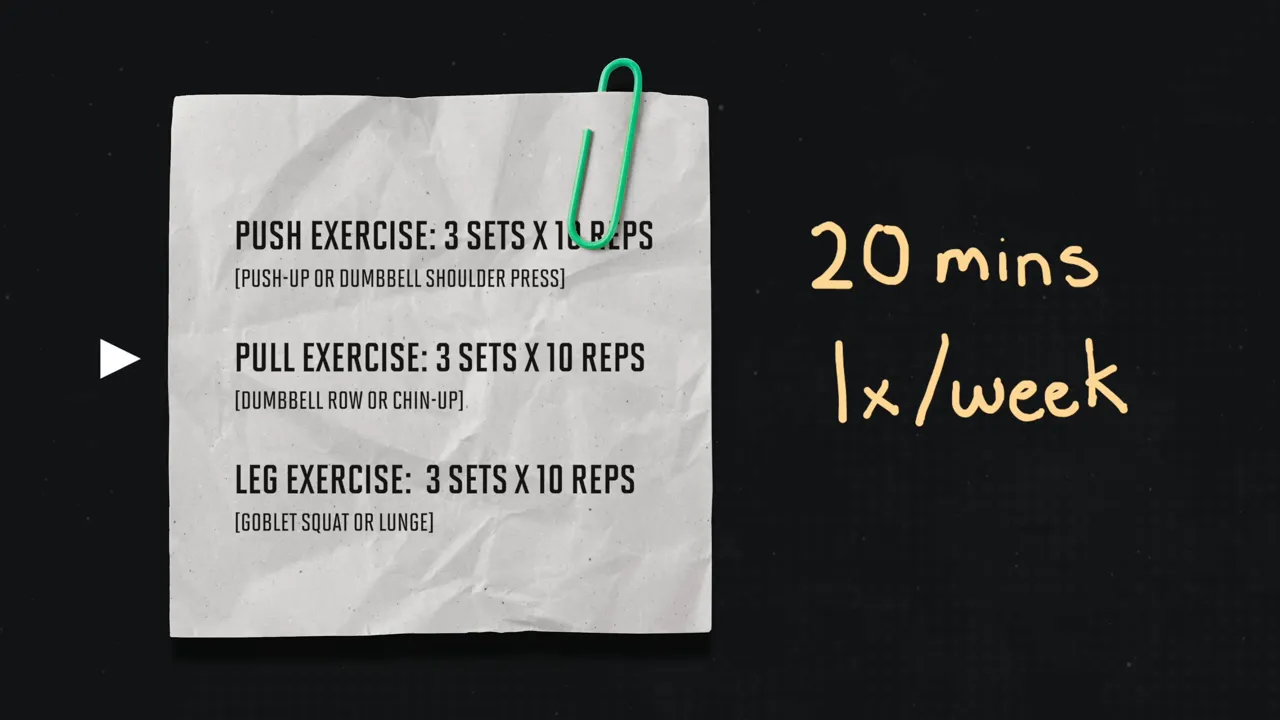
It takes about 20 minutes, once per week:
- One push exercise, such as a push-up or shoulder press.
- One pull exercise, such as a dumbbell row or chin-up.
- One leg exercise, such as a goblet squat or lunge.
The routine uses three sets of 10 reps for each exercise. His strength improved, and his hip pain went away. That is his individual experience, not a promise that this routine treats hip pain, but it illustrates how useful a small amount of training can be.
Even if you love bodybuilding, you will probably have periods when work, school, kids, or travel take priority. Knowing how to scale your training down is valuable. The alternative does not have to be training at full capacity or doing nothing.
The minimum effective dose depends on what you want: strength, health benefits, muscle growth, or simply maintaining what you have already built.
How Little Training Do You Need for Strength?
For strength, the answer is surprisingly encouraging. One heavy working set, performed one to three times per week, can produce meaningful strength gains for many people.
A 2017 meta-analysis of nine studies found that training with just one to four sets per exercise per week produced roughly 81 percent of the strength gains seen with higher-volume training.
If your goal were to improve your squat as efficiently as possible, a minimalist setup could look like this:
- Monday: Warm up, then perform one heavy squat working set of one to three reps.
- Thursday: Repeat one heavy squat working set of one to three reps after warming up.
- Optional: Add one or two lighter back-off sets if you have time and want a little more stimulus.
The key is exposure to heavy loads. For a strength-focused minimalist routine, working in roughly the one-to-five-rep range allows you to keep practicing the lift under relatively heavy loading without accumulating a huge number of sets.
This is also how I have approached the powerlifts when prioritizing bodybuilding: squatting and deadlifting once per week with high effort and relatively heavy loads, rather than devoting a large amount of training time to them.
Notice that these are working sets. A low-volume strength routine still includes the warm-up needed to prepare for heavy lifting.
How Much Lifting Is Enough for Health Benefits?
You do not need a bodybuilding schedule to get substantial health benefits from resistance training.
A 2022 systematic review covering 16 studies examined muscle-strengthening activity in relation to mortality, cardiovascular disease, cancer, and diabetes. The largest observed risk reductions were associated with approximately 30 to 60 minutes of lifting per week.
That is a very manageable weekly investment. It does not mean lifting replaces every other component of health, or that these associations guarantee an outcome for an individual. It does show that the amount of resistance training associated with substantial health benefits is much smaller than many people assume.
How Many Sets Do You Need to Build Muscle?
Muscle growth is a little more complicated because there is a clearer relationship between training volume and hypertrophy.
Training volume is the amount of work you do, commonly estimated as the number of sets performed per muscle per week. One weekly set for your quads is very low volume. Thirty weekly sets is very high volume and requires a much bigger time commitment.
A common recommendation is around 10 sets per muscle per week, often divided across at least two sessions. For example, you might perform five quad sets on Tuesday and five on Friday. More advanced lifters may benefit from working toward 20 weekly sets for certain muscles.
But a good target for maximizing progress is not the same thing as a minimum requirement.
Low Volume Can Deliver a Large Share of the Results
A meta-analysis of weekly training volume and muscle growth provides a useful way to think about the trade-off. Using the gains in the 10-plus-set category as the reference:
- One to four sets per muscle per week produced approximately 64 percent as much growth.
- Five to nine sets per muscle per week produced approximately 84 percent as much growth.
- Ten or more sets per muscle per week served as the higher-volume benchmark.
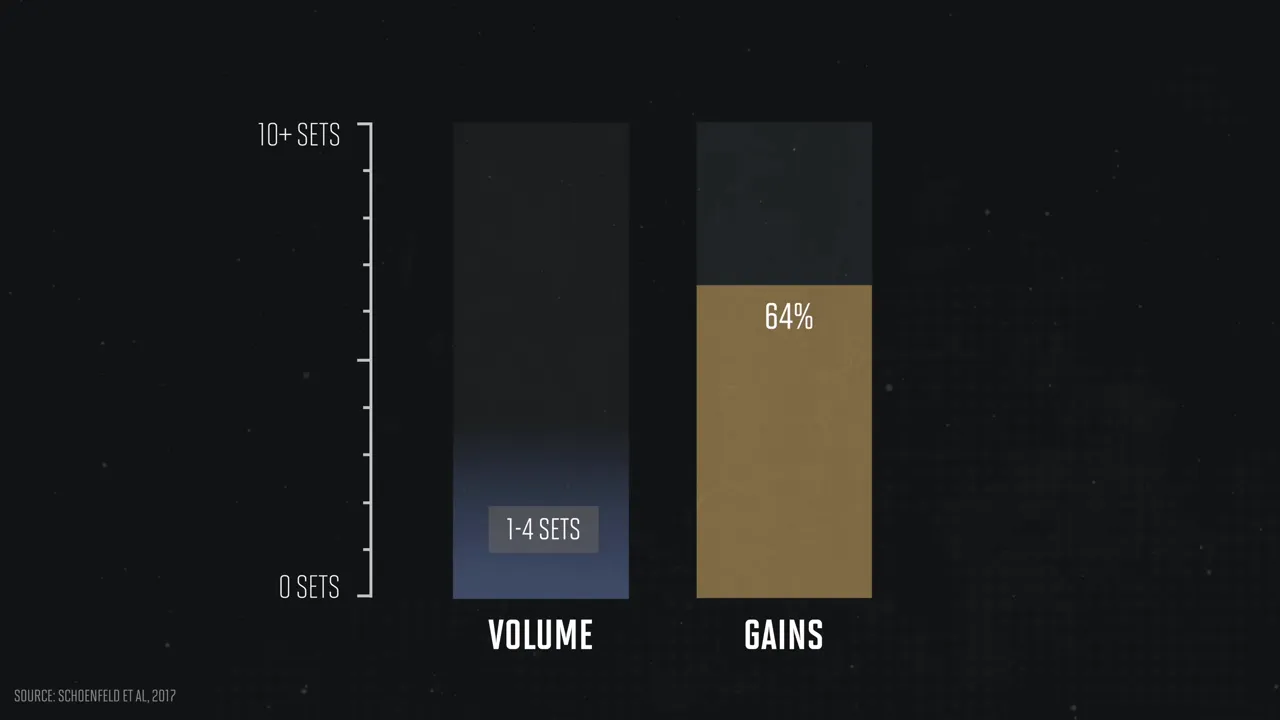
Think about how little time a hard set of curls takes. The point is not that one specific set guarantees a precise percentage of your potential biceps growth. It is that very low training volumes can still produce meaningful results.
You are not necessarily cutting your gains in half just because you cut your training time in half. The relationship is not that simple, and the first few hard sets can offer a lot of value.
What Those Percentages Do Not Tell You
There are some important limitations.
First, the analysis pooled 15 studies, and most involved untrained or recreationally trained participants. Only two involved more experienced lifters.
In those two studies:
- A study by Rhea and colleagues found no difference in lean body mass between one and three sets per exercise per session when sets were taken to failure.
- A study by Ostrowski and colleagues found no statistically significant difference in muscle thickness between three, six, and 12 weekly sets, also performed to failure, although some trends favored higher volume.
A lack of statistical significance does not prove that the approaches are identical. It does, however, give us reason not to dismiss low-volume training.
Second, these are group averages. Some people will get more out of a small number of sets; others will get less. The 64 percent figure is not a personal prediction.
Finally, as you gain lifting experience, you generally need more volume to keep progressing at a comparable rate. That does not mean experienced lifters cannot make measurable progress with substantially less training.
Can Advanced Lifters Succeed With Low Volume?
There are striking examples of accomplished bodybuilders using relatively little volume.
Dorian Yates trained his chest once per week with one working set to failure per exercise, generally for six to eight reps. Across four exercises, that amounted to just four weekly working sets.
Of course, Yates was an enhanced professional bodybuilder. His results are not evidence that everyone should copy his routine. But low-volume training is not limited to enhanced athletes.
Natural bodybuilder Jeff Alberts has used a pull workout consisting of:
- Two sets of seated leg curls.
- Two sets of Romanian deadlifts.
- Two sets of lat pulldowns.
- Two sets of cable biceps curls.
Performing a version of that workout twice per week puts much of his training around four to eight sets per muscle per week. Those sets are performed with very high effort and excellent execution. That detail matters.
Martin Berkhan also helped popularize minimalist lifting through his article on wasted training effort. His criticism centered on habits such as failing to track workouts, accumulating junk volume, doing excessive ab work, and spending more time warming up than he spent on an entire session.
The lesson is not that more training is bad. It is that more time in the gym does not automatically mean more productive training.
Maintaining Muscle Requires Even Less Work
So far, the focus has been on making gains. But sometimes maintenance is the goal, and there is nothing wrong with that.
In a study by Bickel and colleagues, participants were able to preserve muscle size for eight months with training volume reduced to as little as one-ninth of the preceding training dose under the study conditions.
That is not a universal prescription for every age or training background. The useful takeaway is that maintaining muscle is much easier than building it from scratch.
If life becomes busy, you may be able to preserve far more of your progress than you expect with a dramatically reduced routine. You do not have to abandon training because you cannot sustain your usual schedule.
Five Ways to Make Minimalist Workouts More Effective
Reducing volume is only half the equation. The other half is getting more out of the sets you keep.
1. Push Your Working Sets Harder
This is my most important minimalist training tip: as the quantity of work goes down, the quality needs to go up.
For a low-volume muscle-building routine, most working sets should reach failure or finish within about one rep of it:
- RPE 10: You cannot complete another rep with the intended technique.
- RPE 9: You could complete approximately one more rep.
If you are only doing a few sets, stopping each one well short of your capacity leaves a lot of potential stimulus unused. Execute those sets as well as you can and bring a high level of effort.
This recommendation concerns hard hypertrophy work. It is not a reason to turn every heavy squat or deadlift into a failed attempt.
2. Use Drop Sets
A drop set extends a set by reducing the weight after reaching failure, then continuing for additional reps without taking a normal rest period.
In Science and Development of Muscle Hypertrophy, Brad Schoenfeld describes drop sets as a way to increase training volume without substantially extending the session.
My usual approach is straightforward:
- Perform the initial set to failure.
- Reduce the weight by approximately 25 to 50 percent.
- Immediately continue with the lighter weight until reaching failure again.
This lets you accumulate more demanding reps without spending several additional minutes resting. The lighter load is still challenging because the muscle is already fatigued.
3. Choose Sensible Supersets
A superset pairs two exercises back to back without resting between them. But some pairings are better for time efficiency than others.
Pairing a bench press with a dumbbell fly trains the same muscles twice in succession. Research on superset configurations shows that overlapping exercise pairings can reduce training performance.
A better option is to pair movements that do not heavily compete for the same muscles:
- Bench press and dumbbell row: Your chest rests while your back works, and vice versa.
- Leg press and lateral raise: The main muscles involved do not overlap.
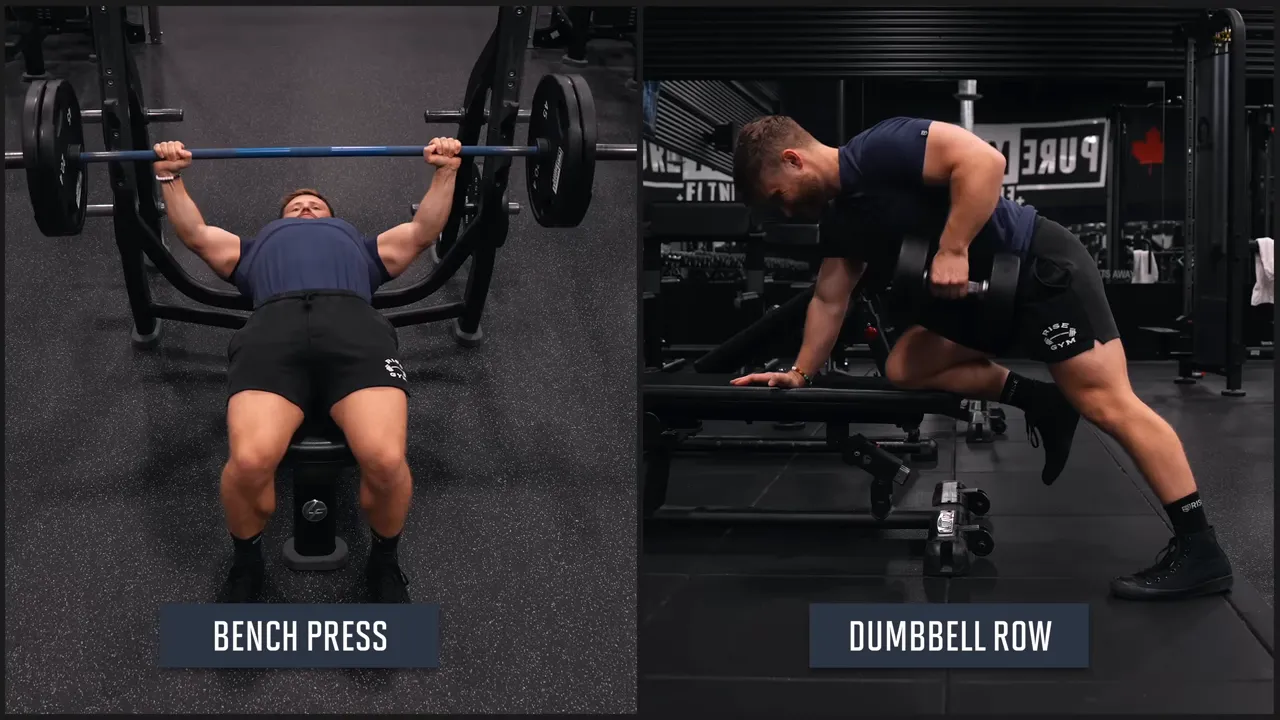
The exercises do not need to form some perfect thematic pairing. They just need to make practical sense and let you maintain good performance.
4. Reduce Rest Periods Gradually, Not Recklessly
When I timed one of my push workouts, the whole session lasted 70 minutes. I spent only 14 minutes actually lifting and 56 minutes not lifting.
That included water breaks, conversations, and photos, so it was not all deliberate between-set recovery. Still, the breakdown was revealing: only 20 percent of the session involved moving weights.
The obvious solution seems to be shorter rest periods. The problem is that research on rest intervals indicates that cutting rest too aggressively can compromise recovery and hypertrophy. Roughly one to four minutes between sets is a typical evidence-based range.
A more measured strategy is to gradually reduce rest as your ability to recover improves. For example:
- Week 1: Rest two minutes between sets.
- Week 2: Rest one minute, 45 seconds.
- Week 3: Rest one minute, 30 seconds.
- Week 4: Rest one minute, 15 seconds.
- Week 5: Rest one minute.
There is evidence that progressively shortening rest can preserve hypertrophy while allowing you to adapt to the greater conditioning demand. Treat this as an option, not a requirement to rush every exercise. The goal is to save time without sacrificing the quality of your work.
5. Streamline Your Warm-Up and Exercise Selection
When time is tight, I keep my general warm-up short: about three to five minutes on the treadmill, a few quick dynamic stretches, then the exercise-specific preparation I need.
Exercise selection also changes how much warm-up time a workout requires.
For barbell back squats, I might need four or five progressively heavier warm-up sets before reaching my working weight. After that, I still have my working sets to perform.
On a machine hack squat, I may only need two warm-up sets before starting the hard work. Choosing movements that require less preparation can shorten the workout without removing productive working sets.
The goal is not to skip necessary preparation. It is to avoid an unnecessarily long warm-up and choose exercises that fit your time budget.
Minimalist Training Is About Priorities, Not Doing Nothing
I enjoy maximalist training. There are times when spending one or two hours in the gym fits my goals and lifestyle perfectly.
But that does not make it the only worthwhile approach. A few heavy sets can improve strength. A modest weekly time commitment can deliver substantial health benefits. Low-volume hypertrophy training can build muscle, and maintenance can require even less.
The most useful shift is to stop treating a full-length workout as the price of admission. Do less when you need to, keep the work purposeful, and make the sets you perform count.
A Structured Option for Shorter Workouts
I created The Essentials Program for people who want effective, intense workouts designed to take no longer than about 45 minutes.
It offers two-, three-, four-, and five-day-per-week options, with most exercises using one to three hard sets. The 12-week plan includes three distinct training blocks, an Excel spreadsheet, exercise demonstrations and coaching cues, and exercise substitutions. It is designed for any experience level when time efficiency is the priority.
|
Consult a physician before starting an exercise program, particularly if you have pain or an existing health concern.


