Training to build as much muscle as possible is not quite the same as training to lift as much weight as possible. There is plenty of overlap, but when pure hypertrophy is the goal, every decision should come back to one question: How effectively is this training stimulating the target muscle?
That means paying attention to how you perform each rep, how hard you push your sets, how you progress, and which exercises give you the most growth stimulus without making recovery unnecessarily difficult.
These five principles are the foundation of how I approach training specifically for muscular development.
Key Takeaways
- Maximize tension on the target muscle with controlled negatives, loaded stretches, and minimal momentum.
- Push sets close to failure while managing fatigue across the workout.
- Progress through more reps, more weight, or better technique over time.
- Choose exercises that deliver a strong muscle-building stimulus without unnecessary recovery demands.
Table of Contents
- 1. Tension Is King
- 2. Use Bodybuilding Technique
- 3. Push Your Sets Hard Enough
- 4. Give Your Muscles a Reason to Grow
- 5. Choose High-Tension Exercises You Can Recover From
- The Supporting Details: Splits, Rest Periods, and Advanced Techniques
- Putting Pure Hypertrophy Training Into Practice
1. Tension Is King
Mechanical tension is the primary driver of muscle growth. It is the force your muscles experience as they stretch and contract under load.
Think of a muscle fiber as a rope in a tug-of-war. The pulling force on that rope is tension. In a muscle, that force initiates a cascade of biochemical signals that ultimately tells the tissue to grow. The research on mechanical tension provides the foundation for the practical principles that follow.
The important distinction is that moving a weight and loading the intended muscle are not always the same thing. You can swing a dumbbell through a curl without making your biceps do as much work as they could. You can add weight to a squat while cutting out the part of the movement that provides a valuable stimulus.
For bodybuilding, the goal is not simply to move the load from point A to point B. It is to make the target muscle experience substantial tension. Technique, effort, progression, and exercise selection are the tools we use to accomplish that.
2. Use Bodybuilding Technique
Bodybuilding technique is different from powerlifting technique, and it is different from the way many people naturally lift. Rather than organizing the movement around lifting the heaviest possible weight, we organize it around loading the muscle effectively.
There are three main boxes to check: lifting tempo, range of motion, and control of momentum.
Control the negative, then lift forcefully
For most exercises, I recommend a controlled two- to four-second lowering phase. This is the eccentric, also called the negative. If you normally let the weight drop, that tempo will initially feel pretty slow.
But the lowering phase deserves your attention. Research comparing eccentric and concentric training suggests that the eccentric may be especially important for hypertrophy. Yet many lifters put all their effort into getting the weight up, then more or less abandon it on the way down.
This often becomes more obvious toward the end of a set. As fatigue builds, the negative gets faster and less controlled. Those difficult final reps are precisely where you should keep resisting the weight, not switch into free fall.
That does not mean every part of the rep should be slow. Research on repetition tempo supports pairing slower eccentrics with faster concentrics, or lifting phases.
- Hack squat: Lower under control, then drive upward forcefully.
- Lateral raise: Resist the dumbbells as they descend, then drive them up and out.
- Most other exercises: Use the same basic combination of a controlled negative and a purposeful positive.
The key is to lift forcefully without turning that intention into uncontrolled swinging.
Prioritize the stretched position
A full range of motion is generally a good starting point. On squat variations, that means reaching at least parallel and ideally a little deeper. On dumbbell presses, lower far enough to get a substantial stretch in your pecs. On pull-ups, use both the top and bottom of the movement.
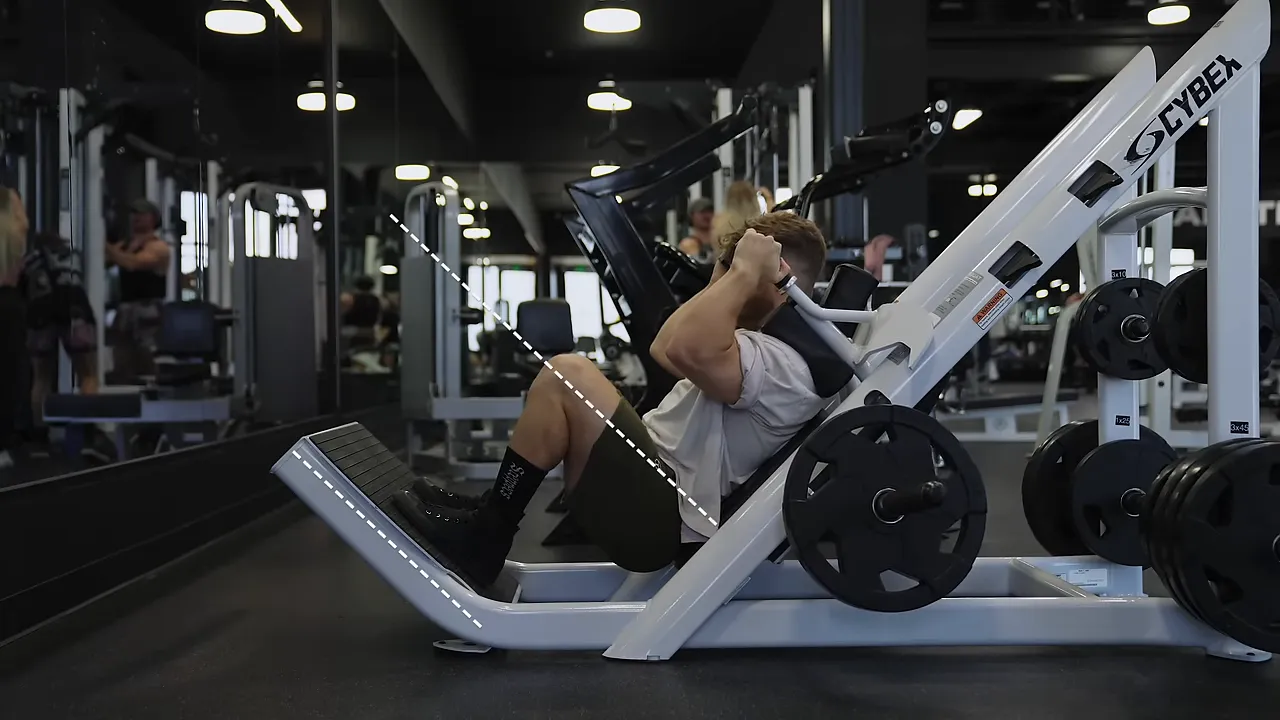
However, full range of motion is not automatically superior in every situation. Research on partial versus full range of motion adds an important nuance: partial reps can sometimes produce more growth when they emphasize the lengthened, or stretched, portion of an exercise.
That is very different from shortening a movement just to move more weight.
For example, the bottom half of a cable curl loads the biceps in a more lengthened position than the top half. Similarly, the lower portion of a squat is particularly relevant when we are thinking about the benefits of training at longer muscle lengths.
The practical priority is to avoid neglecting the loaded stretch. You may not always need to perform every inch of a movement, but you should not consistently cut out the stretched portion.
If you are stopping short of that position, see whether you can comfortably go a little deeper. If extra depth causes pain or serious discomfort, do not force it. Address relevant mobility limitations or choose a different exercise that lets you load the muscle through a comfortable, lengthened position.
Keep momentum under control
A weight can move even when the intended muscle is not doing most of the work.
Take a dumbbell curl. If you rock your torso backward and forward to get the dumbbell up, you are bringing other muscles and momentum into the movement rather than keeping the demand on your biceps.
For pure hypertrophy, that trade-off usually does not make sense. The point is not to make the dumbbell travel upward by any means necessary. The point is to challenge the biceps.
Keep your execution controlled enough that the target muscle remains responsible for the movement.
3. Push Your Sets Hard Enough
You can have excellent technique and still make very little progress if your sets are too easy.
Research consistently finds that people often stop farther from failure than they realize. If you have trained for years without noticeable changes, it is worth asking whether you are truly challenging your muscles before concluding that you have reached your natural limit.
What reps in reserve means
Reps in reserve, or RIR, describes how many more reps you could complete before reaching failure.
- 0 RIR: You could not complete another rep even if you tried.
- 1 RIR: You could complete one more rep.
- 2 RIR: You could complete two more reps.
The closer you get to failure, the harder the set becomes. The question is whether taking every set all the way to failure produces enough extra growth to justify the extra fatigue.
The research on failure is not unanimous
One meta-regression on proximity to failure found that muscle growth tended to increase as sets finished closer to failure. Its trend line suggested a particularly noticeable increase as estimated reps in reserve dropped from two to zero.
That gives supporters of high-intensity, to-failure training a reasonable case.
However, a separate meta-analysis published in 2022, which pooled 15 studies using different inclusion criteria, did not find evidence that momentary muscular failure produced superior hypertrophy compared with non-failure training.
So we should not pretend the evidence gives one completely settled answer. Which studies are included, and how their results are analyzed, can influence the conclusion.
My practical recommendation
For most exercises, I like a compromise that takes effort seriously without letting fatigue crush the rest of the workout:
- Perform two or three working sets.
- Leave one or two reps in reserve on the earlier sets.
- Take the final set to failure when the exercise is appropriate for it.
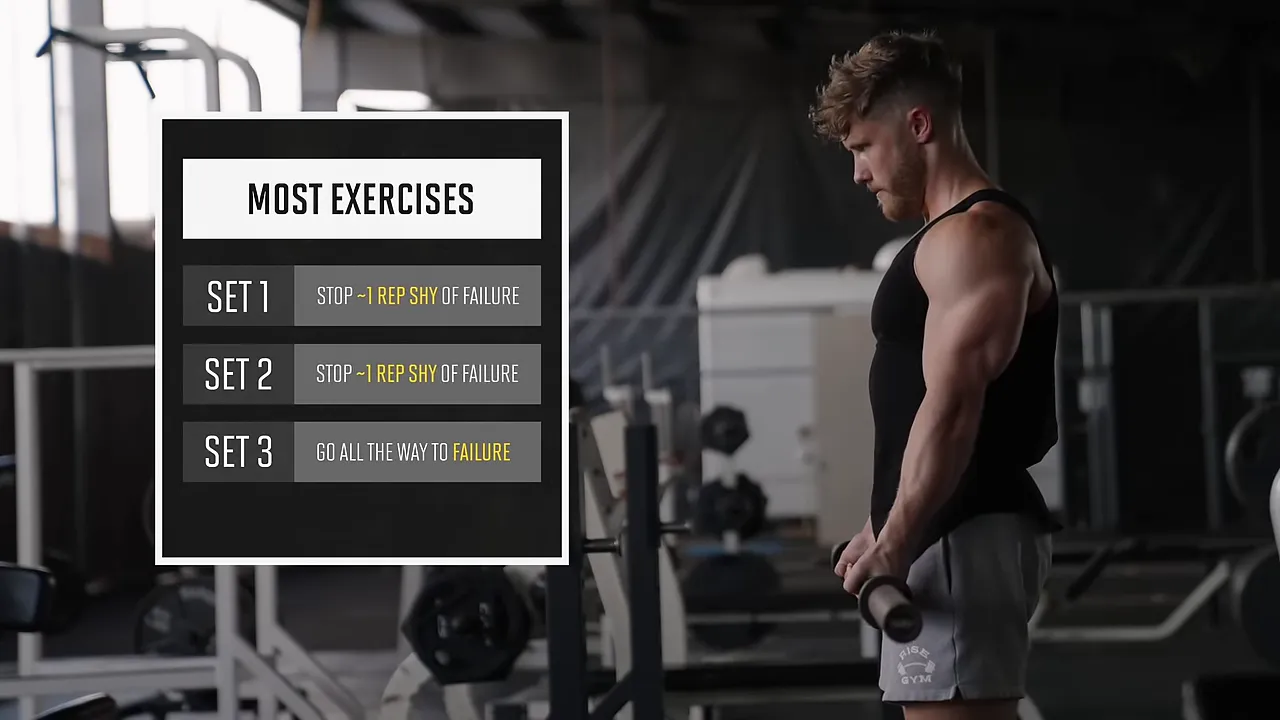
In other words, save a little on the early sets, then really push the last one.
Taking every set to failure can leave you so fatigued that your reps fall off substantially on later sets. That can reduce the amount of productive training you complete. Training volume also matters for hypertrophy, up to a point, so effort and volume need to work together.
There is an important exception: I generally leave one or two reps in reserve on heavy free-weight compound lifts, even on the final set. That includes squats, bench presses, and deadlifts. Going to failure on these movements can carry a disproportionately high fatigue cost, and I do not think the trade-off is usually worthwhile.
This is also one reason a program dedicated purely to bodybuilding does not need to revolve around those lifts.
4. Give Your Muscles a Reason to Grow
Repeating the exact same workout with the same weights, reps, and execution month after month will eventually stop providing much of a new challenge.
Progressive overload means aiming to increase the training demand over time. For bodybuilding, there are several useful ways to do that.
Add reps with the same weight
This works especially well in moderate to high rep ranges. For a biceps exercise, a progression might look like this:
- Week 1: Three sets of 10 reps.
- Week 2: Three sets of 11 reps.
- Week 3: Three sets of 12 reps.
- Week 4: Aim for 13 reps, or increase the weight and return to 10 reps.
Once you increase the weight, you can start building the reps back up again. You are progressing without needing to force a weight increase every session.
Add weight with the same rep target
This approach often fits lower to moderate rep ranges well.
For example, you might perform three sets of six on the hack squat with three plates per side. Over subsequent weeks, you could aim to add 10 pounds per side while maintaining those three sets of six, eventually working toward four plates per side.
That is an example of the progression method, not a requirement to add weight on a fixed schedule regardless of performance.
Improve your technique
Eventually, you will have a week when you cannot add either weight or reps. That does not automatically mean the session offers no opportunity to improve.
You can aim to:
- Control the negative more effectively.
- Use less momentum during the lifting phase.
- Increase your comfortable range of motion.
I count these as useful forms of progression because they can increase the tension experienced by the target muscle, even when the number on the weight stack stays the same.
Conversely, adding weight while making your technique worse is not necessarily progress for hypertrophy.
Improve your mind-muscle connection
As another option, focus more deliberately on feeling the target muscle work. Research on attentional focus during resistance training suggests that a stronger mind-muscle connection can improve hypertrophy in some cases.
I would not put this ahead of adding reps, adding weight, or improving execution. But it is worth keeping in mind, especially on isolation exercises where increasing the load becomes impractical.
5. Choose High-Tension Exercises You Can Recover From
You can build an impressive physique with squats, bench presses, deadlifts, pull-ups, and rows. But if those are literally the only exercises you perform, you are probably leaving some muscular development on the table.
There are two main reasons.
First, some muscles may not receive enough direct work. The biceps, side delts, hamstrings, and calves can need more attention than a very basic compound-only routine provides.
Second, an exercise can stimulate muscle growth while still being a relatively expensive choice in terms of recovery.
Understand the stimulus-to-fatigue ratio
The stimulus-to-fatigue ratio is a concept associated with Dr. Mike Israetel. It describes the relationship between:
- Stimulus: How effectively the exercise loads the target muscle.
- Fatigue: How tiring the exercise is and how difficult it is to recover from.
A deadlift, for example, can provide a substantial stimulus to the glutes and spinal erectors. But it can also be very demanding to recover from.
That does not make deadlifts bad. Fatigue is an inevitable part of training. But if another exercise can provide a comparable or better stimulus to the muscle you want to grow with less fatigue, that is an attractive trade-off for pure bodybuilding.
Machines and cables deserve a major role
Machines and cables can be excellent choices because they often let you apply high tension while reducing some of the demands associated with free-weight exercises. They also tend to be more practical options for taking sets to failure.
Research comparing machines and free weights supports machines as an effective way to build muscle. Free weights do not have an automatic hypertrophy advantage simply because they require more stabilization.
Resistance profiles also matter. In a standard dumbbell curl, the external demand on the biceps is highest around the point where the elbow is bent to 90 degrees. At the bottom, with the arm hanging down, that demand is very low.
A face-away Bayesian cable curl can keep more tension on the biceps through the range of motion, including the lengthened position at the bottom.
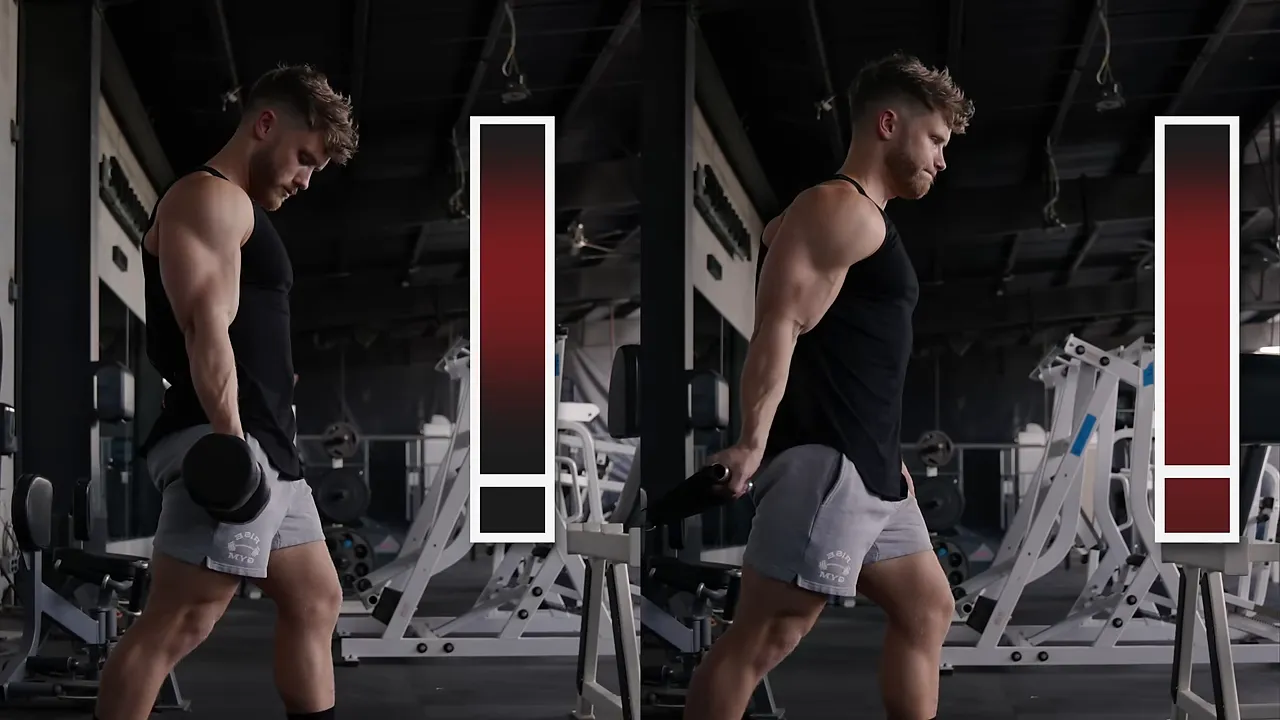
That does not mean machines and cables are universally superior. Free weights have real advantages:
- They are often more accessible.
- They tend to offer better carryover to free-weight strength.
- They may challenge smaller stabilizing muscles more.
I still love the squat, bench press, and deadlift. Strength work can fit neatly into a hypertrophy plan when it is programmed thoughtfully. But if muscle growth is the only goal, there is no requirement to organize your entire program around the big three.
What this looks like in a workout
The first full-body session in my Pure Bodybuilding Program illustrates the approach:
- Cross-body lat pull-arounds: Three sets emphasizing a substantial stretch in the lats.
- Low-incline Smith machine press: Chest work with less demand than a free-barbell press.
- Machine hip adductions: Direct adductor work before the leg press.
- Leg press: A lower-body movement that can be pushed hard without the same overall demands as some free-weight alternatives.
- Face pulls and cable crunches: Targeted work to finish the session.
The point is not that everyone must use that exact exercise sequence. It is that choosing movements with manageable recovery costs can let you train very hard without feeling completely wrecked.
Some exercise variety is useful, too. You do not have to perform the exact same handful of movements year after year, especially if that approach is becoming stale.
The Supporting Details: Splits, Rest Periods, and Advanced Techniques
The five principles above deserve most of your attention. A few other programming details matter, but they should support the fundamentals rather than distract from them.
Choose a split that fits your life
A training split is simply a way to organize your workouts across the week. Full-body routines, upper/lower splits, push/pull/legs routines, and modified body-part splits can all work.
The best option is one that:
- Fits your schedule.
- Allows you to push your sets hard.
- Provides enough training volume.
- Lets you recover between workouts.
The name of the split is less important than whether it lets you accomplish those things consistently.
Do not rush your rest periods
Research on rest intervals generally favors resting at least one minute between sets over resting less than one minute for muscle growth.
That is not a reason to cap every rest period at exactly 60 seconds. The practical lesson is to avoid rushing so much that incomplete recovery limits the quality of your next set.
Use advanced techniques as additions, not replacements
Long-length partials, myo-reps, and drop sets can all be useful tools for continued progress beyond the beginner stage.
But none of them replaces the foundation: load the intended muscle, use deliberate technique, train hard, progress over time, and select exercises you can recover from.
Putting Pure Hypertrophy Training Into Practice
The simplest way to evaluate your training is to ask whether your target muscles are receiving a strong, progressively challenging stimulus at a recovery cost you can manage.
That is the thread connecting all five principles. A controlled negative keeps you engaged with the load. A meaningful range of motion exposes the muscle to tension in the stretched position. High effort makes the sets challenging enough. Progression keeps the stimulus from becoming stagnant. Smart exercise selection lets you repeat that process consistently.
My Pure Bodybuilding Program puts these ideas into a structured 10-week plan, with full-body, upper/lower, and push/pull/legs versions. Each version includes a weak-point and arm day, and I filmed more than 200 exercise demonstrations with specific coaching cues. The supporting materials include a Hypertrophy Handbook and a bodybuilding nutrition booklet.
Train to challenge the muscle, not just to move the weight. When pure muscle growth is the goal, that distinction should guide the entire program.
|


