Most people approach “natty or not” by drawing an imaginary line through a lineup of physiques. Below the line, natural. Above the line, steroids.
The problem? Nobody agrees on where that line belongs.
Some people draw it at Will Tennyson. Others put it just below Simeon Panda. And after millions of people bought Liver King’s claim that his physique came from an ancestral lifestyle rather than an expensive drug regimen, it’s understandable that trust in fitness influencers is pretty low.
But skepticism can go too far in the other direction. If every impressive physique gets dismissed as enhanced, we end up with a distorted picture of natural muscular potential.
A physique being achievable naturally and a particular person actually being natural are two different questions. To separate them, we need more than a gut feeling. We need history, science, and a little common sense.
Key Takeaways
- A naturally achievable physique does not establish whether a particular person has ever used steroids.
- An FFMI above 25 is unusual naturally, but it is not definitive proof of steroid use.
- Transformation speed depends partly on starting body composition, nutrition, and individual training response.
- My practical long-term estimate for consistently trained natural men is an FFMI around 22 to 24.
Table of Contents
- History: How Muscular Were People Before Steroids?
- Science: What FFMI Can Tell Us About Natural Muscle Potential
- Can a Fast Transformation Still Be Natural?
- Common Sense: Exceptional Genetics Actually Exist
- So, How Big Can You Get Without Steroids?
History: How Muscular Were People Before Steroids?
Historical physiques give us something modern social media can’t: examples of muscular development from before anabolic steroids were available.
Most anabolic steroids are testosterone or structurally modified relatives of testosterone. Trenbolone and nandrolone have changes to the underlying molecule. Testosterone propionate, cypionate, and enanthate attach different esters to testosterone, affecting how quickly it is released after administration.
That makes the timeline important. If we can establish when these drugs entered the picture, we can look further back for evidence of what humans could build without them.
When Did Testosterone Enter Strength Sports?
Testosterone was first isolated in 1935 by Ernst Laqueur and his colleagues in Amsterdam, using material extracted from thousands of bull testicles. Not exactly a convenient supplement-manufacturing process.
By the early 1940s, physicians were experimenting with testosterone for symptoms described at the time as “male menopause,” including low mood and reduced sex drive. Its use as a strength and muscle-building drug developed later.
The Soviet weightlifting team’s success at the 1952 Olympics in Finland became an important part of the early story of testosterone in sport. By the mid-1950s, American strength athletes were experimenting with it too. Physician John Ziegler’s work with lifters at York Barbell, including John Grimek, helped bring steroids into American strength culture. This history of Ziegler’s involvement provides more background.
The practical takeaway is that American bodybuilding physiques from before the 1950s are strong historical reference points for natural development.
Steve Reeves: An Impressive Pre-Steroid Physique
Consider Steve Reeves in 1947. He was 21 years old, reportedly 6 feet 1 inch tall and 215 pounds, with a physique that looks roughly 10 to 12% body fat.
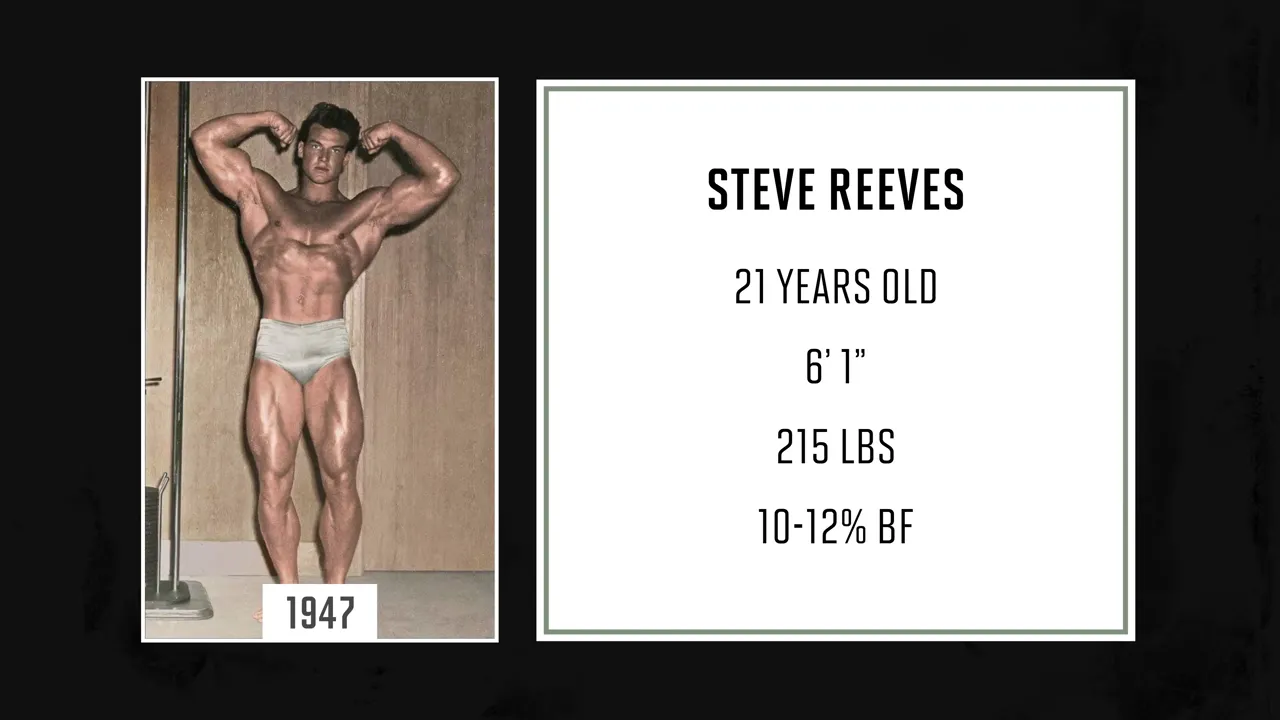
Those body-fat numbers are visual estimates, not laboratory measurements. Still, his physique makes the larger point: men were getting seriously muscular before steroids became established in bodybuilding.
Could someone argue that Reeves somehow obtained testosterone unusually early? Sure. But that requires a much more complicated explanation than accepting that an exceptionally gifted young bodybuilder built an exceptional physique naturally.
For anyone still skeptical, we can go back much further.
Eugen Sandow: Before Testosterone Was Even Isolated
Eugen Sandow, whose likeness became the Mr. Olympia trophy, was photographed in 1897 with a remarkably developed physique. His reported measurements were approximately 5 feet 9 inches and 185 pounds, at an estimated 10% body fat.
This was decades before testosterone isolation. The steroid explanation doesn’t work here.
But Sandow shouldn’t automatically become the ceiling for natural bodybuilding, either. He was a pioneer working with the equipment and knowledge of his era. Some of his published advice promoted weights of just 5 to 10 pounds for sets of 10 to 15 repetitions.
That is hardly a complete blueprint for maximizing muscle growth today. Training equipment, nutrition knowledge, and exercise science have advanced enormously since then. Sandow demonstrates what was possible, not the most muscular physique that could ever be built naturally.
Science: What FFMI Can Tell Us About Natural Muscle Potential
Looking at historical physiques is useful. Putting muscularity into numbers gives us another tool.
Fat-free mass index, or FFMI, describes how much fat-free mass someone carries relative to their height. Unlike body weight alone, it accounts for the fact that a taller person generally carries more mass.
The basic formula is:
FFMI = fat-free mass in kilograms ÷ height in meters squared.
To estimate fat-free mass, subtract fat mass from total body weight. Some research also applies a height adjustment, so it’s important to compare calculations made using the same convention.
Think of FFMI as a useful muscularity estimate, not a steroid detector. Its accuracy depends on the height, weight, and body-fat measurements going into it.
The Famous 1995 Study and the “25 FFMI Limit”
In a 1995 study by Kouri and colleagues, researchers recruited 157 men from gyms in the Los Angeles and Boston areas:
- 74 reported not using anabolic steroids.
- 83 reported using anabolic steroids.
The researchers used urine testing to help assess the reports and measured body composition with hydrostatic underwater weighing, a widely respected method at the time.
When they plotted the participants’ FFMI values, several findings stood out.
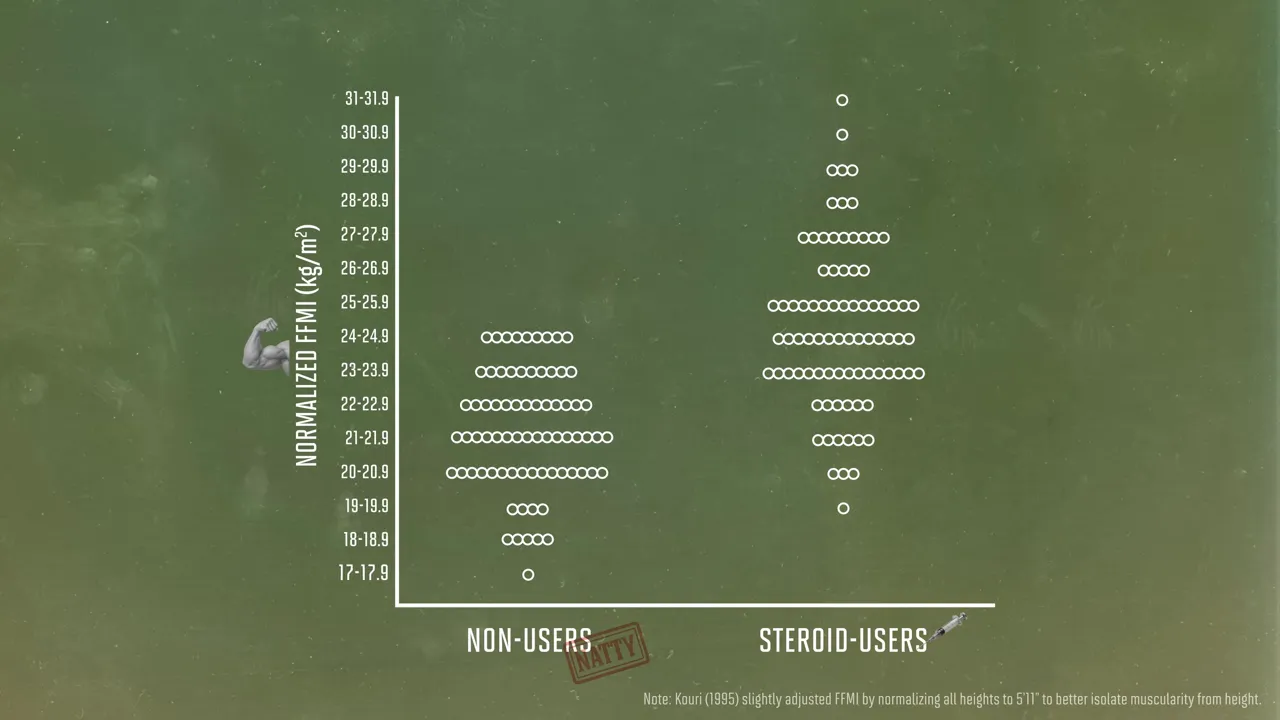
- Steroid users were more muscular on average. No big surprise there.
- Taking steroids did not guarantee being bigger than every natural lifter. One enhanced participant was smaller by FFMI than 86% of the natural group.
- There was considerable overlap. In the FFMI range of 24 to 25, there were 14 enhanced lifters and nine natural lifters.
- The natural group stopped around 25. None of the 74 non-users exceeded that value.
That last result became the basis for the popular claim that 25 is the natural FFMI limit. The authors themselves allowed that rare individuals might exceed it without steroids.
My own measurements fit the general pattern. Using my DEXA body-fat estimate of 10.3%, height of 164.5 centimeters, and weight of 155.8 pounds, my reported FFMI came out to 24.4.
So, case closed? Twenty-five is the ceiling?
Not quite.
Why 25 Is a Reference Point, Not a Universal Cutoff
The same research examined estimated FFMI values for pre-steroid-era Mr. America winners. Some were below 25:
- Bert Goodrich: 24.3.
- Roland Essmaker: 22.6.
- John Grimek: 24.0.
But Frank Leight’s estimated FFMI was 25.5. Other winners from the 1940s also exceeded 25, including Steve Stanko, Clarence Ross, Alan Stephan, George Eiferman, and Jack Delinger.
These historical estimates aren’t equivalent to modern laboratory measurements. Nevertheless, they make it difficult to defend 25 as an absolute biological wall.
There’s also the sample-size issue. Seventy-four natural lifters can tell us something useful about typical muscularity, but that is a small group for identifying the outer limits of human potential. My interpretation is that a larger sample would likely reveal more exceptional individuals beyond that apparent ceiling.
A study of Division I and Division II college football players adds another piece of evidence. Offensive linemen had an average FFMI of 25.1. That was the average, not the maximum.
NCAA drug testing doesn’t establish that every participant was a lifetime non-user. Some may have used performance-enhancing drugs. But assuming that everyone above 25 must have used steroids simply builds the conclusion into the assumption.
An FFMI above 25 is unusual among natural lifters. It is not, by itself, proof of steroid use.
Can a Fast Transformation Still Be Natural?
Size is only one part of the argument. Often, what raises suspicion is how quickly someone got there.
Hussein Farhat is a good example. At approximately 5 feet 11 inches, 185 pounds, and an estimated 12% body fat, his reported FFMI was 22.8. That is not an extraordinary value for a well-trained natural lifter.
The more interesting claim was that he went from 134 to 184 pounds during his first three years of lifting, at roughly the same body-fat percentage.
Before treating that as 50 pounds of new muscle, we need to acknowledge the limitations of the comparison. Different lighting, camera angles, lens distortion, filters, and a post-workout pump can dramatically change how lean and muscular someone appears.
Still, let’s entertain the stronger version of the claim: 50 pounds of lean mass gained in three years. Is that possible naturally?
Realistic Rates of Muscle Gain
In my book, The Muscle Ladder, I gave the following practical ranges for lean-mass gain in men:
- First year: approximately 10 to 25 pounds.
- Second year: approximately 5 to 10 pounds.
- Third year: approximately 2.5 to 7.5 pounds.
These estimates were informed by a 2020 systematic review of muscle growth in healthy adult men. They are practical expectations, not rigid annual allowances.
Added together, that gives a range of about 17.5 to 42.5 pounds over the first three years. Fifty pounds is above that typical range.
One possible explanation is prior steroid use followed by stopping before testing. Normal blood work later would not settle the question of lifetime use.
Another possibility is that the starting point inflated the transformation.
Starting Very Light Changes the Interpretation
A study of body-composition reference values reported an average FFMI of 19.8 among 431 healthy Italian men, without a training intervention. Hussein’s estimated starting FFMI was around 17.
At his height and the assumed body-fat level, an FFMI of 19.8 would correspond to roughly 160 pounds, rather than 134 pounds.
That doesn’t mean every healthy man his height should weigh 160 pounds. A population average is not an individual health requirement. But it illustrates how unusually light his starting point was.
If he had been chronically undereating, part of his subsequent gain could reflect moving toward a more adequately nourished baseline. Combine that with hard training and an unusually good response to lifting, and a dramatic transformation becomes more plausible.
Could he have used steroids? I can’t rule that out. Can his physique be achieved without steroids? My conclusion is yes. His reported FFMI and normal blood work are consistent with that possibility, even if neither proves lifetime natural status.
Why Liver King Was a Different Case
Liver King’s situation involved much more than a fast transformation. Using the estimates of 5 feet 6 inches, 190 pounds, and 7% body fat, his reported FFMI was around 29. His physique was also accompanied by conspicuous features such as a red, puffy face, water retention, and leathery-looking skin.
His subsequent exposure as a steroid user made the deception clear. But physical features alone are not definitive tests, and we shouldn’t treat every muscular person as another version of that case.
Suspicion is not proof, and natural attainability is not proof of someone’s personal drug history.
Common Sense: Exceptional Genetics Actually Exist
Humans differ enormously in height, body weight, longevity, and many other physical traits. It would be strange if muscle-building potential were the one characteristic where everyone clustered tightly together.
Someone has to occupy the far end of the distribution.
A one-in-a-billion trait sounds almost impossible until you remember there are billions of people on the planet. That doesn’t establish whether any specific person is natural. It does mean we should expect some genuinely exceptional physiques.
Julian Fitzgerald Versus Peak Ronnie Coleman
At 19 years old, after four years of training, Julian Fitzgerald was approximately 203 pounds at 5 feet 11 inches, with an estimated body-fat percentage of 10 to 12%.
Using 12% body fat put his reported FFMI at 25.0. Using 10% put it at 25.5.
That is exceptional muscularity, but it also shows how a small change in estimated body fat can move someone from right at the supposed cutoff to above it.
Now compare that with peak Ronnie Coleman. Using the cited stage estimates of 5 feet 11 inches, 290 pounds, and 5% body fat, his reported FFMI was 38.5.
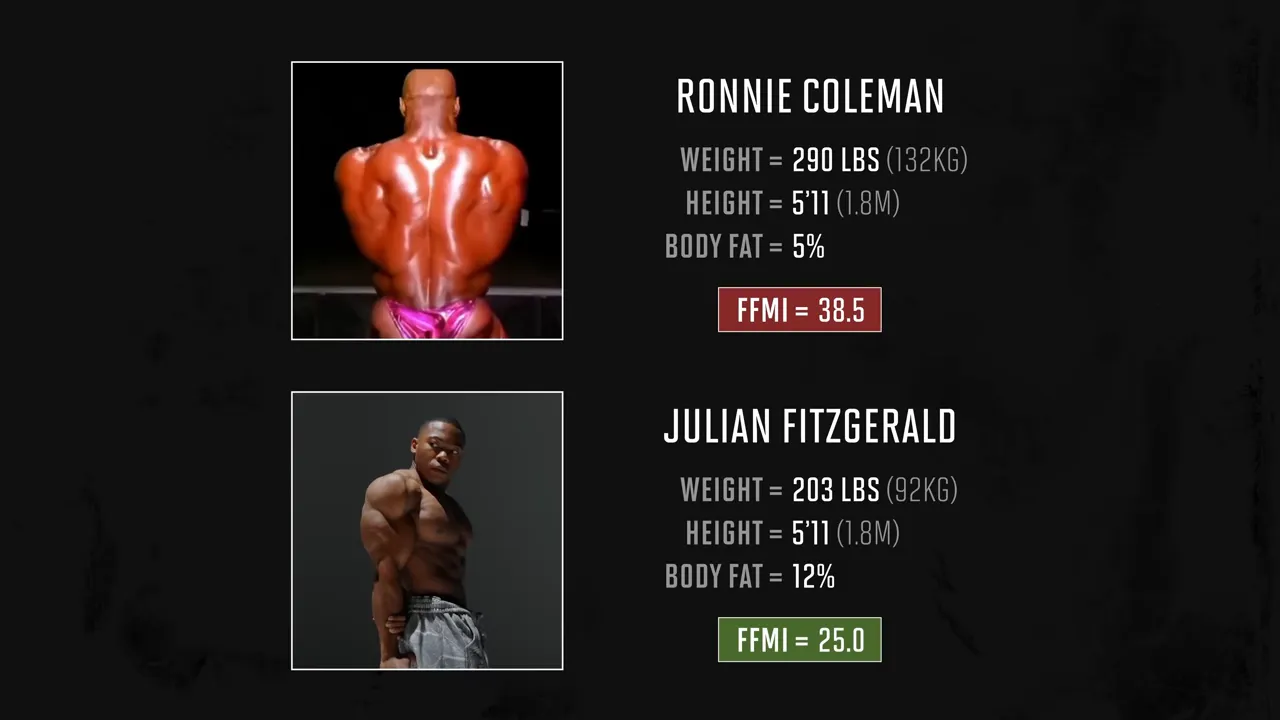
These are not remotely equivalent physiques. Ronnie won eight Mr. Olympia titles and was clearly enhanced at his peak. He also had extraordinary genetics.
Ronnie and his coaches have said he was still natural at age 27, when he already carried an impressive amount of muscle. That remains a reported history rather than something a photograph can verify. But his eventual development makes exceptional underlying genetics very easy to believe.
The Same Program Can Produce Very Different Results
A study of individual responses to resistance training helps put that variability into perspective.
Researchers had 342 women and 243 men train their elbow flexors for 12 weeks using the same training protocol. Muscle-size changes were measured with MRI.
Many participants increased muscle size by around 20%. Some showed little or no growth. Others increased size by approximately 40%, 50%, or even 55%.
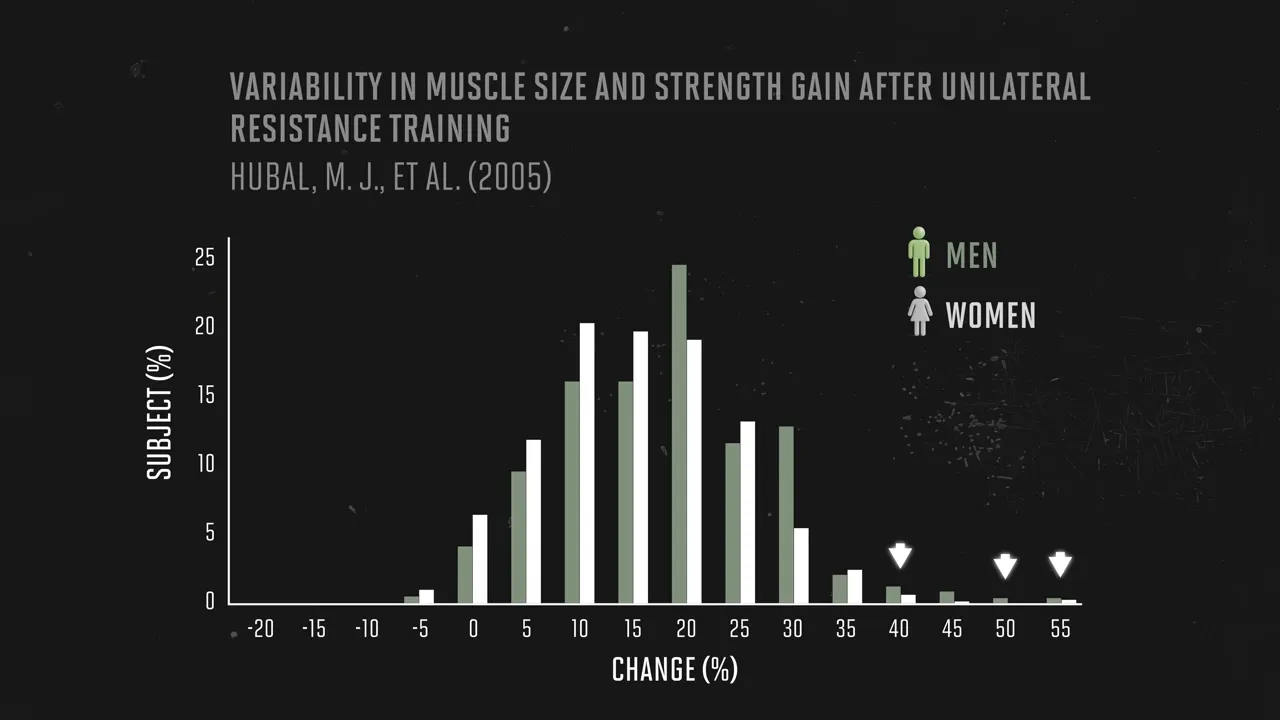
That is a huge spread of outcomes from the same program.
This study doesn’t tell us anyone’s ultimate lifetime muscle limit. It does demonstrate why assuming that everyone should progress at the same rate is a mistake. Even a sample of 585 people contained some remarkable responders.
So, How Big Can You Get Without Steroids?
For an average male who trains hard, eats appropriately, and stays consistent, my practical estimate is an eventual FFMI of around 22 to 24. Getting closer to 25 may be possible with enough time and favorable genetics.
At approximately 12% body fat, the rough body-weight benchmarks I use for an FFMI around 24 are:
- 5 feet 6 inches: about 165 pounds.
- 5 feet 9 inches: about 185 pounds.
- 6 feet: about 200 pounds.
- 6 feet 3 inches: about 220 pounds.
These are rounded reference points, not exact predictions or mandatory targets. Some people will exceed them naturally. Others will build an excellent physique without reaching them.
The best way to assess a “natty or not” claim is to consider several pieces of evidence together: muscularity relative to height, the reliability of body-fat estimates, the transformation timeline, the starting point, and individual variation. None of those makes a photograph a definitive drug test.
Use natural muscle-potential estimates to set realistic expectations, not to turn uncertainty into accusations. The evidence supports being skeptical of deception without becoming skeptical of every impressive natural physique.
And for your own progress, the useful question is not where someone else’s ceiling sits. It’s whether your training, nutrition, and consistency are allowing you to get closer to yours.
Nutrition is a crucial part of that process. I use my nutrition app, MacroFactor, to manage both bulking and cutting, with food tracking and coaching that adjusts the plan over time.
|