The training that gets you through your first year in the gym probably won’t keep working unchanged forever. As you build more muscle and gain experience, progress slows, and the way you structure your training needs to evolve.
That doesn’t mean beginners need complicated programs or advanced lifters need to abandon the basics. It means putting your effort into the things that matter most at your current stage: learning technique and adding weight as a beginner, refining progression and effort as an intermediate, and experimenting more strategically as an advanced lifter.
Nutrition provides the foundation at every level. From there, I’d focus on three key training priorities for each stage.
Key Takeaways
- Match calories to your goal and consume 1.6 to 2.2 grams of protein per kilogram daily.
- Beginners should prioritize technique, gradual strength progression, and learning what muscular failure feels like.
- Intermediates benefit from rep progression, planned exercise rotation, and more accurate effort assessment.
- Advanced lifters can experiment with specialization phases, selective intensity techniques, and different training frequencies.
Table of Contents
- Nutrition for Muscle Growth at Every Level
- Beginner Training: Build the Foundation
- Intermediate Training: Make Progress More Deliberate
- Advanced Training: Experiment Strategically
- Keep the Basics, Adjust the Strategy
Nutrition for Muscle Growth at Every Level
The fundamentals of muscle-building nutrition don’t change much with training experience. Total daily calories and protein intake are the biggest priorities.
Match your calories to your goal
- To maximize muscle gain: A calorie surplus of roughly 10 to 20 percent above maintenance is a reasonable starting point for supporting growth without excessive fat gain.
- To limit fat gain: Eating around maintenance while optimizing your training can allow body recomposition, meaning you build muscle and lose fat simultaneously.
- To prioritize fat loss: A calorie deficit of roughly 10 to 20 percent below maintenance is a reasonable target.
Maintenance is the calorie intake that keeps your body weight roughly stable. Whether you eat above, at, or below it should reflect your main goal.
Training experience affects what you can realistically expect. Body recomposition tends to work best for beginners and early intermediates, and it becomes harder as you get more advanced. Building muscle in a calorie deficit is also possible, but it becomes less feasible as you accumulate years of productive training.
Get enough protein each day
A good daily target is 1.6 to 2.2 grams of protein per kilogram of body weight, or approximately 0.7 to 1 gram per pound. This range is consistent with the research on protein intake and resistance-training adaptations.
Once those nutritional basics are in place, the bigger differences between training levels come down to what you do in the gym.
Beginner Training: Build the Foundation
The beginner stage generally covers your first one to two years of lifting, although people don’t all progress on the same timeline.
Assuming reasonably effective training and nutrition, without steroids, broad estimates for muscle gain across this initial period are:
- Males: Around 10 to 25 pounds, or roughly 4.5 to 11 kilograms.
- Females: Around 6 to 15 pounds, or roughly 3 to 7 kilograms.
These are estimates, not promises. The ranges are wide because genetic differences between individuals are substantial. You can read more about the reasoning behind these expectations in this discussion of genetic muscular potential.
To make the most of your newbie gains, focus on three things.
1. Learn good technique
Technique is about applying tension to the muscles you’re trying to train. Learn how to perform a variety of machine and free-weight exercises rather than assuming that moving the weight from point A to point B is enough.
The main priorities are:
- Use an appropriate range of motion that takes the target muscle through a reasonably full stretch and contraction.
- Control the negative, or lowering portion, rather than simply letting the weight fall.
- Learn to breathe and brace appropriately for the exercise.
As a general starting point, I recommend inhaling during the negative and exhaling during the positive, or lifting portion.
As you gain experience, you can consider the Valsalva maneuver for heavier compound exercises such as squats. This involves taking a breath and bracing before the repetition, holding that breath through the lowering and lifting portions, then releasing it at the top.
The important point is to learn the movement first. Adding weight should build on good technique, not replace it.
2. Use linear strength progression
For beginners, the main method of progressive overload can be pretty simple: pick a handful of primary exercises and aim to add a small amount of weight each week while keeping the rep count the same.
A rep target somewhere around 6 to 12 works well for this approach.
For example, you might start bench pressing the empty bar for six reps, then aim to add five pounds each week while maintaining the same technique and rep count. Small increases can add up substantially over a year. For many beginners, a body-weight bench press for a one-rep maximum can be a realistic first-year benchmark, although individual progress will vary.
You don’t need to make progression complicated while this straightforward approach is still working.
3. Learn what training to failure feels like
Once you understand the technique sufficiently well, start learning what muscular failure feels like on different exercises. In practical terms, this is the point where you can’t complete another repetition with the intended technique.
You don’t need to take every set to failure to grow. But if you never learn what your limit feels like, it’s difficult to judge how hard you’re actually training.
This matters even more later. A set that feels uncomfortable isn’t necessarily a set that’s close to failure. Developing that distinction now helps prevent you from consistently training too easily as an intermediate.
Intermediate Training: Make Progress More Deliberate
Somewhere within roughly one to five years of training, many lifters find themselves in the intermediate stage. The overlap with the beginner timeline is intentional: productive training experience matters more than a precise anniversary.
With effective training and nutrition, broad estimates for additional muscle gain across the intermediate years combined are around 10 to 20 pounds for males and 6 to 12 pounds for females. Those are not annual expectations.
At this point, progressive overload still matters. You just need more options than adding weight every week.
1. Progress through reps before automatically adding sets
Eventually, you won’t be able to keep increasing the weight every workout or every week without compromising your form. That doesn’t mean you’ve stopped being able to progress. It means progress will be less frequent and less linear.
One useful strategy is rep overload: use a rep range instead of a fixed rep target, then increase the reps before increasing the load.
Here’s what that could look like for EZ-bar curls in a six-to-eight-rep range:
- Week one: Curl 60 pounds for six reps.
- Week two: Keep 60 pounds and aim for seven reps.
- Week three: Keep 60 pounds and aim for eight reps.
- Next progression: Add a little weight and return to six reps.
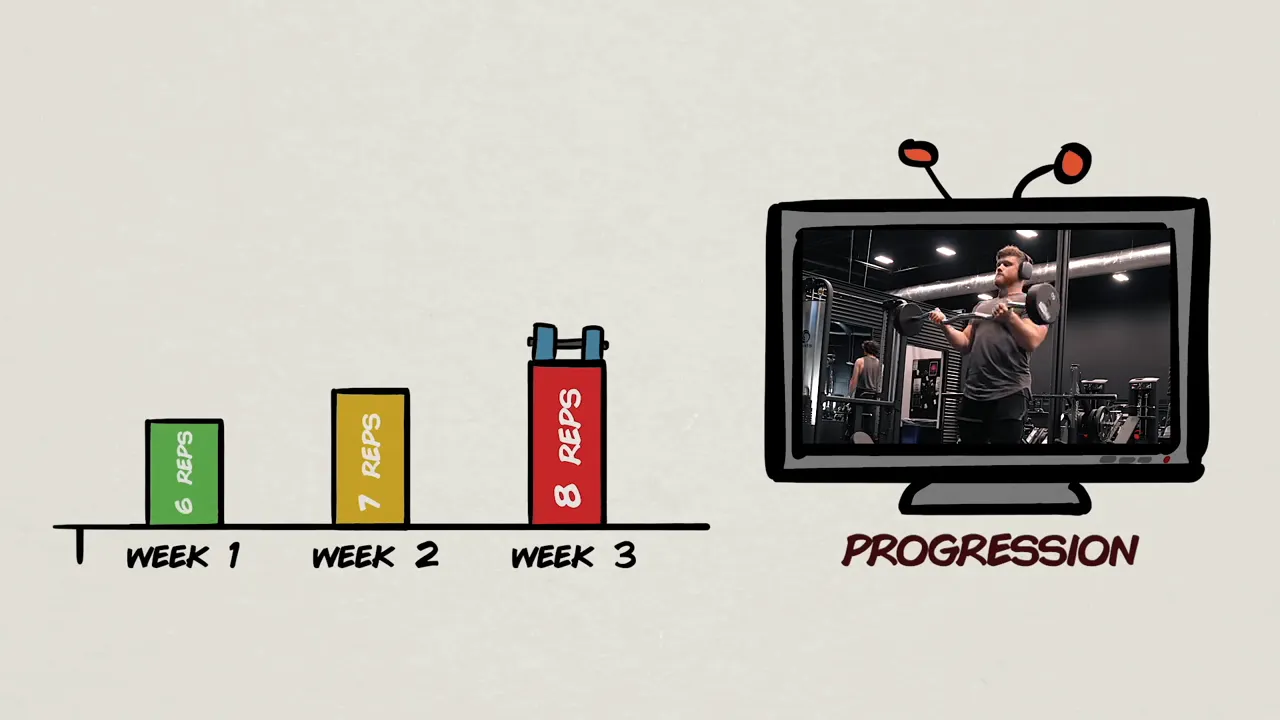
That’s an example progression, not a requirement to hit a personal record every week. The principle is to earn the load increase by progressing through the range with consistent technique.
If several weeks pass and you can’t increase either weight or reps without form breakdown, adding a set is another option. For example, you could move from three sets of six to eight reps to four sets.
However, I’d save that as a later option. Adding a whole set increases volume much more abruptly than adding a rep or a little weight, and it places a bigger demand on recovery.
The goal is to find your volume sweet spot, not to increase volume forever. Roughly 10 to 20 sets per body part per week is a useful general range, with individual needs varying. If you’re already well above that range and still struggling to progress, an exercise swap may make more sense than another set.
2. Rotate exercises periodically, not randomly
Exercise variety can be useful, but constantly changing exercises makes it harder to establish whether you’re improving.
Instead, keep an exercise in your program for around one to two months. Work on increasing the weight, reps, and perhaps sets, then consider replacing it with another exercise for the same muscle.
I mainly use this approach for isolation work. For example, a side-delt exercise rotation could look like this:
- Standing dumbbell lateral raises for one to two months.
- Lean-away Egyptian cable lateral raises for one to two months.
- Chest-supported incline lateral raises for the next block.
- Machine lateral raises for a later block.
Each exercise stays around long enough to make measurable progress. The variation is planned rather than haphazard.
3. Fine-tune your proximity to failure
As a beginner, the goal was to learn what failure feels like. As an intermediate, the goal is to get better at recognizing what one, two, or three reps short of failure feels like.
This is often described as reps in reserve, or RIR. Two reps in reserve means you estimate that you could complete two more repetitions before reaching failure.
For most working sets, I suggest:
- Compound exercises: Finish around one to three reps shy of failure on movements such as squats and presses.
- Isolation exercises: Finish around zero to two reps shy of failure.
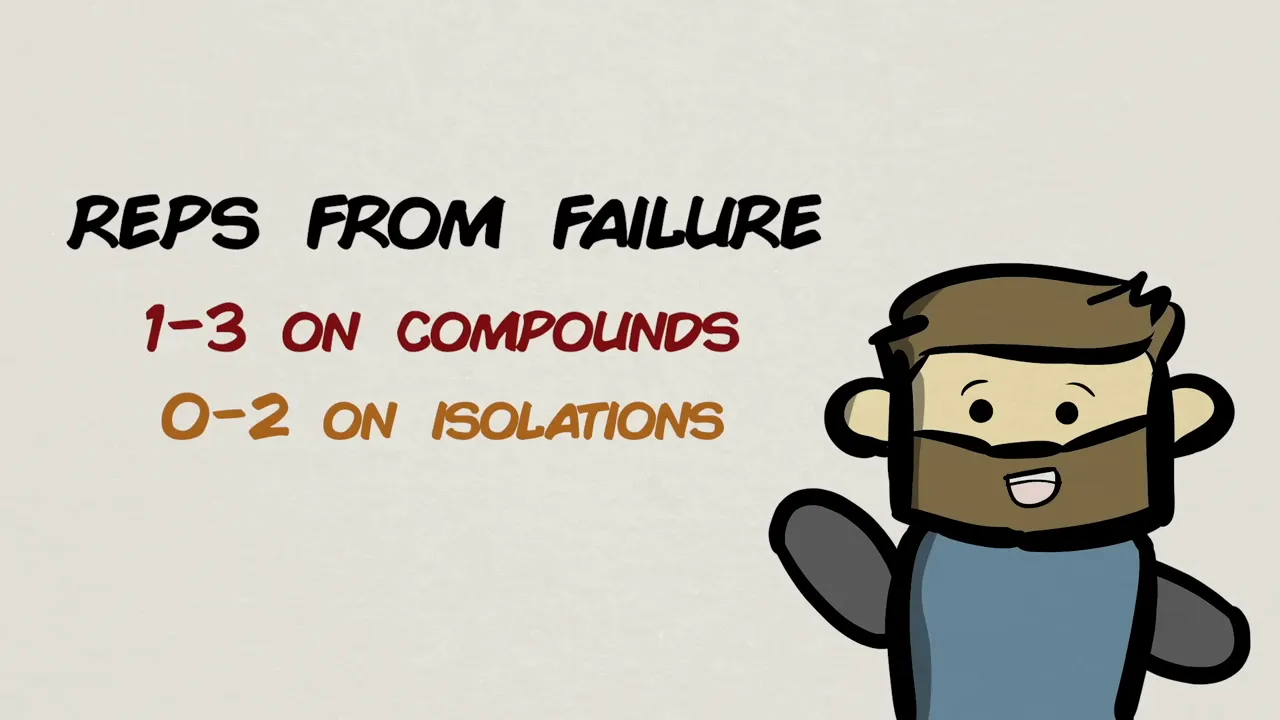
Taking every set all the way to failure isn’t always the best trade-off for recovery. But stopping too far away can leave you without a sufficiently challenging stimulus.
I also suggest taking the last set of isolation exercises to failure as a regular reminder of what that limit actually feels like. That helps keep your effort estimates grounded in experience.
Advanced Training: Experiment Strategically
After roughly four to five years of serious, dedicated training, many lifters will reach an advanced stage. The key assumption is that those years have already included reasonably well-optimized training and nutrition.
At this point, annual muscle gain may be closer to:
- Males: Around one to two pounds per year.
- Females: Around half a pound to one pound per year.
Slow progress isn’t necessarily a sign that your training is broken. It can be the reality of getting closer to your natural muscular potential. At a certain point, you may also need a more deliberate, potentially larger calorie surplus to support further growth.
With the fundamentals already in place, there are three strategies worth experimenting with.
1. Use specialization phases for priority muscles
A specialization phase dedicates around one to two months to bringing up one or two body parts by giving them more training volume than usual.
That doesn’t mean pushing every muscle harder at once. Depending on how much work you add, you may need to reduce training for other muscles to maintenance levels so that your overall recovery remains manageable.
For example, suppose you want to prioritize chest development and you’re currently doing 12 hard chest sets per week. I’d consider increasing that volume by roughly 20 to 40 percent, bringing it to about 15 to 17 weekly sets.
If recovery becomes an issue, you could reduce some delt or triceps isolation work rather than trying to keep everything at full volume.
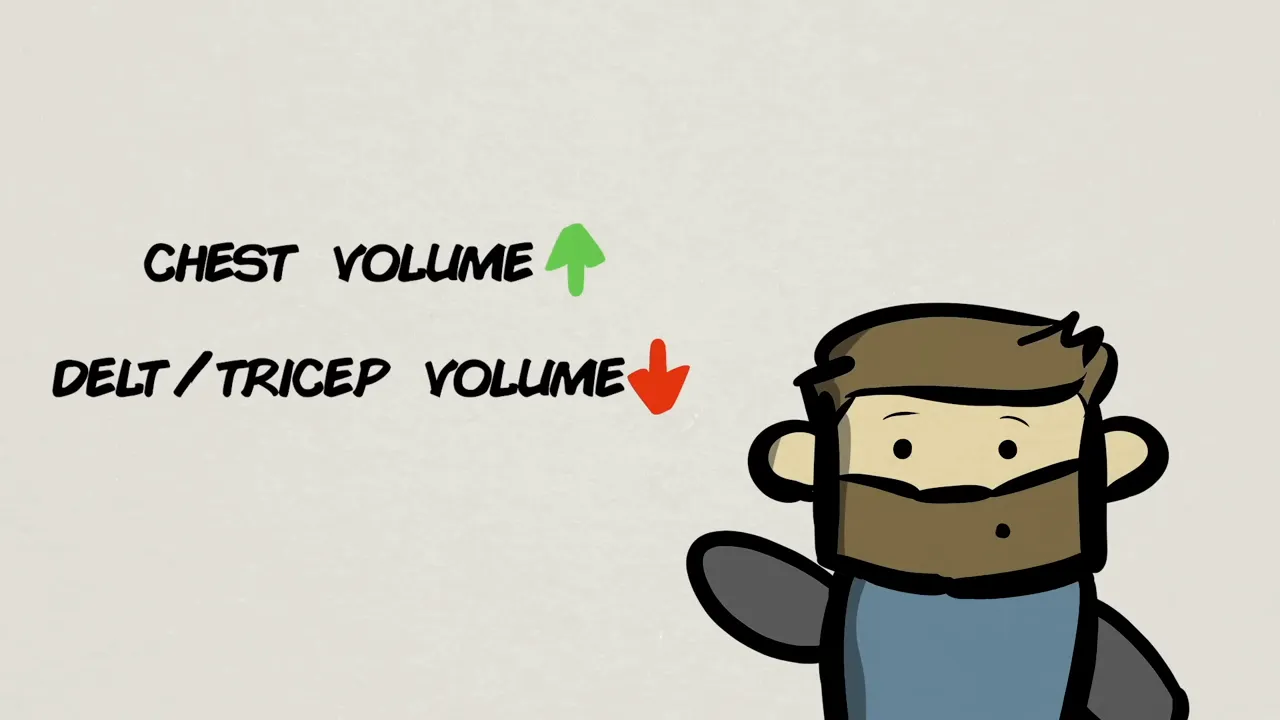
The idea is to concentrate your training resources where you want the most improvement. For more detail, this guide to muscle-group specialization cycles provides useful background.
2. Experiment with intensity techniques
Advanced intensity techniques can be worth periodically including for stubborn muscles, particularly on the final set of isolation or machine exercises.
Three options are:
- Drop sets: Reach failure, reduce the weight, and continue performing repetitions with the lighter load.
- Myo-reps: Use very brief rests to extend a hard set with additional mini-sets at the same weight. The version described here uses pauses of around three or four seconds before attempting a few more reps.
- Eccentric-accentuated reps: Emphasize the negative portion by slowing the lowering phase or having a partner apply additional resistance during it.
These are tools to experiment with, not techniques you need to apply to every set. If you want a more detailed explanation of rest-pause-style training, this myo-reps guide is a useful reference.
Be careful not to overdo intensity techniques. Extending sets this way can carry a greater recovery cost than a standard set. My preference is to use them selectively rather than turning the entire workout into a test of how exhausted you can get.
3. Try different training frequencies
Training each muscle around twice per week is a solid general approach for muscle growth. However, the frequency that works best can vary between individuals, which makes this a useful variable for advanced lifters to explore.
If you’ve trained each muscle only once per week for a long time, I’d try twice per week. If you’ve already used twice-weekly training for years, consider a higher-frequency approach, such as a full-body split.
Not everyone responds better to higher frequency. In my experience, some people do noticeably better, while others get similar results to a more moderate frequency. That’s a reason to experiment, not a reason to assume that more frequent training is automatically superior.
This review of training frequency and muscle growth provides additional context for that individual variation.
Keep the Basics, Adjust the Strategy
The fundamentals don’t disappear as you become more advanced. Good technique, progressive overload, sufficient effort, appropriate calories, and enough protein remain the foundation.
What changes is how you apply them. Beginners can get a lot out of learning their exercises and steadily adding weight. Intermediates need more deliberate progression, planned exercise variation, and a better sense of proximity to failure. Advanced lifters can explore specialization, selective intensity techniques, and different training frequencies to find what works best for them.
The goal isn’t to make training more complicated. It’s to make the right adjustment when the simpler approach stops delivering progress.


