To build muscle, you have to bulk. To lose fat, you have to cut. You cannot do both at once.
That advice gets repeated so often that it can sound like a physiological law. It is not. Building muscle while losing fat, also called body recomposition, is possible. And I think it is a practical goal for far more people than the usual advice suggests.
That does not mean bulking and cutting are useless. I have run a substantial bulk myself, which I called “bear mode,” and there are circumstances where accepting some fat gain makes sense. But gaining fat is not an unavoidable admission fee for building muscle.
The key is to understand who recomp works best for, then put training, calories, protein, and recovery together in a way that supports both goals.
Key Takeaways
- Building muscle while losing fat is practical for many beginners, returning lifters, and suboptimized trainees.
- Progressive resistance training drives recomposition; nutrition and recovery support the process.
- Choose a primary goal, then adjust calories relative to maintenance and prioritize protein.
- Sleep, workout nutrition, and selected supplements become more important as you advance.
Table of Contents
- Why You Do Not Need a Massive Bulk to Build Muscle
- Who Can Realistically Achieve Body Recomposition?
- Step 1: Make Progressive Resistance Training the Driving Force
- Step 2: Choose Your Primary Goal
- Step 3: Set Calories Around Maintenance
- Step 4: Set Your Macros, Starting With Protein
- Step 5: Optimize the Details as You Get More Advanced
- Put the Fundamentals Before the Fine-Tuning
Why You Do Not Need a Massive Bulk to Build Muscle
The idea that muscle growth requires a huge calorie surplus comes largely from old-school bodybuilding practices: eat aggressively to gain size, then diet off the extra fat before competition.
But more food does not automatically translate into proportionally more muscle.
In a 2013 study by Garthe and colleagues, athletes assigned to a higher energy intake ate roughly 600 additional calories per day. They did not gain significantly more lean mass than the comparison group, but they gained more than three times as much fat mass. Much of the extra bulk was simply extra fat.
If your priority is gaining muscle and strength as quickly as possible, a calorie surplus can still be useful. The trade-off is that pushing calories higher can also mean gaining more fat, which many people would rather avoid.
Fortunately, fat tissue and muscle tissue are separate systems. Your body can draw on stored fat for energy while responding to resistance training by building muscle. You do not need a large dietary surplus for those processes to occur together.
Who Can Realistically Achieve Body Recomposition?
Recomposition tends to be easiest when you have a strong opportunity for muscle growth, substantial stored energy, or both. There are four commonly recognized groups, plus a fifth that deserves much more attention.
- New lifters. Beginners are highly responsive to resistance training. With progressive training and a reasonable diet, they can build muscle while using stored body fat to help meet their energy needs.
- People carrying more body fat. Larger energy reserves make it possible to eat in a calorie deficit while still having stored energy available to support muscle growth.
- Detrained lifters. If you previously built muscle and then stopped training because of injury or other commitments, muscle memory can help you regain it relatively quickly.
- People using anabolic steroids. These drugs can greatly accelerate muscle growth, making simultaneous fat loss and muscle gain more achievable. This explains one scenario where recomp occurs; it is not a recommendation to use them.
- The suboptimized trainee. You may have years of gym experience without having consistently trained hard, followed a well-designed program, or paid close attention to nutrition. Improving those areas can create a new opportunity for recomp.
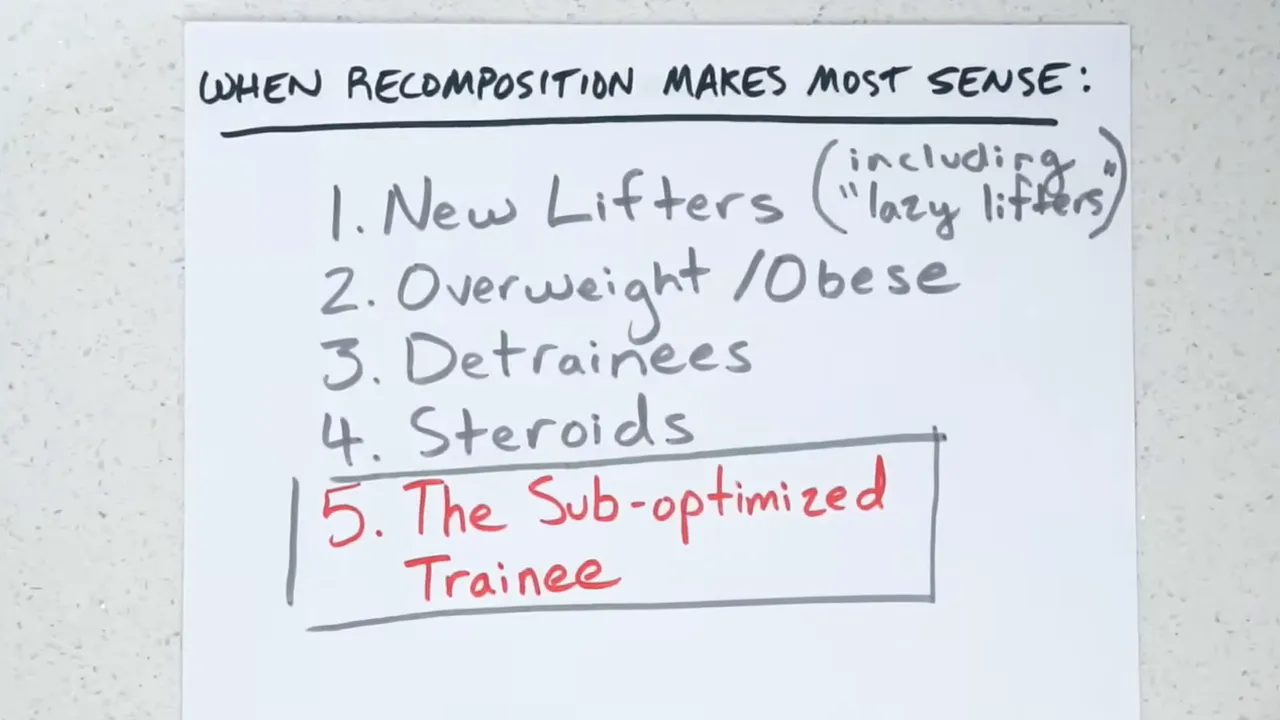
That fifth group is important. Training age is not the same thing as training advancement. Spending several years in a gym does not necessarily mean you have exhausted your beginner potential.
My co-author, researcher Chris Barakat, has described seeing recomposition repeatedly in training studies, including among experienced trainees. Improving macronutrient intake, nutrient timing, and training execution can make a meaningful difference even when someone is already reasonably strong.
One striking example he shared involved a resistance-trained basketball player who could squat 1.75 times his body weight. Over ten weeks, the athlete reportedly gained about 20 pounds of lean mass while losing roughly one pound of fat. That is an exceptional individual result, not a realistic promise. It is also worth keeping the terminology straight: lean mass is not synonymous with pure muscle tissue.
The group I consider least suited to recomp is much smaller: truly advanced lifters who already have highly optimized training and nutrition and are close to their genetic ceiling for muscle growth. For them, dedicated gaining and fat-loss phases may be more practical.
For almost everyone else, there is usually room to improve the conditions that make recomposition possible.
Step 1: Make Progressive Resistance Training the Driving Force
You can have an incredibly precise diet and eat protein all day, but without a progressive training stimulus, you are not giving your body much reason to build new muscle.
I like to think of the process as a car:
- Training is the engine. It drives the adaptation.
- Nutrition is the fuel. It supports training performance and recovery.
- Sleep and stress management are maintenance. They help keep the whole system running.
Better fuel can improve performance, but it cannot make a car move if there is no engine.
Your training should prioritize three fundamentals:
- Progressive overload: Increase the demands of training over time rather than repeating the same comfortable work indefinitely.
- Appropriate effort: Your sets need to provide a meaningful challenge.
- Proper technique: Perform your exercises well rather than sacrificing execution just to move more weight.
Once those fundamentals are in place, adjust training volume to your experience level and ability to recover. About 10 to 20 sets per muscle group per week is a useful ballpark for most people and most muscles, not a requirement that every lifter must reach the top of that range.
Step 2: Choose Your Primary Goal
Even though you want to gain muscle and lose fat, it helps to decide which outcome matters more right now. That choice guides your calorie intake.
As a rough starting framework:
- If you are already lean: At approximately 8% to 12% body fat for men or 18% to 22% for women, I would generally prioritize building muscle.
- If you are carrying more fat: At approximately 15% to 20% body fat or higher for men, or 25% to 30% or higher for women, I would generally consider prioritizing fat loss.
These are approximate decision-making ranges, not rigid boundaries. The point is not to get stuck debating a single percentage point. It is to establish a clear priority rather than trying to maximize two competing outcomes equally.
Step 3: Set Calories Around Maintenance
Maintenance calories are the amount of food energy you need to maintain your body weight. Use maintenance as your reference point, then adjust in the direction of your primary goal.
If muscle gain is the priority
My general framework is a surplus of 5% to 25% above maintenance.
Where you fall within that range matters. A leaner, less advanced person with a strong capacity for muscle growth may have more room to use a larger surplus. That does not mean everyone should choose the upper end, especially if minimizing fat gain is a major priority.
The goal is to provide enough energy to support growth, not to assume that more calories always produce better results.
If fat loss is the priority
Use a deficit of approximately 10% to 20% below maintenance.
Generally, the more body fat you have to lose, the more room you have to use the larger end of that deficit. The objective is to encourage fat loss while continuing to support productive resistance training.
Detrained lifters, highly advanced trainees, people who are significantly overweight, and people who describe themselves as “skinny fat” can require more individualized decisions. The basic principle remains the same: start from maintenance and make a deliberate adjustment that matches your situation.
Step 4: Set Your Macros, Starting With Protein
Protein is the most important macronutrient to prioritize for body recomposition. In our guide, Chris and I use a sliding model based on lean body mass rather than total body weight.
- Higher body fat: Aim closer to 1.2 grams of protein per pound of lean body mass per day.
- Lower body fat: Aim closer to 1.6 grams of protein per pound of lean body mass per day.
Notice that the recommendation is per pound of lean body mass, not per pound of total body weight. That distinction makes a substantial difference, particularly for someone carrying more body fat.
A practical protein calculation
Using my own numbers at the time as an example, I weighed about 165 pounds at roughly 10% body fat.
- Estimated fat mass: 165 × 0.10 = 16.5 pounds.
- Estimated lean body mass: 165 − 16.5 = 148.5 pounds.
- Because I was lean, I chose a multiplier near the higher end: 1.5 grams per pound.
- Daily protein target: 148.5 × 1.5 = 222.75 grams, rounded to about 225 grams.
You may be able to build muscle with less protein than this. I do not present this range as the minimum required for muscle growth. It is the higher-protein approach I favor when trying to optimize recomposition.
Set fat, then fill the remaining calories with carbs
After protein, I personally set dietary fat at a minimum of 20% of total calories, then allocate the remaining calories to carbohydrates.
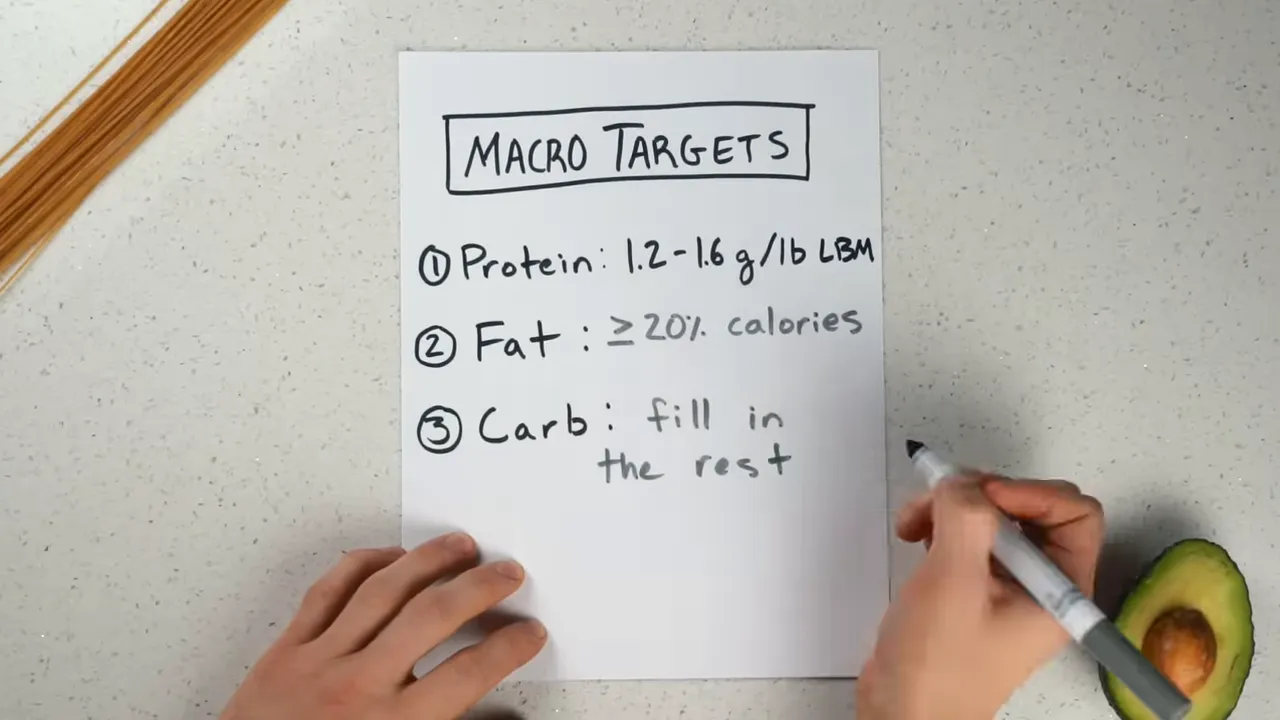
That gives you a straightforward order of operations: set total calories, establish protein, provide enough fat, and use carbs to complete the plan.
Step 5: Optimize the Details as You Get More Advanced
A beginner may achieve recomp simply by following the first four steps consistently. As you become more advanced, the margin for improvement gets smaller, and the details become more important.
Take sleep seriously
Sleep may be the most underrated factor in changing your physique. It is not just about feeling less tired. It can affect the composition of the weight you lose.
In a 2018 study by Wang and colleagues, 36 participants were assigned to calorie restriction with or without additional sleep restriction. The sleep-restricted group was instructed to sleep one hour less on five nights per week, with extra sleep permitted on the other two nights.
After eight weeks, the groups lost a similar amount of total weight. However, the reported breakdown was dramatically different: the normally sleeping group lost about 83% of its weight as fat, while the sleep-restricted group lost about 85% as lean mass.
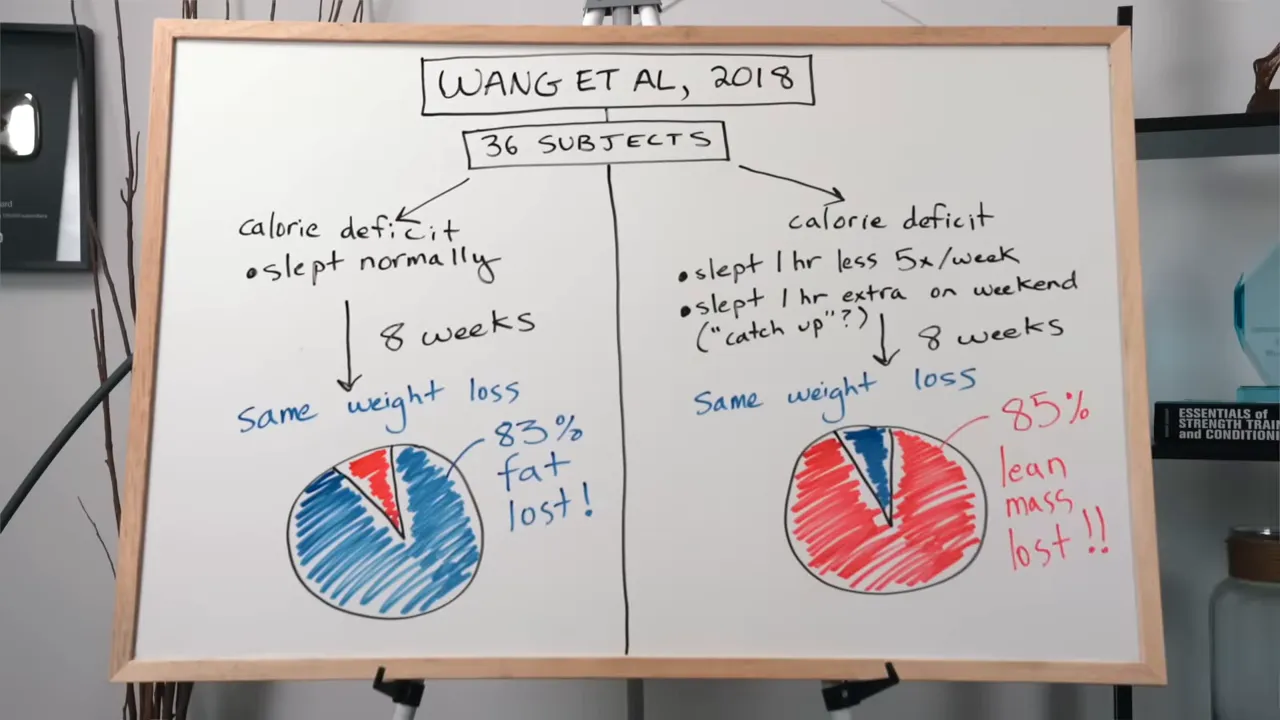
There is an important limitation: these participants were not resistance training. We cannot assume the same percentages would apply to lifters, and lean mass is not exclusively muscle. Still, the practical lesson is hard to ignore: do not treat sleep as optional while trying to improve body composition.
Pay attention to nutrition around training
Peri-workout nutrition means the food and nutrients you consume around your workout. Once total calories and daily macros are established, pre-workout and post-workout nutrition are additional areas to refine.
Keep the priorities straight. Meal timing is an optimization tool, not a replacement for an appropriate calorie intake, enough protein, or a productive training program.
I discuss this further in my full day of eating breakdown, including some common misconceptions about workout nutrition.
Use supplements to support the plan, not replace it
There is no special “recomp supplement” that causes muscle gain and fat loss on its own. The most useful options support protein intake or training performance.
Protein powder
Protein powder is a convenient way to meet your daily target. Whey can be used whenever it fits your diet; its main practical benefit is making adequate protein easier to achieve.
For vegan lifters, a blend of rice and pea protein is an option I recommend. Sometimes marketed as “vegan whey,” it is not actually whey, but the blend offers a complementary amino acid profile and can provide a substantial amount of leucine.
A casein source before bed may also have merit. Again, these are ways to refine a solid nutrition plan, not reasons to neglect your daily total.
Creatine monohydrate
Creatine is one of the most extensively studied sports supplements. Given its affordability and low risk of side effects for healthy users, it is a strong option to consider.
My recommendation is 3 to 5 grams of creatine monohydrate per day. For a more detailed explanation, see my creatine science breakdown.
Caffeine
Caffeine can increase strength and delay fatigue during training. It can also increase acute fat oxidation, although that is not the same thing as guaranteeing greater long-term body-fat loss.
Unlike creatine, caffeine is subject to tolerance. One strategy is to reserve it for your heaviest or most demanding sessions rather than automatically using it before every workout. Periodically taking a break is another approach to consider.
Put the Fundamentals Before the Fine-Tuning
Body recomposition does not require a secret diet or a special supplement stack. It requires a progressive training stimulus, calories matched to your primary goal, adequate protein, and recovery that supports the work.
For beginners and people returning to training, those basics can go a long way. For experienced lifters, the question is often whether training and nutrition are genuinely optimized, not simply how many years they have been lifting.
If you want a more detailed framework, my Ultimate Guide to Body Recomposition, co-authored with Chris Barakat, expands these principles across 15 chapters with more than 140 scientific references. It includes step-by-step calorie and macro setup, sample meal plans, pre-workout and post-workout meal examples, cardio strategies, recovery guidance, and a full chapter on training for recomp.
|


