A bodyweight bench press is a meaningful milestone. So is a two-times-bodyweight deadlift. But how strong should you realistically expect to become, and what needs to change in your training to get there?
I break strength down into six categories: noob, beginner, intermediate, advanced, elite, and freak. These squat, bench press, and deadlift standards can help you set realistic goals, but the label is only useful if it helps you decide what to do next.
The goal isn't to jump straight from your first plate to a world record. It's to identify where each lift sits now and build a plan that takes it one level higher.
Key Takeaways
- Strength standards are practical guides, not deadlines or guarantees of your genetic potential.
- Compare one-rep maximums with consistent technique, using bodyweight ratios within their intended limits.
- Beginners can progress linearly, while intermediate and advanced lifters often need more deliberate programming.
- Assess each lift separately and focus on reaching the next realistic level.
Table of Contents
- Before You Compare Your Lifts, Understand the Limitations
- 1. Noob: Your First Three to Six Months
- 2. Beginner: Roughly Six Months to Two Years
- 3. Intermediate: Roughly Two to Five Years
- 4. Advanced: Often Around Five Years or More
- 5. Elite: Often Five to Ten Years or More
- 6. Freak: Exceptional Strength, Even Among Strong Lifters
- Set Your Next Goal One Level at a Time
- A Structured Program for Building Muscle and Strength
Before You Compare Your Lifts, Understand the Limitations
Genetics affect both your starting point and your potential
Strength isn't determined by effort alone. Your skeleton, or your leverages, can make a substantial difference.
For example, my short arms and relatively large rib cage are helpful for the bench press. However, those same short arms are a disadvantage on the deadlift because my hips have to start lower for me to reach the bar. Short femurs are generally advantageous for squatting.
That doesn't mean unfavorable proportions decide your fate. Dr. Layne Norton set a squat world record despite having very long femurs. Intelligent programming and technique adjustments can help compensate for less favorable leverages.
There are other differences, too: tendon resilience, neural drive, and how much muscle someone carries before they ever start lifting. For more context, this discussion of genetics and strength training explains why people can respond so differently.
Someone with outstanding genetics might reach advanced numbers within a couple of years. Someone with below-average genetics might need five to ten years. The timelines below are rough guides, not deadlines.
I've based these standards on more than a decade of coaching experience, competitive powerlifting results, and existing strength scales from coaches such as Mark Rippetoe and Tim Henriques. They are practical benchmarks, not universal laws.
Three rules for using these standards
- Keep your technique consistent. Cutting squat depth to lift more weight doesn't represent the same improvement as getting stronger through the same range of motion. For these bench press standards, briefly pause the bar on your chest.
- Recognize the limits of bodyweight ratios. These standards mainly apply to natural, reasonably lean lifters: below roughly 20 to 25 percent body fat for men and 30 to 35 percent for women. Simple ratios become less useful at very high bodyweights. If you're a natural lifter above 250 pounds, or about 113 kilograms, use 250 pounds as your reference weight for this scale.
- Compare one-rep maximums, not working sets. Every standard refers to a one-rep max, or 1RM. That doesn't mean you need to test a true maximum frequently.
To estimate your 1RM, enter a recent hard set taken close to failure, preferably below about five reps, into the ExRx one-rep max calculator. Treat the result as a ballpark figure. Performing a maximum single is its own skill, so an estimate won't perfectly predict what you can actually lift.
For the ratio-based standards, multiply your bodyweight by the listed number. A 1.5-times-bodyweight lift means 270 pounds for someone weighing 180 pounds. Some practical examples below are rounded to convenient barbell loads rather than exact mathematical results.
Your lifts don't have to fall into the same category
As a reference point, at a bodyweight of about 180 pounds, or 81 kilograms, the numbers I'm using for my own comparison are:
- Squat: 480 pounds, or about 218 kilograms, roughly 2.6 times bodyweight.
- Bench press: 380 pounds, or about 172 kilograms, roughly 2.1 times bodyweight.
- Deadlift: 530 pounds, or about 240 kilograms, roughly 2.9 times bodyweight.
That places my squat and bench in the elite category, while my deadlift sits in advanced. My ratios have been higher at a lighter bodyweight, but these comparisons use the same bodyweight and training period rather than combining unrelated all-time bests.
1. Noob: Your First Three to Six Months
This is the stage where learning the movements matters more than chasing a particular number. Starting strength varies enormously, especially on the deadlift.
Starting strength ranges
For men:
- Squat: approximately 45 to 135 pounds, or 20 to 61 kilograms.
- Bench press: approximately 45 to 95 pounds, or 20 to 43 kilograms.
- Deadlift: approximately 45 to 135 pounds, or 20 to 61 kilograms.
For women:
- Squat: approximately 45 to 95 pounds, or 20 to 43 kilograms.
- Bench press: up to approximately 45 pounds, or 20 kilograms, with lighter implements as needed.
- Deadlift: approximately 45 to 135 pounds, or 20 to 61 kilograms.
These aren't minimum entry requirements. Some people will deadlift 225 pounds on their first day, while others need time to become comfortable with a much lighter load. Getting to one 45-pound plate per side, a total of 135 pounds with a standard bar, is often a useful early squat or deadlift milestone.
How to reach the beginner level
Focus on improving technique and adding small amounts of weight as you become capable of doing so. For strength work, the three-to-six-rep range is a useful place to build skill while progressing the load.
You don't need elaborate periodization yet. You need repeatable practice, manageable increases, and reps that become more consistent over time.
2. Beginner: Roughly Six Months to Two Years
At the beginner stage, your technique should look reasonably consistent from rep to rep. It probably won't be fully mastered, and staying locked in near a maximum can still be difficult. That's normal.
Beginner strength standards
For men:
- Squat: 1.25 times bodyweight.
- Bench press: 1 times bodyweight.
- Deadlift: 1.5 times bodyweight.
For a 180-pound man, practical targets are approximately a 225-pound squat, 185-pound bench, and 275-pound deadlift.
For women:
- Squat: 0.5 to 1 times bodyweight.
- Bench press: 0.5 times bodyweight.
- Deadlift: 0.5 to 1 times bodyweight.
For a 140-pound woman, those ratios correspond to a 70-to-140-pound squat, a 70-pound bench, and a 70-to-140-pound deadlift.
Keep the main lifts consistent
You should generally still be able to progress from workout to workout. That might mean adding five pounds or performing one more rep with the same weight in the three-to-six-rep range.
Not every session will be a personal record. Some days you'll feel weaker. The important point is that progress should still be relatively frequent.
It's perfectly fine to keep training enjoyable by changing accessory bodybuilding exercises. But keep a few core movements, such as the squat, bench press, and deadlift, stable enough to track and improve them.
Usually around the one-to-two-year mark, progress begins slowing noticeably. If you can no longer set new records every session without compromising technique or recovery, that may be a sign that you're entering intermediate territory, not that you're doing something wrong.
3. Intermediate: Roughly Two to Five Years
This is where many lifters encounter their first substantial plateau. Some stay here indefinitely, becoming the so-called lifetime intermediate: training regularly, but no longer moving meaningfully forward.
A progressive strength plan can help you avoid simply repeating the same workouts and hoping for a different result.
Intermediate strength standards
For men:
- Squat: 1.25 to 1.75 times bodyweight.
- Bench press: 1 to 1.5 times bodyweight.
- Deadlift: 1.5 to 2.25 times bodyweight.
For a 180-pound man, that is approximately a 225-to-315-pound squat, a 185-to-275-pound bench, and a 275-to-405-pound deadlift.
For women:
- Squat: 1 to 1.5 times bodyweight.
- Bench press: 0.5 to 0.75 times bodyweight.
- Deadlift: 1.25 to 1.75 times bodyweight.
For a 140-pound woman, that means a 140-to-210-pound squat, a 70-to-105-pound bench, and a 175-to-245-pound deadlift.
Move beyond adding weight every workout
The key change is to take a less linear approach. Instead of using the same rep range and trying to add weight every session, train slightly different qualities on different days.
For example, you could organize your squat training like this:
- Heavy day: three to five reps at relatively high exertion.
- Lighter day: six to ten reps for hypertrophy, or two to four reps at lower exertion for speed and technique.
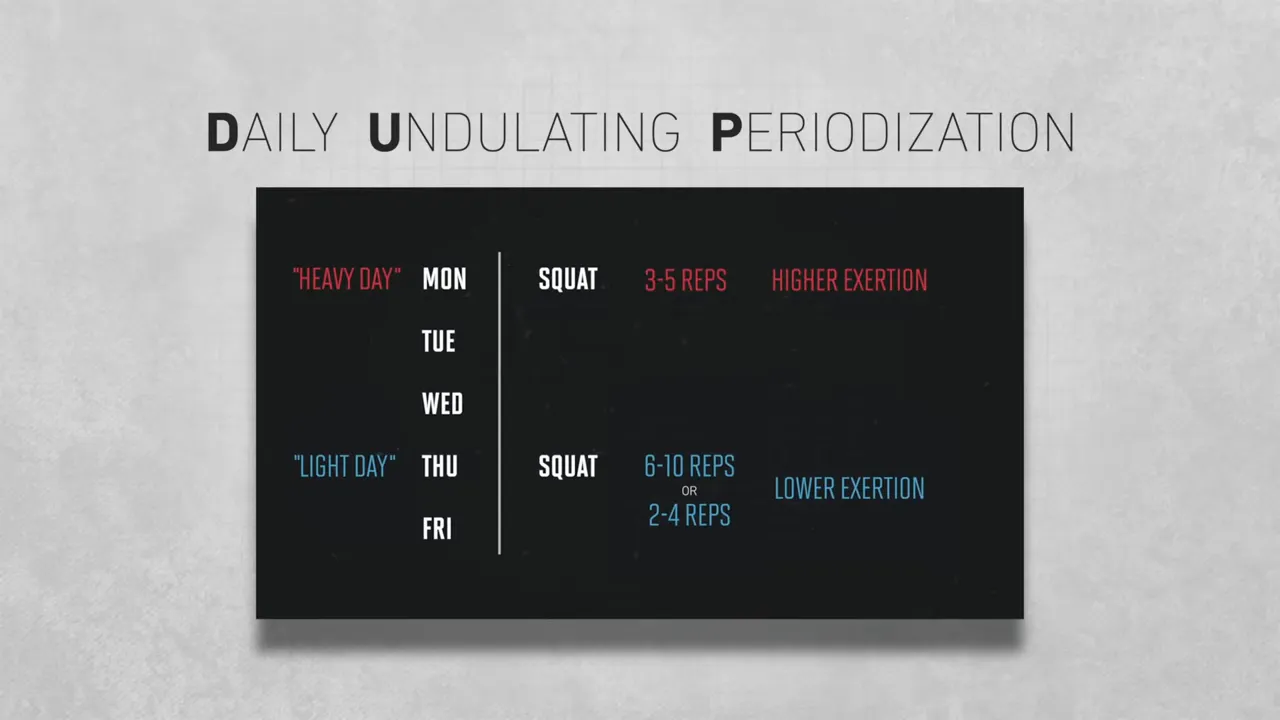
This is an example of daily undulating periodization, or DUP. The rep ranges and training emphasis vary across the week instead of every session asking you to do essentially the same thing.
Your lifts still need to trend upward. The difference is that the progress curve will usually be slower and less straight than it was as a beginner.
4. Advanced: Often Around Five Years or More
With consistent training and a focused plan, many committed lifters can move into advanced territory around the five-year mark. Again, individual timelines vary considerably.
Advanced strength standards
For men:
- Squat: 1.75 to 2.5 times bodyweight.
- Bench press: 1.5 to 2 times bodyweight.
- Deadlift: 2.25 to 3 times bodyweight.
For a 180-pound man, practical reference numbers are approximately a 315-to-455-pound squat, a 275-to-365-pound bench, and a 405-to-545-pound deadlift.
For women:
- Squat: 1.5 to 1.75 times bodyweight.
- Bench press: 0.75 to 1 times bodyweight.
- Deadlift: 1.75 to 2.25 times bodyweight.
For a 140-pound woman, those ratios correspond to a 210-to-245-pound squat, a 105-to-140-pound bench, and a 245-to-315-pound deadlift.
Getting stronger requires more specific decisions
Moving from advanced to elite isn't necessarily possible for everyone. I do think more people can get there than many realize, but the extra progress may require sacrifices they aren't interested in making.
At this stage, three strategies become especially relevant.
- Specialize in one lift. You may need to put other lifts at maintenance while concentrating training and recovery on your priority. Alex from AlphaDestiny reached a 405-pound bench press using this kind of focused approach.
- Address your actual weak points. If deadlift lockout consistently limits you, exercises or methods such as chains, hip thrusts, and block pulls could help. The choice should address the problem rather than simply make training more complicated.
- Build more muscle. Once technique is well developed, muscle size can become the limiting factor. Several months, or even a year, emphasizing moderate-to-high-rep hypertrophy training in a caloric surplus may help support further strength gains.
No one reaches elite strength by accident. It takes increasingly intentional planning, consistency, and dedication.
5. Elite: Often Five to Ten Years or More
Elite numbers represent ambitious long-term targets for natural lifters who prioritize maximum strength. Some people can reach them sooner, but time alone doesn't get you there.
Elite strength standards
For men:
- Squat: 2.5 to 3 times bodyweight.
- Bench press: 2 to 2.25 times bodyweight.
- Deadlift: 3 to 3.5 times bodyweight.
For a 180-pound man, that works out to approximately a 455-to-545-pound squat, a 365-to-405-pound bench, and a 545-to-630-pound deadlift using practical rounded loads.
For women:
- Squat: 1.75 to 2.25 times bodyweight.
- Bench press: 1 to 1.25 times bodyweight.
- Deadlift: 2.25 to 3 times bodyweight.
For a 140-pound woman, that means a 245-to-315-pound squat, a 140-to-175-pound bench, and a 315-to-420-pound deadlift.
I consider these some of the highest numbers many natural lifters can realistically strive for. Not everyone will reach them, but with enough time, appropriate programming, and dedication, I think many people can become elite in at least one or two lifts.
Beyond that, we're talking about exceptional genetic potential as well as exceptional training.
6. Freak: Exceptional Strength, Even Among Strong Lifters
This category isn't simply the next guaranteed reward for training longer. It describes performances that require an unusual combination of genetics, preparation, and dedication.
For men, the thresholds are above:
- Squat: 3 times bodyweight.
- Bench press: 2.25 times bodyweight.
- Deadlift: 3.5 times bodyweight.
For women, the thresholds are above:
- Squat: 2.25 times bodyweight.
- Bench press: 1.25 times bodyweight.
- Deadlift: 3 times bodyweight.
Taylor Atwood: Numbers that almost need another category
Taylor Atwood's performances as a drug-tested raw powerlifter in the 163-pound, or 74-kilogram, weight class show just how far beyond these thresholds exceptional athletes can go.
- Squat: 668 pounds, or 303 kilograms, approximately 4 times bodyweight.
- Bench press: 430 pounds, or 195 kilograms, approximately 2.6 times bodyweight.
- Deadlift: 750 pounds, or about 340 kilograms, approximately 4.6 times bodyweight.
Those squat and deadlift performances were American records at the time. For perspective, that deadlift was about 200 pounds above my all-time deadlift best at the same bodyweight. Absolutely mind-boggling.
Jessica Buettner: World-class strength across all three lifts
Canadian drug-tested raw powerlifter Jessica Buettner provides another outstanding example. At the meet highlighted here, competing in the 167-pound, or 76-kilogram, weight class, she achieved:
- Squat: 464 pounds, or 210.5 kilograms, approximately 2.77 times bodyweight, earning gold and a world record at the time.
- Bench press: 231 pounds, or 105 kilograms, approximately 1.4 times bodyweight, earning bronze.
- Deadlift: 546 pounds, or 247.5 kilograms, just over 3.25 times bodyweight, earning gold and another world record at the time.
These are examples of extraordinary performance, not reasonable expectations for everyone who follows a good program.
Set Your Next Goal One Level at a Time
The most useful question isn't “How far am I from a world-class powerlifter?” It's “What does my next realistic strength milestone require?”
- If you're new, build technique and add small amounts of weight.
- If you're a beginner, keep the main lifts consistent and take advantage of frequent progress.
- If you're intermediate, introduce more variation in training emphasis rather than forcing linear increases.
- If you're advanced, consider specialization, targeted weak-point work, and whether more muscle would help.
Use the standards to give your training direction, not to turn every workout into a test of whether you're strong enough. Take it one lift and one level at a time.
A Structured Program for Building Muscle and Strength
My Powerbuilding Phase 2.0 program is designed for intermediate-to-advanced lifters who want to build both muscle and strength. It runs for 12 weeks, combines full-body and push/pull/legs training structures, and offers options for four or five to six training days per week.
It includes a 120-page ebook, a custom Excel tracking spreadsheet, a technique handbook, exercise demonstrations, substitutions, and progress checkpoints. Exercise variations include Larsen presses, Meadows rows, chest movements at multiple heights, and biceps and forearm variations.
Phase 2 is a separate program intended to build on Phase 1, so I recommend completing Phase 1 first. If you're still in your first year or two of lifting, my Fundamentals program is the more appropriate starting point.
|


