After more than 15 years of natural bodybuilding, I was starting to wonder whether I had built all the muscle I could build. I was still training hard, but I hadn’t seen noticeable gains in a few years. Had I reached my natural ceiling, or had I just stopped being as consistent and deliberate as I thought?
To find out, I committed to a year of the most optimized training and nutrition I could manage: tracking every workout, pushing my sets harder, logging every calorie, and taking recovery seriously.
My brother Brad joined me. He’s a similar height and shares some of my genetics, but he started as a completely untrained beginner. That gave us an interesting comparison: someone brand new to lifting versus someone 15 years deep.
The experiment ultimately ran about 14 months because we extended the final cut. At the same starting and finishing body weight, I gained 2.7 pounds of lean mass. Brad gained about 10 pounds of lean mass while losing about 10 pounds of fat.
But those final numbers don’t tell the whole story. There was an overly aggressive bulk, a disappointing recomp, a knee injury, and a pretty important reminder that lifting does more than change how you look.
Key Takeaways
- I gained 2.7 pounds of lean mass despite already having more than 15 years of training experience.
- Brad gained about 10 pounds of lean mass while losing about 10 pounds of fat.
- Rapid early lean-mass gains can include substantial water, making multiple progress measurements valuable.
- A less aggressive bulk is the main change I would make after gaining more fat than intended.
Table of Contents
- The Question: Had I Reached My Natural Muscle-Building Ceiling?
- How We Measured Progress
- The Training Plan: Five Days a Week, With Everything Logged
- Nutrition, Sleep, and Supplements
- Month One: Huge Numbers, With an Important Catch
- The Six-Month Bulk: Bigger, Stronger, and Definitely Softer
- Months Seven Through Nine: Could I Recomp at Maintenance?
- A Knee Injury Changed the Final Phase
- The Cut: Losing Fat Without Giving Back Every Gain
- The Final Results: Beginner Versus Advanced Lifter
- What I’d Change, and What This Means for Natural Lifters
- Putting the Training Plan Into Practice
The Question: Had I Reached My Natural Muscle-Building Ceiling?
Muscle growth is usually fastest in your first few years of lifting. As you become more advanced, progress slows. Eventually, it’s tempting to assume you’ve reached a hard limit.
I had definitely thought about steroids, but the potential side effects scared me. I also didn’t want to settle for maintenance if I still had natural gains available.
The problem is that there isn’t a clear scientific test that tells an individual lifter, “That’s it. You’re done.” A long plateau doesn’t necessarily establish that you’ve exhausted your potential.
My hypothesis was that I still had room to grow. I set an ambitious prediction of four pounds of muscle for me and nine pounds for Brad. The research team wasn’t exactly overflowing with confidence about my prediction. Challenge accepted.
How We Measured Progress
We started at McMaster University and returned for repeated check-ins. Rather than relying on the scale or a good pump, we used several measurements:
- DEXA scans to estimate body fat and lean mass.
- Ultrasound to measure muscle thickness in our biceps and quads.
- Standardized physique photos with consistent lighting and camera angles.
- Strength testing using a Biodex dynamometer, which measures how much torque you produce against the machine.
- Bioelectrical impedance analysis, or BIA, as another body-composition measurement.
My starting DEXA result was 15.8% body fat and 132.7 pounds of lean mass. Brad started at 36.2% body fat. Both body-fat estimates were higher than we expected, which probably says something about how accurately most of us judge our own leanness.
One distinction matters throughout this experiment: lean mass is not the same thing as muscle mass. It includes muscle, but also body water, organs, and other nonfat tissue. A gain of three pounds of lean mass doesn’t automatically mean three pounds of new muscle.
That’s why the ultrasound, strength tests, and photos mattered. Each gave us another piece of the picture.
The Training Plan: Five Days a Week, With Everything Logged
Our main program combined an upper/lower split with push/pull/legs:
- Monday: Upper body, with a greater strength emphasis.
- Tuesday: Lower body, with a greater strength emphasis.
- Wednesday: Rest.
- Thursday: Push, targeting chest, shoulders, and triceps.
- Friday: Pull, targeting back and biceps.
- Saturday: Legs.
- Sunday: Rest.
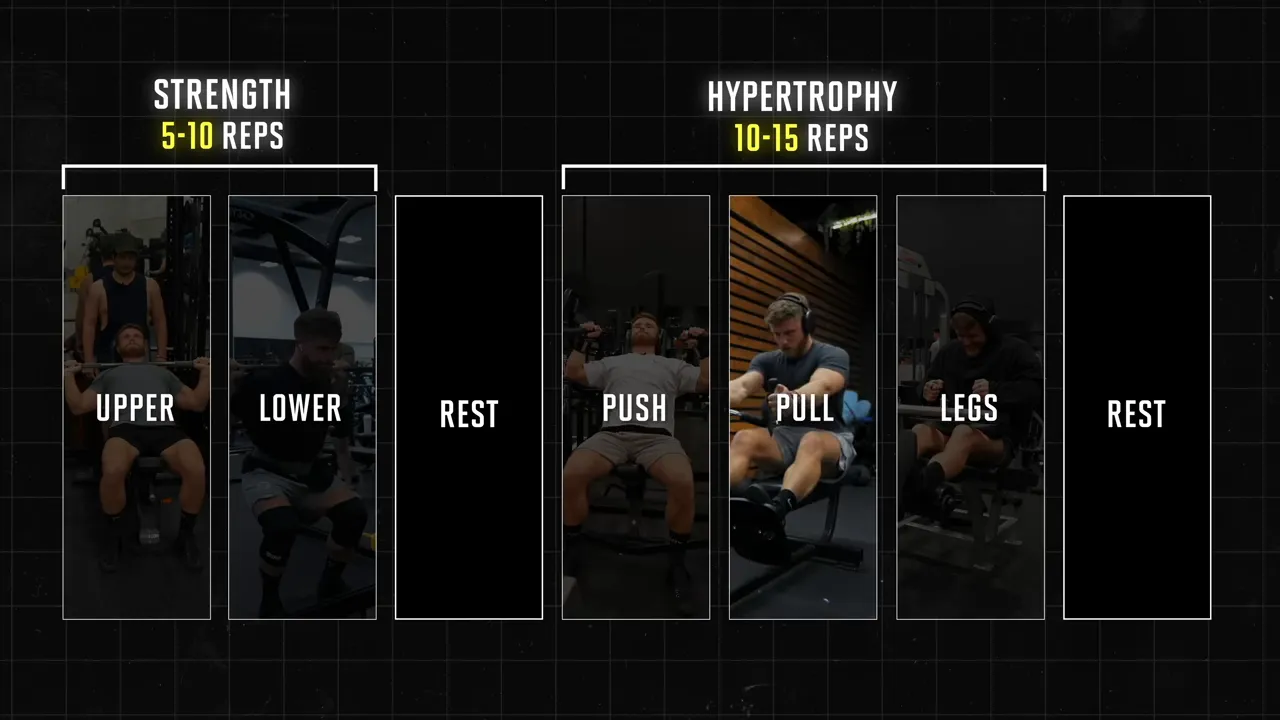
The first two sessions leaned more toward strength, while the final three emphasized hypertrophy. We kept this overall structure for most of the experiment.
What I Changed After 15 Years of Training
I wasn’t starting from scratch. The question was what I could improve beyond my usual training. I focused on three changes.
- Take the final set of every exercise to failure. That initially included heavy compound exercises, with appropriate safety bars or spotting. Previously, I usually stopped compound lifts with one or two reps left, even on the last set.
- Be more selective with exercises. I prioritized movements I considered especially effective for muscle growth rather than including exercises without a clear hypertrophy purpose.
- Track every working weight and rep. The goal was to add a little weight or another rep when possible, rather than simply hoping progressive overload would happen.
Research on proximity to failure suggests a trend toward greater hypertrophy as sets get closer to failure. That doesn’t mean everyone needs to fail every final set. I still think leaving a rep or two on compound exercises is a good approach for most people.
For this experiment, though, I wanted to remove any doubt about whether I could have pushed harder. Later, I would adjust that approach as my recovery demands changed.
How We Eased Brad Into the Program
Brad followed the same overall program, but we gradually increased his workload:
- Week one: One set per exercise.
- Week two: Two sets per exercise.
- Week three onward: Three sets per exercise.
He didn’t train to failure during the first two weeks. The priority was learning the movements and getting through the initial soreness.
For example, when teaching the Romanian deadlift, we focused on sending his hips back and keeping the bar close rather than letting it drift forward. Getting comfortable with basic technique came before pushing the sets hard.
The program was more advanced than I would normally choose for a total beginner. Sharing the same training structure made our comparison more consistent, but that doesn’t make it the ideal starting prescription for everyone.
Nutrition, Sleep, and Supplements
During the bulk, we both targeted approximately:
- Calories: 3,000 per day.
- Protein: 150 grams per day.
- Carbohydrates: 410 grams per day.
- Fat: 85 grams per day.
For me, that was about 15% above estimated maintenance, with a target gain of roughly two pounds per month.
For Brad, bulking at a body-fat level above 30% was not what I would recommend for his best individual transformation. Normally, I would have started him in a roughly 5% to 20% calorie deficit and aimed for fat loss alongside muscle growth.
We matched food targets to keep our protocols similar. Still, this was a two-person experiment, not a perfectly controlled trial, and these calorie targets were not universal recommendations.
Tracking Every Day Was a Real Adjustment
We used MacroFactor to log our food and body weight. Its barcode scanner and multi-food logging helped keep my tracking time to about five to ten minutes a day.
Brad had more of a learning curve. Early on, he would run out of his fat allowance while still having carbohydrates left. At one point, he sat staring at a glass of orange juice he really didn’t want to drink. He even started dreaming about logging food and calculating how many grams of candy he had dropped.
So, yes, tracking got easier. But it was still a substantial new habit, especially for someone who hadn’t done it before.
Recovery Was Part of the Plan
We both wore Oura rings and aimed for eight to nine hours of sleep, with reasonably consistent bedtimes and wake times.
Sleep isn’t only about total hours. Research on sleep regularity and mortality also highlights the importance of a consistent sleep schedule, although that research is not a direct test of muscle growth.
We also followed the same supplement regimen. Supplements were a small part of the plan, but creatine became important when interpreting Brad’s early results.
Month One: Huge Numbers, With an Important Catch
Our first check-in was pretty shocking.
Brad was up 12.7 pounds of lean mass after just one month. His body fat dropped from 36.2% to 33.4%, and ultrasound measured increases of about 14 millimeters in quad thickness and one millimeter in biceps thickness.
I was also up just over three pounds of lean mass. Unlike Brad, I gained some fat: my body fat increased from 15.8% to 16.7%.
Those results were a massive motivator. But they also set up a measurement lesson we would come back to: rapid early lean-mass gains can include a lot of water, not just new muscle tissue.
The Six-Month Bulk: Bigger, Stronger, and Definitely Softer
The first six months weren’t spent in a perfectly controlled bubble. Two months in, I went to Mexico for a three-week writing retreat with Steph to finish my book. Finding a gym and a grocery store helped me settle into a routine, and the 3,000-calorie budget left room for some tacos and tequila.
Back home, balancing work and training was harder. Filming exercise content could take seven or eight hours, after which I still had my actual workout to do.
Normally, I might have counted a training-related filming session as enough. This time, I did the planned workout afterward, even when I really didn’t feel like it.
The workouts you’re tempted to skip and the sets you’re tempted to coast through can add up. Being more deliberate about those small decisions was one of the biggest changes in my training.
That didn’t mean ignoring recovery. I took a light deload in April, and when I started feeling sick, I postponed a scheduled workout rather than forcing a poor session. “Perfect” training had to include responding to reality.
The Benefit I Almost Overlooked
On a trip to Arizona with Brad and our dad, I noticed how much stronger Brad had become. His back exercises were getting surprisingly close to some of my working weights.
But during a hike in Sedona, he told me something more important: his social anxiety had improved dramatically. Situations that once felt overwhelming, like approaching a service counter or asking for help in a store, had become much easier.
That was his personal experience, not proof that lifting will resolve anxiety for everyone. Still, it was a light-bulb moment for me. I had been so focused on visual gains that I had almost forgotten the other ways training can change someone’s life.
What the Six-Month Measurements Showed
By the end of the bulk, we had each gained about 15 pounds.
- Brad: Up about 13 pounds of lean mass, with body fat falling from 36.2% to 35.0%.
- Me: Up about 4.5 pounds of lean mass, but also about 11 pounds of fat, bringing body fat to just over 20%.
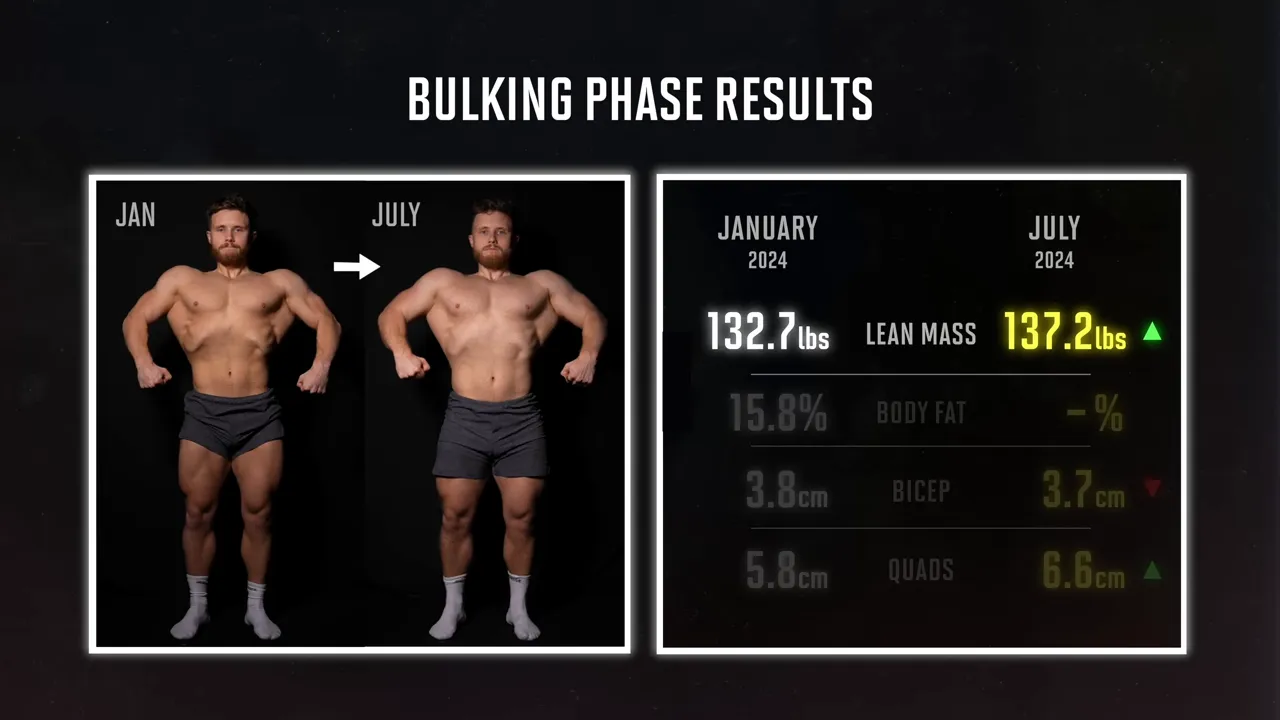
Brad’s results initially looked confusing. If he had gained 12.7 pounds of lean mass in month one, had he really gained only another 0.3 pounds over the next five months?
Probably not. He had started creatine for the first time and jumped into a demanding training program. I suspect a substantial part of that initial jump was water. The longer-term trend was more informative than treating every pound from the first scan as muscle.
For me, the conclusion was pretty straightforward: I had added lean mass, but I had also gained more fat than I wanted. Now I needed to find out how much of that lean mass would survive the cut.
Months Seven Through Nine: Could I Recomp at Maintenance?
Next, we reduced intake to about 2,800 calories per day, our estimated maintenance at that point. The goal was to build muscle and lose fat while keeping body weight relatively stable.
My strength stopped increasing as consistently as it had during the bulk. I was still pushing hard, and I thought my physique looked a little sharper, but the weekly progression had slowed.
During this phase, we spent three weeks in Japan. We kept logging food, but getting enough protein was harder, and we were more flexible with our diets than a truly optimized approach would have allowed.
We also temporarily changed to full-body training three days per week so we could spend less time in the gym and enjoy the trip. Once home, we returned to the upper/lower/push/pull/legs split.
At the nine-month check-in:
- I lost 0.8 pounds of measured lean mass and about half a pound of fat.
- Brad lost 0.7 pounds of measured lean mass and about 3.5 pounds of fat, bringing his body fat to 33.8%.
Both lean-mass changes were within the DEXA’s margin of error. Brad hadn’t lost strength, so I wasn’t especially concerned that his small measured decline represented actual muscle loss.
For me, though, there was no clear evidence of new growth. My interpretation was that, at my training level, I probably needed at least a small calorie surplus to keep progressing. Travel and the temporary program change may have contributed, so this doesn’t prove advanced lifters can never recomp. It simply didn’t produce measurable growth for me over those three months.
A Knee Injury Changed the Final Phase
At each check-in, we also tested strength on the Biodex. Brad’s strength had been trending upward, and mine had improved more modestly.
At the nine-month visit, I hit a personal best of 359.2 newton-meters. On the next attempt, I felt something strange in my knee. I had partially torn a tendon.
That was not an ideal way to start a cut.
We hadn’t warmed up before the test because of time constraints, and I was fasted. I questioned those circumstances afterward, but I can’t establish exactly what caused the injury.
My physiotherapist expected at least one to two months of rehabilitation. Initially, I trained my quads with much lighter loads, using a three-second lowering phase, a pause, and a three-second lifting phase.
It kept some tension on the muscles, but it wasn’t comparable to my normal loading. The injury became an important limitation when interpreting my final quad measurements.
The Cut: Losing Fat Without Giving Back Every Gain
For the cut, we dropped to 2,200 calories per day and increased protein to 190 grams. Brad was excited to finally focus on losing weight, and I was ready to get the extra fat off.
We kept the same basic training split, with some exercise substitutions. I also backed off slightly on compound lifts, stopping about one rep short of failure. I continued taking final sets of isolation exercises to failure.
With fewer calories and a knee injury to manage, I didn’t want to add another recovery problem. The goal was to retain muscle, not prove how exhausted I could make myself.
As the cut progressed, my strength started returning and I could finally see some of the muscle I had built during the bulk.
At the one-year mark, however, neither of us had returned to our starting weight. I wanted that same-weight comparison, but I didn’t want to rush the process with a crash diet. We extended the experiment by about two months.
The Final Results: Beginner Versus Advanced Lifter
Somehow, we both matched our starting weigh-ins exactly to the decimal. I started at 164.6 pounds and finished at 164.6 pounds.
That made the final question especially interesting: what had changed underneath the same scale weight?
Brad: About 10 Pounds More Lean Mass and 10 Pounds Less Fat
Brad finished with approximately 10 pounds more lean mass and 10 pounds less fat than he started with. His final strength test was also his best.
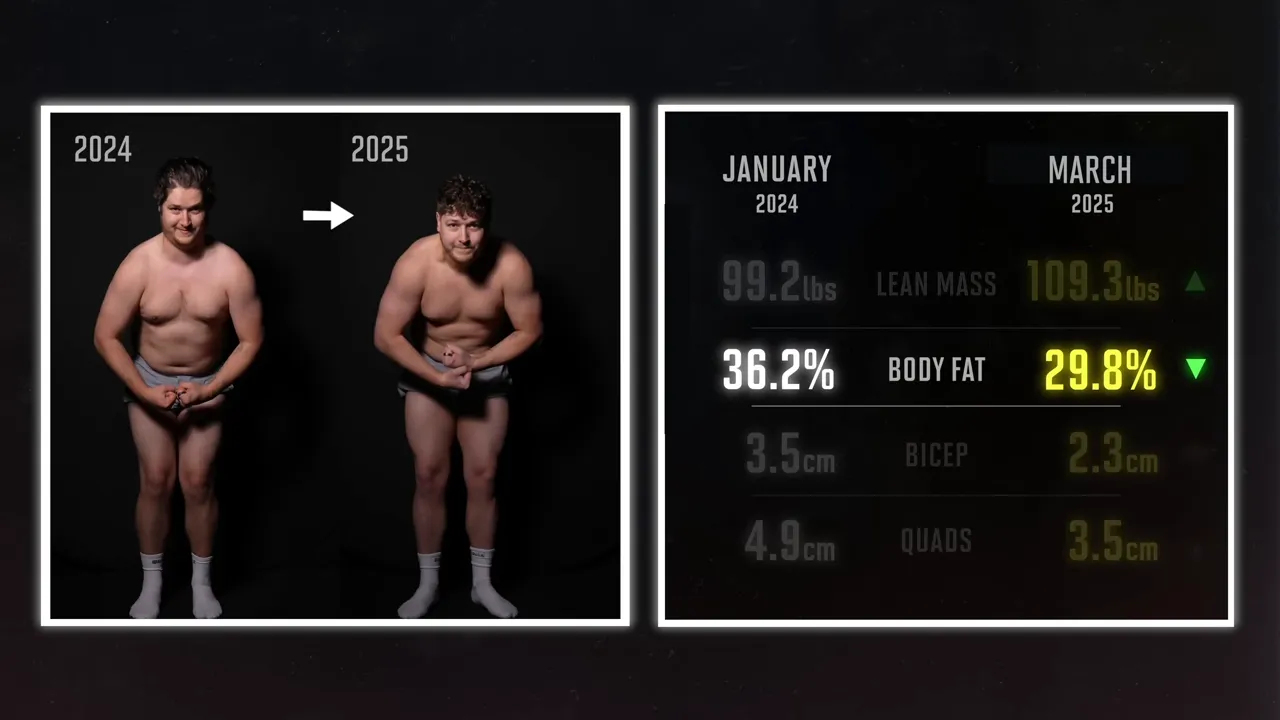
His Oura ring also estimated an improvement of about four years in its cardiovascular-age metric. That’s a wearable estimate rather than a clinical measurement, but it was another encouraging sign alongside his strength and personal confidence.
He didn’t stop after the final check-in, either. While I was editing the results, he had already lost another five or six pounds.
My Results: 2.7 Pounds More Lean Mass at the Same Body Weight
I finished with 2.7 pounds more lean mass. My body fat decreased from 15.8% to 14.5%.
That might not sound dramatic, but after more than 15 years of training, I was genuinely happy with it. At just under 5 feet 5 inches, a few pounds distributed across my physique can make a noticeable difference.
I saw the biggest visual improvements in my chest and back, with changes in my shoulders and hamstrings too.
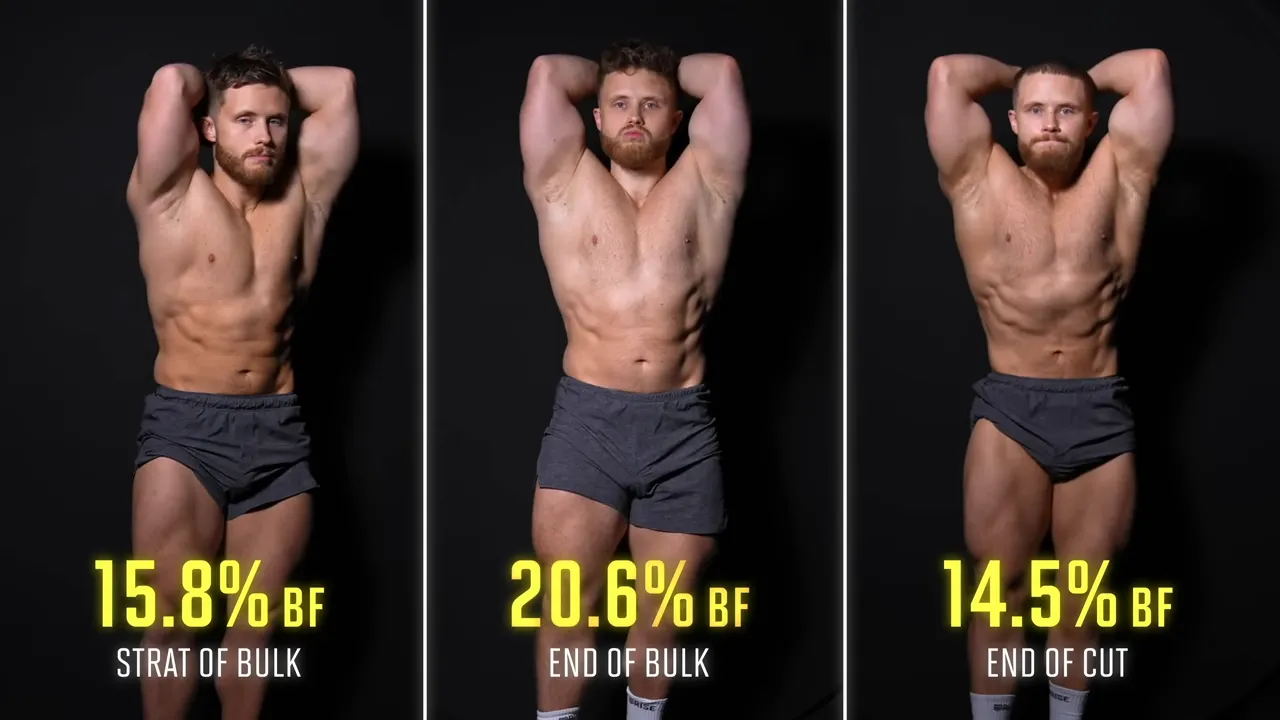
At the end of the bulk, I was up 4.5 pounds of lean mass. At the end of the cut, I was still up 2.7 pounds. In other words, I retained more than half of the measured increase while losing all the fat I had gained, plus roughly another two pounds of fat.
The ultrasound results supported net biceps growth after the cut. My quads had grown during the bulk, but largely returned toward baseline by the end. My injured left side lost more, while the right quad retained some net growth.
Why the BIA Result Told a Different Story
For transparency, the BIA device estimated that I lost about one pound of lean mass over the experiment.
That would have been pretty discouraging if it were the only measurement I had. BIA has a larger error margin than DEXA and may not be sensitive enough to detect the small changes an experienced lifter makes.
In my case, DEXA, ultrasound, strength testing, and standardized photos collectively pointed toward progress. The lesson isn’t to ignore measurements you dislike. It’s to interpret small changes using multiple sources of evidence rather than treating one gym body-composition scan as a verdict.
What I’d Change, and What This Means for Natural Lifters
My biggest change would be a less aggressive bulk. I suspect that gaining about half as much total weight might have produced similar lean-mass gains with substantially less fat. This experiment didn’t directly test that alternative, but it’s what I would do differently.
I also wouldn’t take the opening “no exceptions” mindset too literally. Over the experiment, I postponed a workout when sick, deloaded, changed my split for travel, and reduced failure training during the cut. Adapting the plan was part of continuing it.
As for my natural ceiling, I still think a biological limit exists in principle. Otherwise, anyone lifting consistently into their 70s or 80s would eventually become the biggest bodybuilder alive.
But a plateau is not proof that you’ve reached that limit. This experiment showed me that I could still make progress naturally by tightening up my training, nutrition, and consistency.
It doesn’t establish how much muscle every beginner or advanced lifter should expect. It does give me a pretty clear personal answer: I wasn’t done yet, and I’m not planning to use steroids.
My next goal is to get properly shredded, below 8% body fat. Brad is continuing his cut. After all that work, neither of us is ready to stop making progress.
Putting the Training Plan Into Practice
The Bodybuilding Transformation System uses the upper/lower/push/pull/legs structure we followed, but with separate beginner and intermediate-to-advanced versions rather than forcing everyone into the same prescription.
It includes two substitution options for every exercise, exercise demonstrations, technique cues, volume analytics, and a handbook explaining the science behind the program.
|


