How much of an impressive physique comes from training, how much comes from genetics, and how much can steroids change the equation?
The difference is bigger than many people realize. Natural lifting can produce a dramatic transformation, but anabolic steroids can push muscle growth far beyond what training and nutrition alone can achieve. In some studies, men taking testosterone without lifting gained more fat-free mass than men who trained naturally.
That deserves a closer look. Not because steroids make training irrelevant, and definitely not because the extra muscle comes without consequences, but because realistic expectations matter.
Key Takeaways
- Natural muscle growth is fastest early and slows substantially as you approach your individual potential.
- Anabolic steroids can dramatically increase muscle gains, with results varying by drug exposure and genetics.
- Steroid use carries serious health risks that medical monitoring cannot completely eliminate.
- Evaluate training advice by its reasoning and evidence, not the adviser’s muscle size.
Table of Contents
- How Much Muscle Can You Build Naturally?
- What Impressive Natural Muscle Growth Looks Like
- How Much Muscle Do Steroids Add?
- Natural Versus Enhanced Bodybuilding: Two Real-World Examples
- Genetics Matter With and Without Steroids
- The Downsides of Steroids Are Not a Footnote
- Why I Recommend Maximizing Your Natural Potential First
- A Bigger Physique Does Not Automatically Mean Better Advice
How Much Muscle Can You Build Naturally?
A useful ballpark for lifetime natural muscle gain is 20 to 40 pounds, or roughly 9 to 18 kilograms, for men. For women, the corresponding estimate is about 12 to 24 pounds, or roughly 5 to 11 kilograms.
These are estimates, not hard biological limits. Some people will gain less, and exceptional responders can gain more. Research on fat-free mass in steroid users and nonusers helps frame what natural muscular development can look like, but it cannot tell you your exact personal ceiling.
The more predictable part is the shape of the journey: fast progress early, followed by increasingly slow gains.
My Own Natural Muscle Growth Over 15 Years
I won a gold medal at Canadian natural bodybuilding nationals, but I’m certainly not claiming to be the best natural bodybuilder in the world. My experience is simply one useful example.
After about 15 years of steroid-free training, at 5 feet 5 inches tall, I weighed around 160 pounds when lean and 180 pounds when bulked. My estimated muscle gains broke down roughly like this:
- First five years: About 20 pounds of muscle.
- Next five years: Another 5 pounds or so.
- Following five years: Perhaps another 1 to 2 pounds.
That adds up to approximately 27 pounds, or 12 kilograms, of muscle.
Both of my parents were bodybuilders, so I trained pretty hard from the beginning. Even with that foundation, progress slowed dramatically. The effort did not stop. The return on that effort simply became smaller.
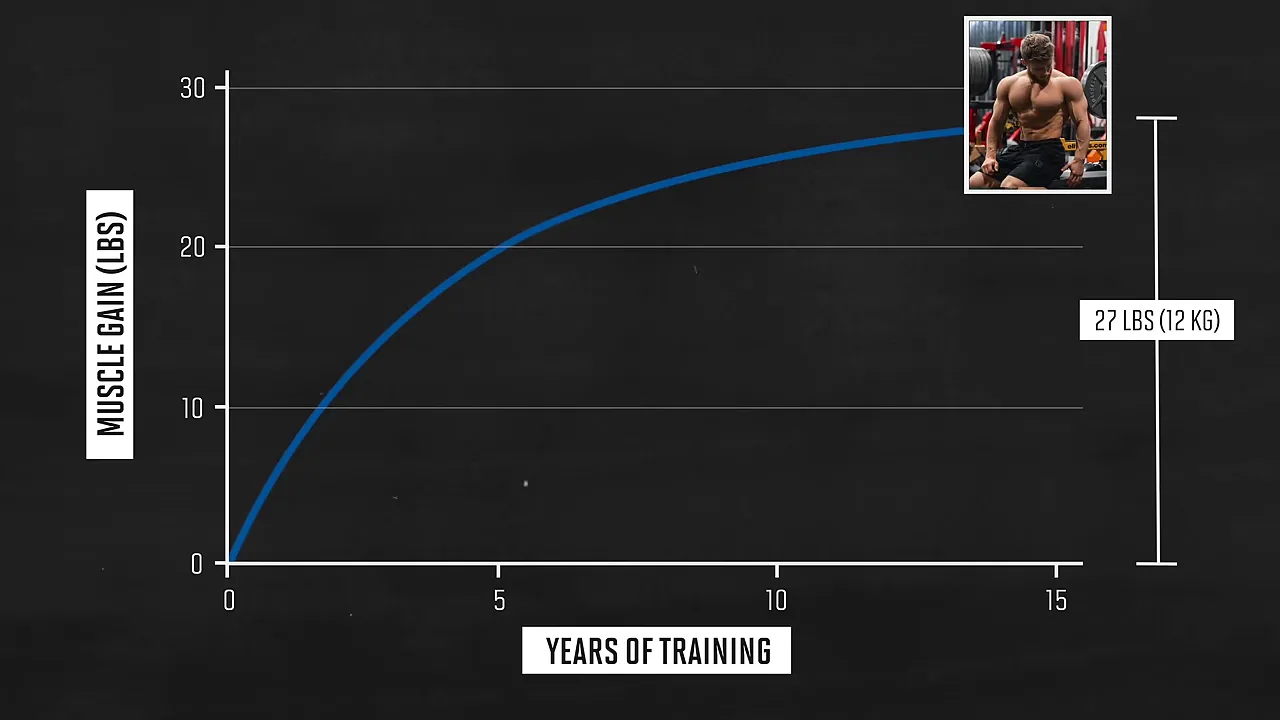
Most natural lifters who do the important things consistently well will experience a similar curve. Advanced training and nutrition strategies may nudge your ceiling upward, but those late-stage improvements are usually marginal, not another round of beginner gains.
What It Takes to Approach Your Natural Potential
Years spent holding a gym membership are not the same as years of productive training. To get close to your natural potential, the basics need to be in place.
- Train hard: Regularly take sets close to muscular failure.
- Keep technique consistent: Make progress with comparable execution rather than increasingly loose reps.
- Do enough volume: Around 5 to 15 sets per muscle per week is a useful ballpark.
- Use a variety of exercises: Build your training around more than one movement for a muscle.
- Apply progressive overload: Aim to add weight or repetitions over time.
- Eat enough calories: For maximizing growth, I favor spending at least half your lifting time in a moderate calorie surplus.
- Eat enough protein: Aim for at least 0.7 grams per pound of body weight daily, or about 1.6 grams per kilogram.
Five to ten years of consistently productive training and nutrition can bring you close to your natural potential. Truly maximizing it may take a decade or longer. Those two ideas are compatible: you can build most of your eventual muscle relatively early and spend many more years chasing the final few pounds.
What Impressive Natural Muscle Growth Looks Like
Personal estimates are helpful, but looking at several lifters gives us a better sense of the range.
Alex Leonidas: Roughly 40 Pounds Over 13 Years
At 5 feet 6 inches tall, Alex Leonidas went from around 120 pounds to 160 pounds at a broadly similar body-fat percentage over 13 years of lifting. That suggests roughly 40 pounds of muscle gained.
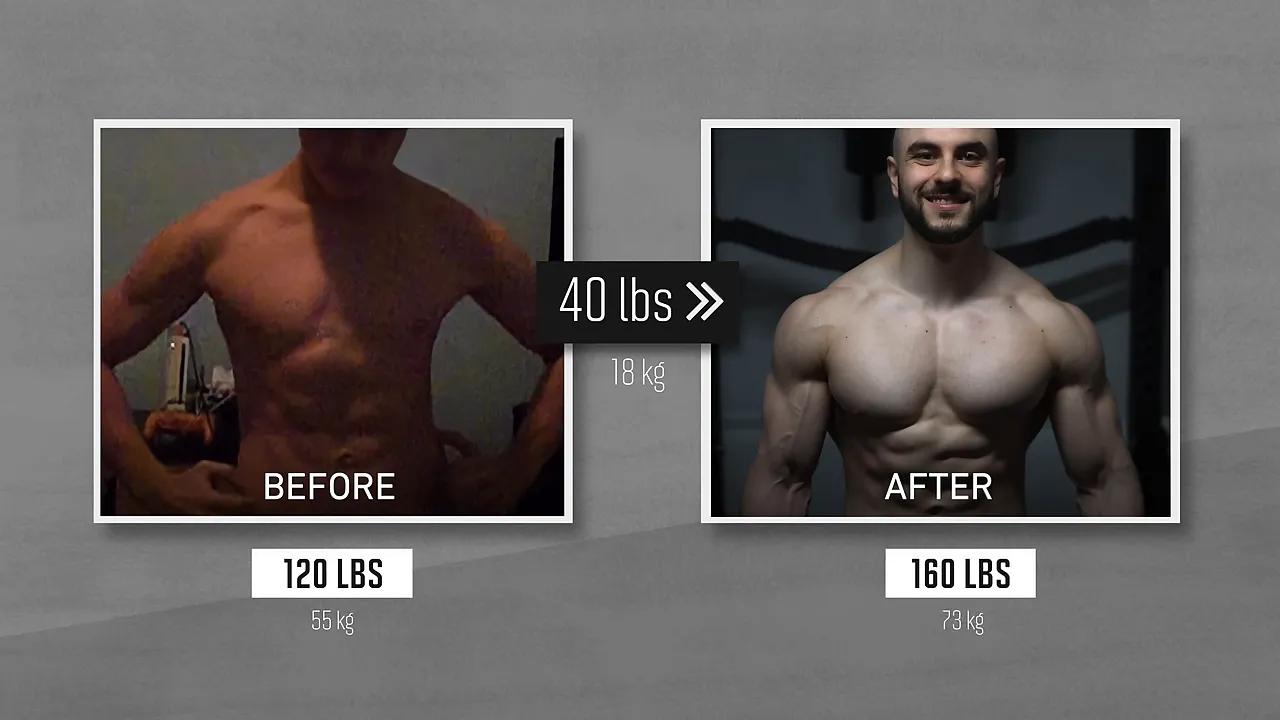
But those 40 pounds did not go on while he stayed equally lean throughout the entire process. Alex completed extended bulks, reaching as high as 200 pounds at around 20 percent body fat before dieting down.
He has argued that spending time in a surplus, and accepting a somewhat higher body-fat level, helps maximize natural muscular development. Whether or not everyone needs to follow his exact approach, his example makes an important point: a lean before-and-after comparison does not show all the bulking and cutting that happened in between.
Geoffrey Verity Schofield: Roughly 43 Pounds Over 10 Years
For a taller example, Geoffrey Verity Schofield went from about 150 pounds to 193 pounds at 6 feet tall over approximately 10 years. With a similar apparent body-fat percentage in the comparison photos, that suggests roughly 43 pounds of muscle gained.
Again, this involved a series of bulks and cuts. His peak bulk weight reached around 224 pounds before he cut down to 193.
Neither example is a promise that everyone can add 40-plus pounds of muscle. They illustrate the upper end of what I consider plausible natural development after many years of serious work.
What About Bodybuilders Before Steroids Existed?
There will always be skepticism about modern athletes’ natural status. For a different kind of evidence, consider bodybuilders from the pre-steroid era.
Testosterone was isolated and synthesized in the early 1930s, with injectable preparations appearing in 1935. Physiques developed in the 1800s and early 1900s therefore offer examples of muscular development before those drugs were available.
Strongmen, strongwomen, and bodybuilders from that period displayed impressive muscularity and leanness. Clearly, building a remarkable physique naturally is not a modern invention.
But I would not treat those athletes as the absolute limit of natural development. Training and nutrition methods have improved, and many more people now participate in bodybuilding. That larger talent pool makes it reasonable to expect exceptional modern natural athletes to surpass historical examples.
How Much Muscle Do Steroids Add?
The real-world examples are interesting. Controlled research makes the difference harder to dismiss.
One terminology point matters here: fat-free mass is not exactly the same thing as pure muscle tissue. The research numbers below describe changes in fat-free mass, which is often discussed more loosely as muscle gain. Keep that distinction in mind when comparing study results with physique transformations.
The 1996 Study: Training Naturally Versus Taking Testosterone
In a famous 1996 study by Bhasin and colleagues, 43 men were assigned to four groups. Over 10 weeks, the results were approximately:
- No training, no testosterone: No significant gain in fat-free mass.
- Training without testosterone: A gain of 4.4 pounds.
- Training with testosterone: A gain of 13.4 pounds.
- Testosterone without training: A gain of about 7 pounds.
The testosterone groups received 600 milligrams per week as part of the research protocol. The group combining testosterone with training gained more than three times as much fat-free mass as the natural training group.
And here is the result that really gets people’s attention: the group taking testosterone without lifting gained more than one and a half times as much as the group that trained naturally.
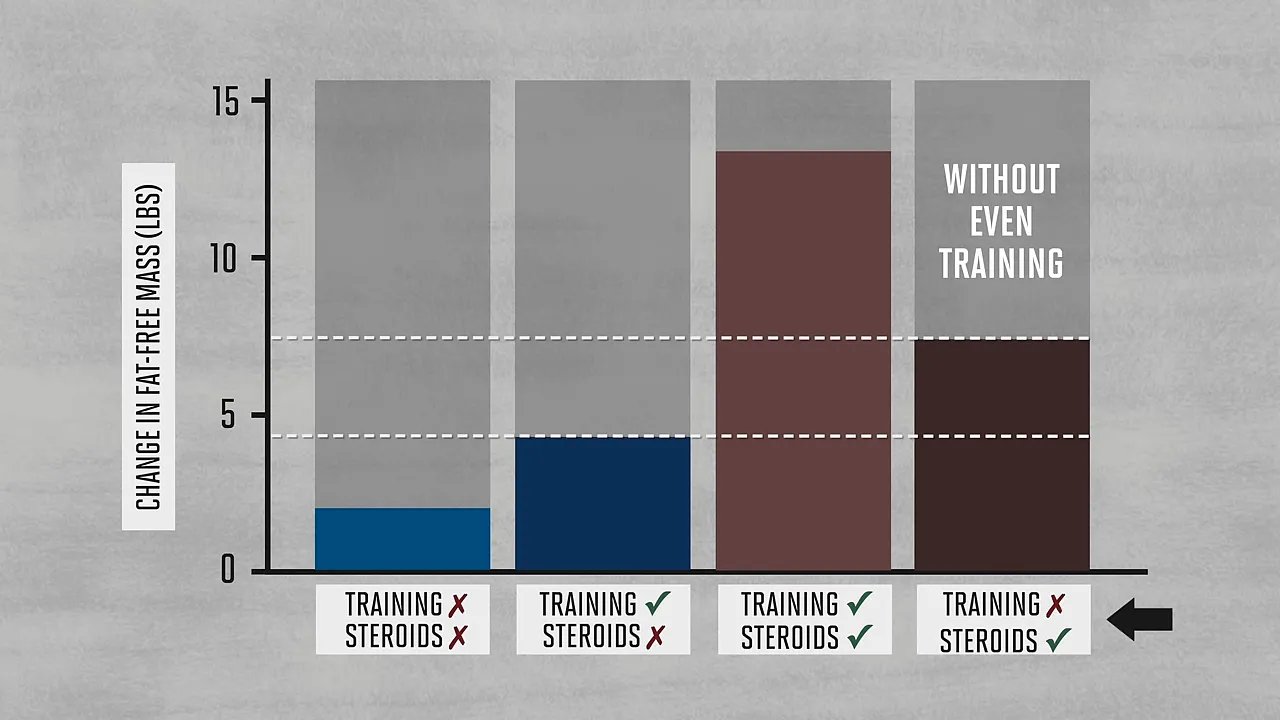
That does not mean an enhanced bodybuilder’s hard work is fake. It means the drug effect is substantial enough that we cannot fairly compare natural and enhanced results as though the only difference were effort or programming.
Was 600 Milligrams a High Dose?
To put the study in context, I spoke with an anonymous anabolics expert. His answer was essentially: high compared with what?
He described roughly 100 milligrams per week as representative of therapeutic testosterone replacement for some patients. Around 150 to 200 milligrams may fall into what parts of the fitness industry call “sports TRT,” potentially pushing free testosterone beyond normal physiological levels even when total testosterone looks normal on paper.
He characterized 300-plus milligrams as clearly enhanced territory, and 500 to 600 milligrams as an entry-level bodybuilding cycle. For highly competitive professional bodybuilding, he reported seeing total anabolic drug use of 1,000 milligrams per week or more, with some extreme cases reaching 4,000 to 5,000 milligrams.
Those are descriptions of reported use, not dosing recommendations or safety thresholds. The response to a given amount depends on the individual, and “TRT” is not a guarantee that someone is maintaining normal hormone levels.
The useful takeaway is that 600 milligrams is high by replacement-therapy standards, but not necessarily high compared with reported practices in elite bodybuilding.
The 2001 Study: A Clear Dose-Response Relationship
In a 2001 follow-up study, the same research group assigned 61 men to weekly testosterone doses of 25, 50, 125, 300, or 600 milligrams for 20 weeks.
Fat-free mass gains generally increased alongside the dose. At the low end, gains were small. At the high end, the average gain was roughly approaching 20 pounds over 20 weeks.
And the participants did not lift weights during the study.
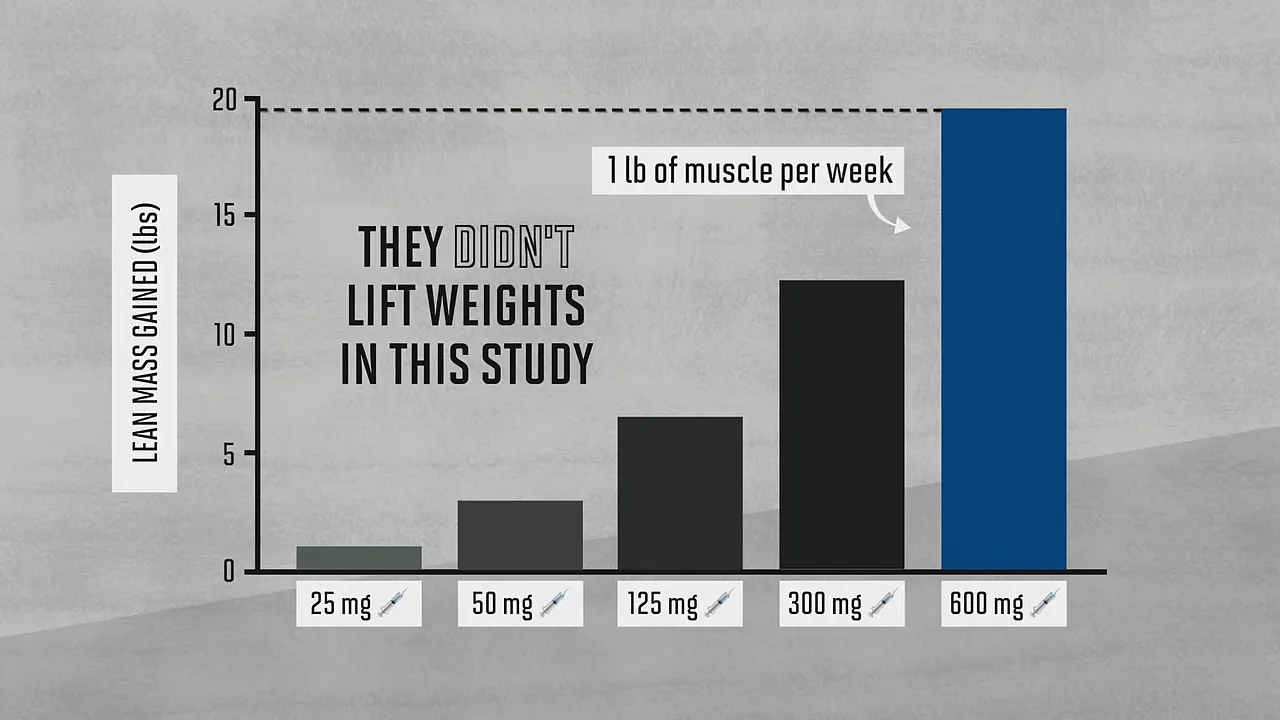
As a late-stage natural lifter, I might be happy to add one pound of muscle over the next year. The rate of fat-free mass gain in the highest-dose group was on an entirely different scale.
These are short-term results under specific research conditions, not a formula you can extrapolate indefinitely. Still, they demonstrate just how powerfully testosterone can change the muscle-building equation.
Natural Versus Enhanced Bodybuilding: Two Real-World Examples
Studies tell us what happens over weeks or months. Career-long transformations offer another perspective, although the estimates are much less controlled.
Shaun Clarida: About 60 Pounds Beyond His Natural Competition Weight
Before becoming an Olympia 212 champion, Shaun Clarida was a world-class natural bodybuilder. At 5 feet 2 inches tall, he competed at around 130 pounds, or 59 kilograms, in the WNBF, a federation known for stringent drug testing.
Based on the information I could find, my rough estimate is that he added around 20 pounds naturally, progressing from approximately 110 to 130 pounds.
He was already training extremely hard. Footage from that period includes heavy leg presses and demanding arm training. This was not someone who had barely explored what serious lifting could do.
After moving into enhanced bodybuilding, he eventually reached around 190 pounds. That is an additional 60 pounds beyond his natural competition weight, approximately three times the estimated muscle he had built naturally.
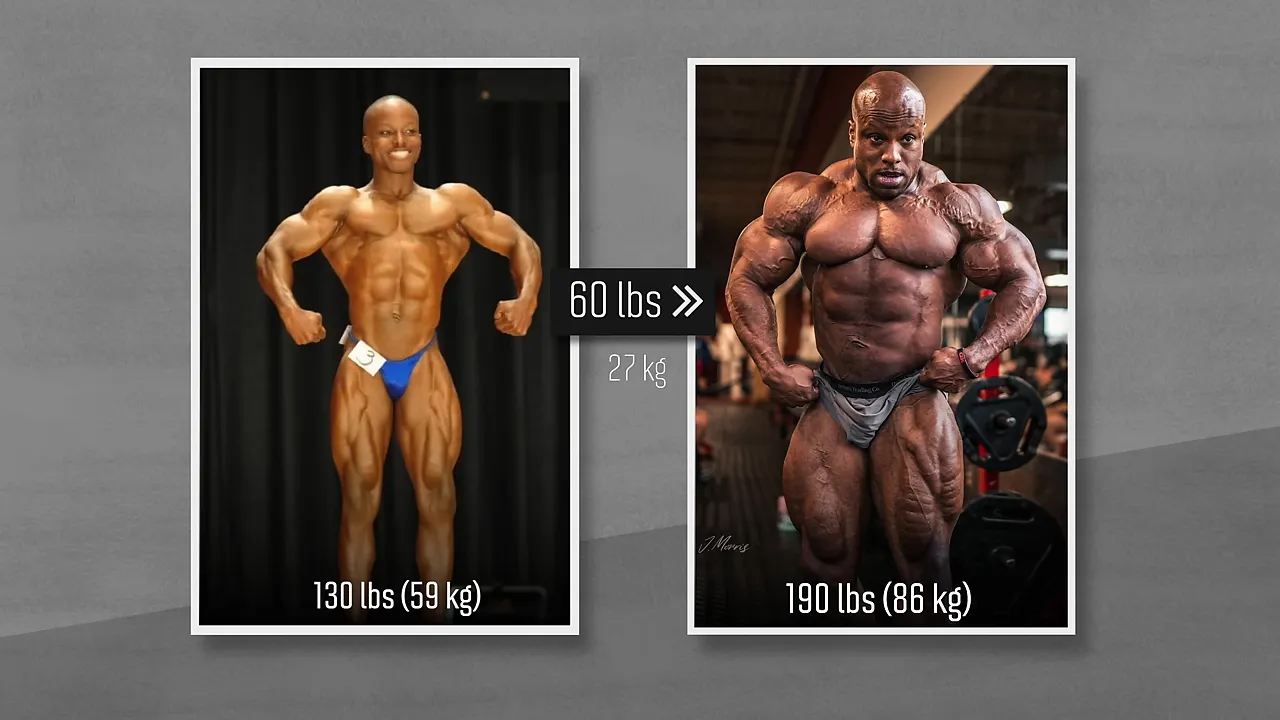
This is rough physique math, not a laboratory measurement of muscle tissue. But the magnitude of the change is hard to miss.
Chris Bumstead: An Example of Exceptional Genetics
Chris Bumstead presents a different pattern. At 6 feet 1 inch tall, he reportedly began lifting at age 14 weighing around 170 pounds. By 19, he weighed approximately 225 pounds, a 55-pound increase.
I believe the 225-pound example was still natural. He was already extraordinarily muscular at 17, and the reported timing from his coach places the start of his first cycle after the comparison photo. That is my interpretation of the available information, not independent proof of his drug history.
At the later point being compared, his offseason weight was about 264 pounds at an apparently similar body-fat level, suggesting another roughly 40 pounds after enhancement.
On those estimates, he appears to have built a remarkable amount of his size naturally. However, the initial 55-pound increase was body weight gained during adolescence, not a direct measurement of 55 pounds of new muscle.
His transformation made me wonder whether his drug use was relatively modest by elite bodybuilding standards, but appearance cannot establish someone’s dose. The stronger takeaway is that exceptional genetics can produce exceptional results. Someone has to sit at the far end of the response curve.
Genetics Matter With and Without Steroids
People do not respond identically to natural training. Some gain relatively little muscle, some gain a tremendous amount, and most fall somewhere in between. Research on individual variability in resistance-training responses illustrates that spread.
The same principle applies to anabolic drugs.
Among the highest-dose participants discussed in the 2001 research, individual gains ranged from roughly 9 pounds to around 31 pounds of fat-free mass over 20 weeks.
Same study. Same dose. Very different outcomes.
The best responder gained more fat-free mass in about five months without lifting than my estimated muscle gain across 15 years of natural training. Even allowing for the difference between fat-free mass and muscle, that is a pretty staggering comparison.
A Practical Estimate of the Difference
Putting the research and real-world examples together, my rough framework for men is:
- Natural development: Around 20 to 40 pounds of total muscle gain for many lifters.
- Enhanced development: Potentially another 20 to 40 pounds beyond that natural development.
- More extreme enhanced development: People with favorable genetics may add another 20 to 40 pounds or more beyond that.
In other words, steroids can potentially double or even triple total muscle gains, depending on genetics and drug exposure.
These are broad estimates, not guaranteed outcomes or proven lifetime ceilings. They describe the potential scale of the difference, not a predictable return from any particular dose.
The Downsides of Steroids Are Not a Footnote
Steroids may have the biggest potential upside for muscle growth, but they also come with major potential downsides.
The National Institute on Drug Abuse’s information on anabolic steroids outlines serious health risks. The cardiovascular risks alone should give anyone pause:
- High blood pressure.
- Blood clots.
- Heart attacks.
- Stroke.
- Artery damage.
There are also unwanted visible effects, including gynecomastia, hair loss, acne, abscesses, and oily skin.
Medical supervision, monitoring, and limiting exposure may help mitigate some risks. They do not make nonmedical anabolic steroid use risk-free. You are still taking a gamble with your health.
This is educational information, not personalized medical advice. Hormonal treatment is something to discuss with a qualified medical professional.
Why I Recommend Maximizing Your Natural Potential First
I am not interested in moralizing about what people do with their own bodies. But an informed decision requires understanding both the muscle-building effects and the potential costs.
If someone is considering enhancement, my opinion is that they should first spend about a decade training hard, training intelligently, and learning how their body responds.
That process teaches you how to adjust training and nutrition effectively. It also gives you time to build an impressive physique without feeling that anabolics are necessary.
Getting close to your natural potential should be an accomplishment, not evidence that you have run out of worthwhile reasons to train.
If your priority is maximizing health, my recommendation is to stay natural unless a medical professional recommends hormonal treatment for a medical reason.
A Bigger Physique Does Not Automatically Mean Better Advice
There is one final lesson that applies whether you are natural, enhanced, or simply trying to choose a training program: do not judge advice by the size of the person giving it.
An enhanced bodybuilder with excellent genetics will probably be bigger than a natural lifter. That does not prove their training methods are better. It does not prove they are worse, either. Physique size alone cannot settle the comparison.
Good advice should stand on sound reasoning. That reasoning might draw on scientific research, carefully considered anecdotal evidence, or years of practical experience. Evaluate the evidence on its own merits.
Steroids and genetics can profoundly influence the result. Neither one automatically tells you who understands training best.


