Getting your abs to show comes down to two things: building the abdominal muscles and getting lean enough to reveal them. You can make meaningful progress in 60 days, but whether that means a clearly defined six-pack depends on where you’re starting.
The good news is that the plan doesn’t need to be complicated. You don’t need a daily ab circuit, a restrictive list of approved foods, or a cabinet full of supplements. You need progressive training, a manageable calorie deficit, and a way to check that you’re moving in the right direction.
Key Takeaways
- Visible abs require both developed abdominal muscles and a sufficiently low body fat level.
- Train weighted crunches and leg raises twice weekly, progressively increasing the challenge.
- Use calorie estimates as starting points and aim to lose 0.5% to 1% of body weight weekly.
- Track photos and waist measurements alongside weight, and prioritize sustainable leanness over extreme definition.
Table of Contents
- How Lean Do You Need to Be to See Your Abs?
- Train Your Abs Like Any Other Muscle
- Add Cardio to Support Fat Loss and Maintenance
- Set Up Your Six-Pack Diet
- Avoid These Three Common Dieting Mistakes
- Which Supplements Are Actually Worth Considering?
- Use Feedback to Keep Your Nutrition Plan on Track
How Lean Do You Need to Be to See Your Abs?
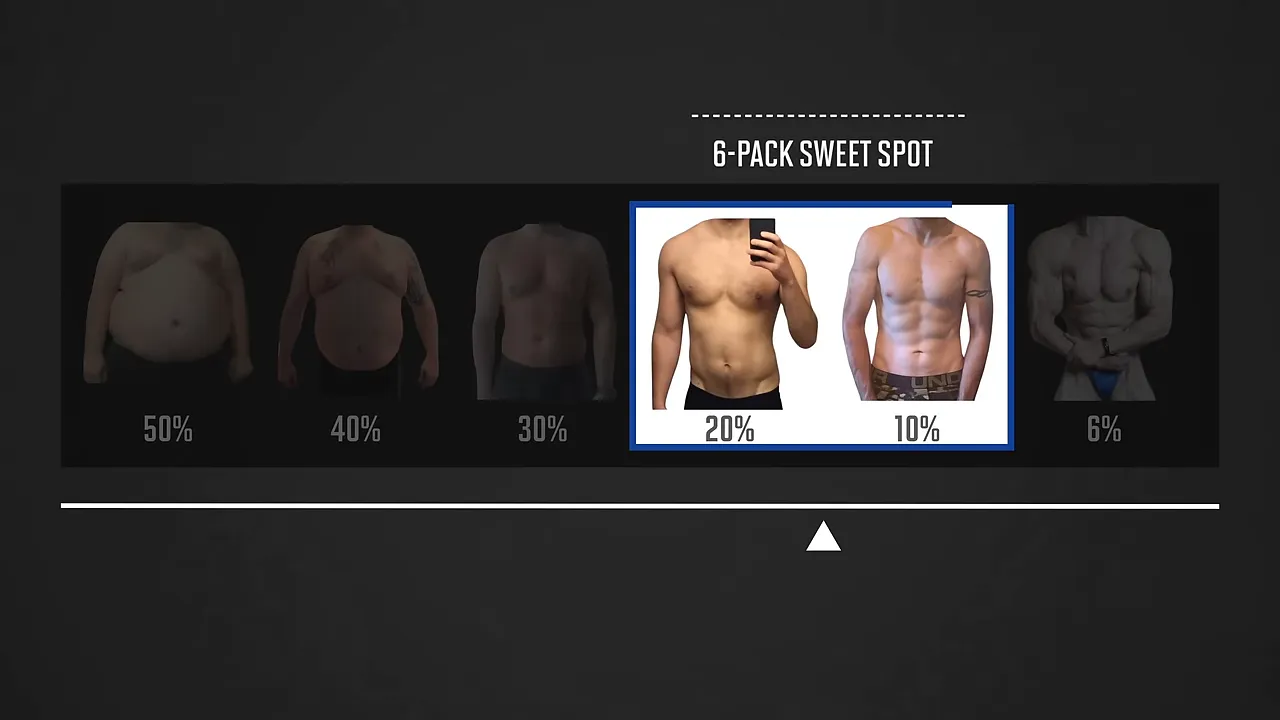
Body fat makes a big difference to how your midsection looks. In the male examples, moving from around 50% to 40% body fat means a smaller waistline, but the abs are still covered. At around 30%, the stomach is flatter, although abdominal definition is generally still limited. Around 20%, some definition can become visible, while around 10%, a well-developed six-pack can look much sharper.
These are useful reference points, not precise appearance guarantees. How much abdominal muscle you’ve built and your genetic structure also matter.
For many people, a practical range for visible abs is approximately:
- Men: 10% to 20% body fat.
- Women: 18% to 28% body fat.
You don’t need to reach bodybuilding-stage leanness. Natural bodybuilder Alberto Nuñez, for example, reached a DEXA-measured 6.2% body fat during contest preparation. That’s a very different goal from having visible abs while feeling good and maintaining your results.
Genetics also determine the arrangement of your abs. At the end of my last cut, at roughly 10% body fat, mine looked more like a four-pack than a six-pack. Training can make those muscles bigger, but it can’t change their underlying layout.
The goal is to make your abs more developed and visible, not force them to match someone else’s.
Train Your Abs Like Any Other Muscle
You’ll sometimes hear that direct ab training is pointless because you won’t see your abs unless you’re lean enough anyway. I disagree.
We wouldn’t tell someone to stop training their shoulders just because body fat is hiding some definition. The same logic applies here. When you lose the fat, you want enough muscle underneath for your abs to stand out.
The problem isn’t ab training itself. It’s that many fast-paced, supposedly fat-burning ab circuits function more like cardio than productive muscle-building work. If you move from exercise to exercise without bringing the abdominal muscles close enough to failure, you may burn some calories without providing much stimulus for growth.
For abdominal hypertrophy, focus on challenging sets and progressive overload. You really only need two main movements: a weighted crunch and a leg raise.
Exercise 1: Weighted Crunch
A cable crunch is my first choice. Grab a rope attachment, kneel down, and crunch your torso while allowing your lower back to round as you contract your abs.
Don’t turn it into an arm exercise by yanking the rope downward. Your hands hold the attachment; your abs should produce the crunch.
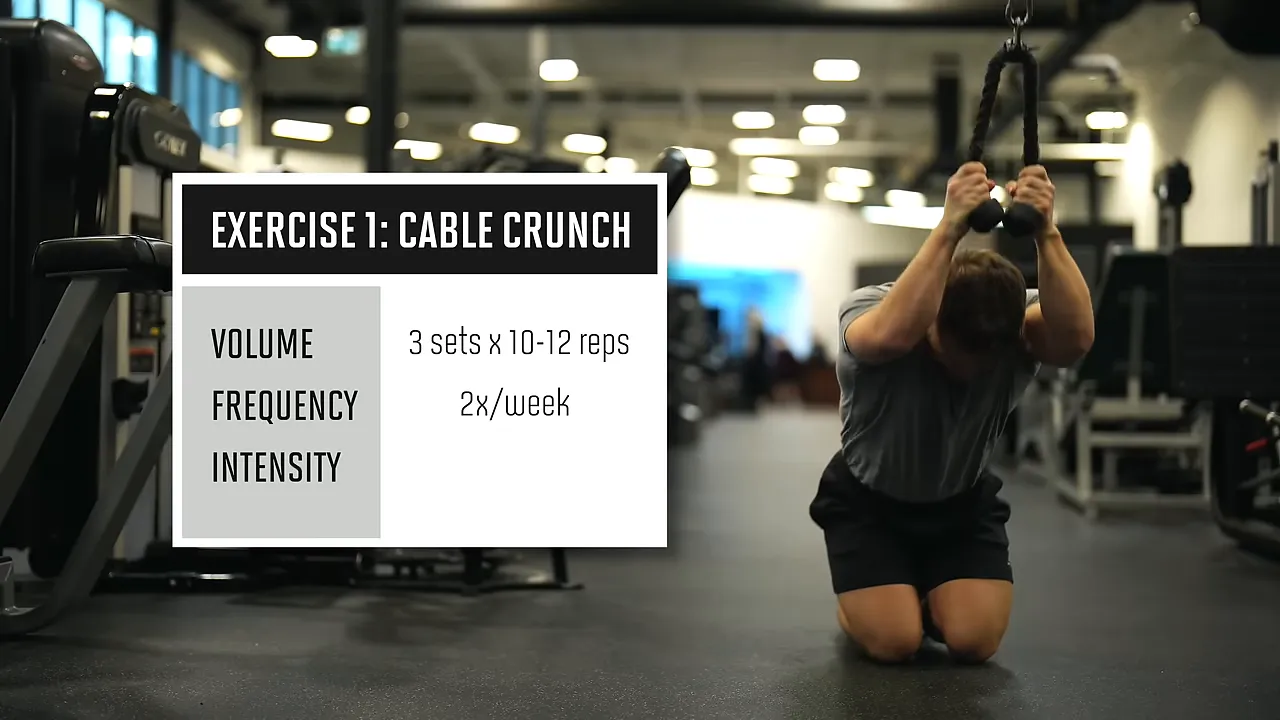
If you don’t have access to a cable machine, hold a weight plate against your chest and perform plate-weighted crunches instead.
- Sets: 3 per session.
- Reps: 10 to 12.
- Frequency: Twice per week.
- Effort: Take the final set to failure, meaning you cannot complete another full rep despite maximum effort.
- Progression: Try to add a rep or a little weight over time while keeping your technique controlled.
Weighted crunches train the whole six-pack, with a likely slight emphasis on the upper portion. For some lower-abdominal bias, add a leg raise.
Exercise 2: Leg Raise
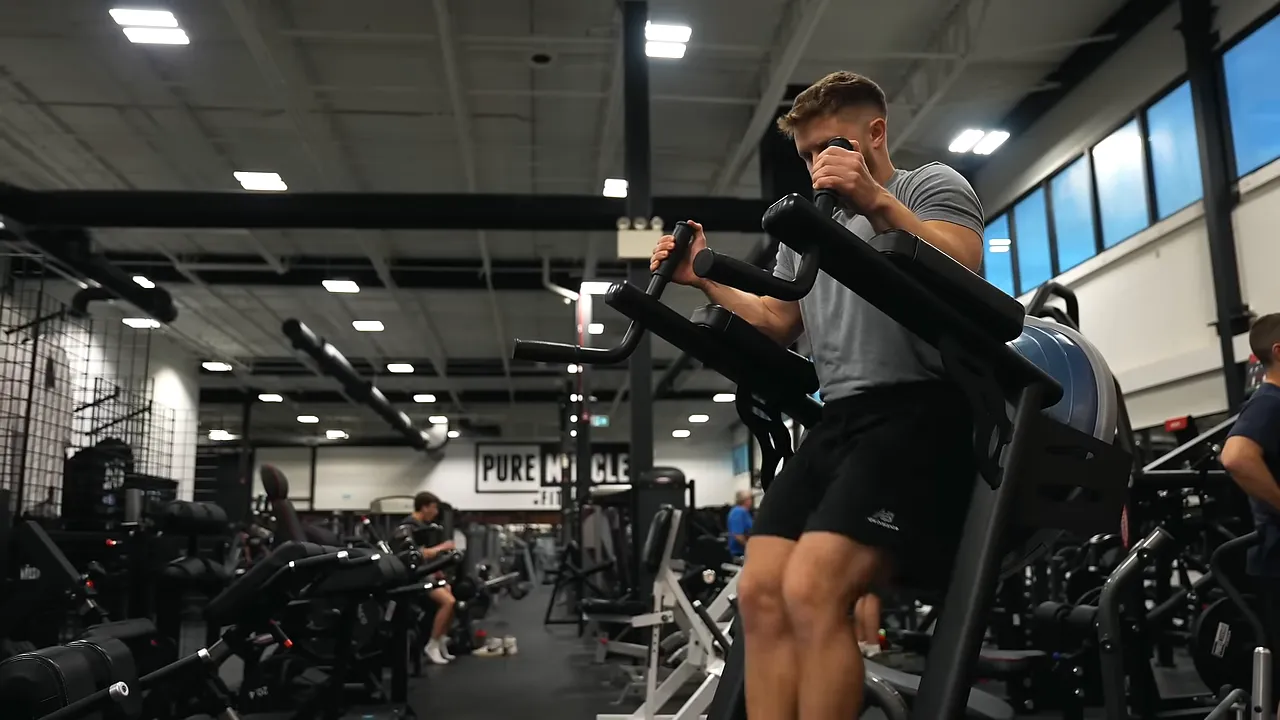
You can perform leg raises hanging from a pull-up bar or supported in a Roman chair. I prefer the Roman chair because the back support helps me keep my lower back stable and direct my attention toward my abs.
If straight-leg raises are too difficult, start with bent-knee raises.
- Sets: 3 per session.
- Reps: 10 to 20.
- Frequency: Twice per week.
- Effort: Take the final set to failure.
- Progression: Build up your repetitions, then increase the difficulty.
My preferred progression is simple: start with three sets of 10 and work toward three sets of 20, aiming to add a rep each week. Once you reach that upper end, you can add ankle weights or slow down the lowering portion of each rep.
That’s the core of the program. Perform both exercises twice weekly, arranging the sessions around the rest of your training. Monday and Thursday would work, but there’s nothing special about those particular days.
What About Planks and Anti-Rotation Exercises?
Planks can be useful for general core strength and stability. I just don’t consider them the most efficient choice when the specific goal is to grow the six-pack muscles.
Anti-rotation exercises also have a place, particularly for training the broader core, including the obliques and transverse abdominis. But for directly loading the six-pack, weighted crunches and leg raises are my priorities. Think of the other movements as optional additions rather than replacements.
Add Cardio to Support Fat Loss and Maintenance
Cardio isn’t mandatory for fat loss, but it can make the process easier.
A review of exercise and abdominal fat supports combining aerobic exercise with resistance training for reducing waist size, rather than relying on resistance training alone.
Being more active also increases your calorie expenditure, which can allow you to eat more while still maintaining a deficit. And people who stay active tend to be more successful at keeping lost weight off over the long term.
My suggested starting point is two to five sessions of low- to moderate-intensity cardio per week, lasting about 30 minutes each.
Still, even excellent ab training and regular cardio won’t guarantee visible abs if your nutrition doesn’t bring your body fat down far enough.
Set Up Your Six-Pack Diet
Your diet needs to accomplish two things: create a calorie deficit and provide enough protein to support your muscle while you lose weight.
Here’s a straightforward starting framework, using body weight in pounds:
- Daily calories: Multiply your current body weight by 10 to 12.
- Daily protein: Multiply your goal body weight by 0.8 to 1 to get your target in grams.
- Daily fat: Include at least 50 grams.
- Remaining calories: Allocate them to carbohydrates, additional fat, or additional protein according to your preferences.
The distinction between current and goal weight matters: the calorie estimate uses your current weight, while the protein estimate uses your goal weight.
These numbers are starting estimates, not a personalized prescription. Energy needs vary considerably from person to person. For some people, this calorie range will be too high; for others, it will be too low. The important part is checking your response and adjusting rather than assuming a formula must be perfect.
Food Quality Matters, but You Don’t Need a Perfect Diet
For fat loss, consistently hitting your calorie and protein targets matters much more than sticking to a supposedly magical selection of foods.
Remember Alberto Nuñez’s contest condition? He got that lean while regularly including Pop-Tarts. That doesn’t mean Pop-Tarts are a special fat-loss food. It means you can include foods you enjoy without preventing progress.
At the same time, I’d still prioritize minimally processed, nutritious whole foods most of the time. Flexible eating and a nutritious diet aren’t competing ideas. You can do both.
Avoid These Three Common Dieting Mistakes
1. Trying to Lose Weight Too Quickly
An overly aggressive cut increases the risk of losing muscle and strength, and it can make rebounding after the diet more likely.
A sensible target is approximately 0.5% to 1% of your body weight per week. If you weigh 200 pounds, that means roughly 1 to 2 pounds per week.
This is also why a 60-day deadline needs some perspective. If you have more fat to lose than you can reasonably lose at that pace, give yourself more time rather than forcing a crash diet.
If your cut will last longer than three months, I strongly recommend considering a two- to three-week diet break somewhere in the middle.
- As a rough starting estimate for diet-break calories, multiply your current body weight in pounds by 16 to 18.
- Treat that estimate as adjustable, just like your initial fat-loss calories.
- Expect individual variation: you might gain a little water weight, or you might continue losing weight.
The purpose is a temporary break from the deficit before resuming your cut. Don’t judge its usefulness solely by what happens to the scale during those few weeks.
2. Relying Too Much on the Scale
The scale is useful, but it doesn’t tell you everything. If you’re building muscle while losing fat, your body composition can improve without a dramatic drop in body weight.
Alongside your weight, track:
- Monthly progress photos: Use the same lighting so comparisons are more meaningful.
- Monthly waist measurements: A shrinking waist can help show fat loss even when scale progress looks slow.
Taking starting photos might feel uncomfortable, but having a clear record makes it much easier to recognize changes that are hard to notice day to day.
3. Setting an Unnecessarily Lean End Goal
Leaner isn’t automatically better. As men move below roughly 8% to 10% body fat, or women below roughly 18% to 20%, problems such as low energy, extreme hunger, and reduced libido can become more likely.
Those ranges aren’t exact thresholds for everyone, but they’re a reason not to chase the lowest number possible.
The goal should be visible abs at a level of leanness you can maintain without feeling miserable.
Which Supplements Are Actually Worth Considering?
Supplements come after training and nutrition. None replaces a calorie deficit or progressive ab work, but a few can make the process more convenient or support your performance.
Protein Powder: Convenience, Not a Requirement
Protein powder is useful if it helps you reach your daily protein target. If you already get enough through food, you don’t need it.
I’ll often have a shake providing 30 to 50 grams of protein after training. That’s not because there’s an extremely narrow anabolic window that closes if I don’t drink it immediately. It’s simply a convenient routine that helps me reach my daily total.
Creatine Monohydrate: Support for Strength and Muscle
I take 5 grams of creatine monohydrate every day. Timing doesn’t appear especially important, and you don’t need to cycle on and off.
Creatine has extensive research behind its effects on strength and muscle mass. The International Society of Sports Nutrition’s position stand reviews both its effectiveness and its safety in healthy populations.
I wouldn’t avoid it out of fear that it will automatically make your physique look watery or bloated. Responses do vary, though. Research discussed around creatine has estimated that roughly a quarter of people may show little response, so don’t expect everyone to experience the same benefit.
Caffeine: Useful for Focus, Not a Fat-Loss Shortcut
I use caffeine mainly because it helps me feel focused and alert during training. A pre-workout can provide it, but coffee or caffeine tablets can also do the job.
Caffeine has a small thermogenic effect, meaning it can increase calorie expenditure. What’s less clear is whether that translates into meaningfully greater long-term fat loss. I wouldn’t make that the reason to take it.
You can also develop tolerance. My preference is to reserve it for days when I really need it, or take a few weeks off every few months.
Use Feedback to Keep Your Nutrition Plan on Track
The hardest part of a diet often isn’t calculating your first calorie target. It’s knowing what to change as your weight and energy needs change.
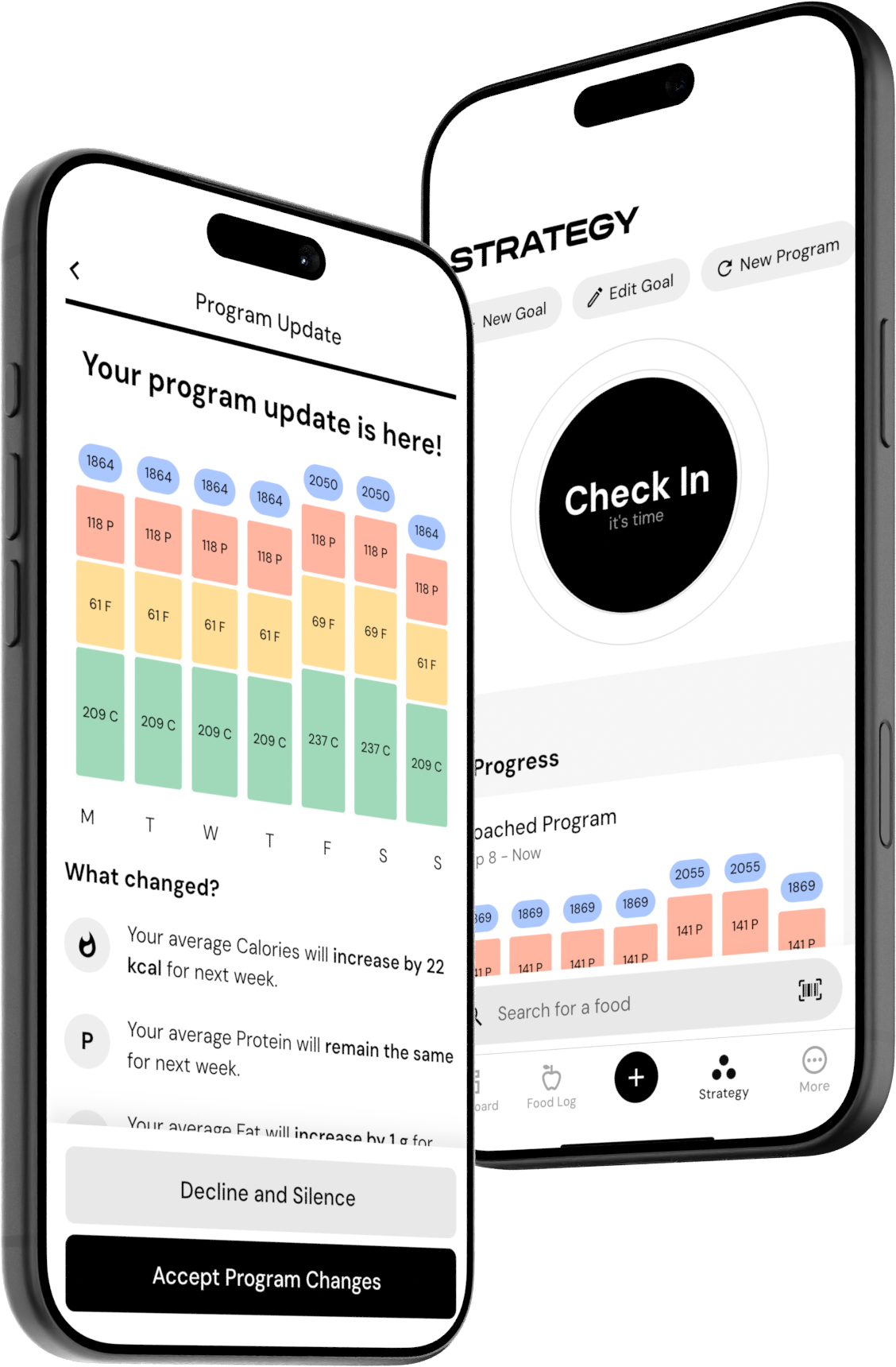
That’s one of the reasons I helped create MacroFactor. Its nutrition-coaching algorithms help adjust your plan based on your data, rather than leaving you to rely indefinitely on a body-weight multiplier.
For my own transformation, I lost 30 pounds while following the app’s algorithm-driven recommendations without manually changing the targets myself. That’s my experience, not a promise of identical results for everyone.
The app also includes barcode scanning, a nutrition-label scanner for foods that aren’t available through barcode lookup, progress analytics, and weekly check-ins. There’s an active Facebook community and subreddit for questions and sharing progress, too.
Whether you use an app or manage the process yourself, the fundamentals stay the same: train your abs progressively, eat enough protein, maintain a manageable deficit, and use more than the scale to evaluate progress. Sixty days is a useful block of time to put those habits into practice, not a reason to rush past what’s sustainable.
|
This is general educational information, not personalized medical advice. Consult a physician before starting an exercise program.


