I’ve spent the last couple of years arguing that the stretched part of a lift matters more for muscle growth than the squeezed part. High tension at long muscle lengths has become one of the main things I look for when choosing exercises.
But there was a fair criticism of that position: most of the research supporting lengthened partials involved beginners. Would the same approach work for someone who already had years of serious lifting under their belt?
That question started bothering me. Rather than keep arguing about it online, I teamed up with Dr. Pak, Dr. Milo Wolf, and the exercise science research team in New York to help test it.
After eight weeks of hard, supervised training, we got an answer. It wasn’t the clear victory for lengthened partials some people might have expected. But it also wasn’t a reason to throw them out.
Key Takeaways
- Full range of motion and lengthened partials produced similar muscle growth in experienced lifters over eight weeks.
- Lengthened partials emphasize the stretched portion of an exercise, not arbitrary half reps.
- Partial reps still require controlled lowering, consistent technique, and hard effort.
- The findings support training flexibility rather than promises of dramatically faster gains from stretch-focused training.
What Are Lengthened Partials?
Before getting into the study, we need to distinguish three ways of performing a rep:
- Full range of motion: You move through the complete range of the exercise, including both the stretched and contracted portions.
- Shortened partials: You use only the portion where the target muscle is relatively shortened. Think of emphasizing the squeeze.
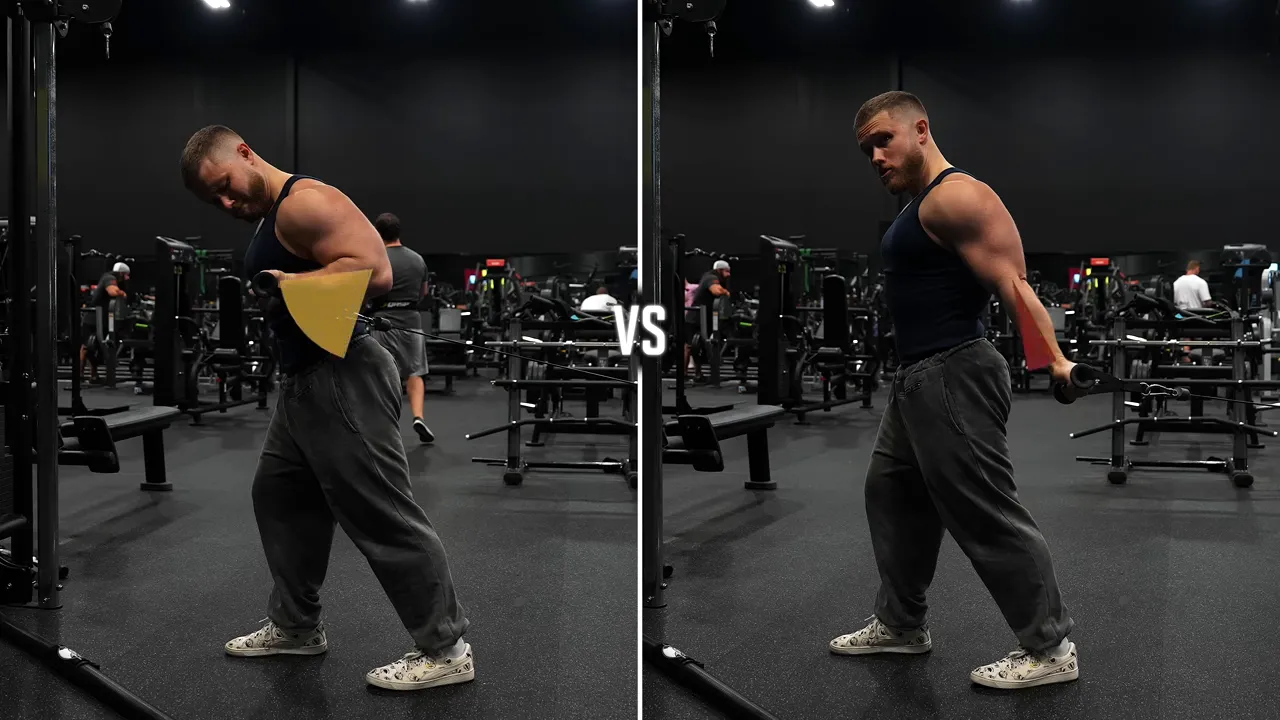
- Lengthened partials: You use only the portion where the target muscle is relatively stretched. Think of emphasizing the stretch.
For a curl, a lengthened partial means working through roughly the bottom half rather than curling all the way up. For a pulldown, it means working in the overhead, stretched portion instead of pulling the handle all the way down.
The important distinction isn’t simply full reps versus half reps. It’s which half of the rep you’re doing. Cutting out the stretch is a very different strategy from cutting out the squeeze.
Why the Stretch Looked So Promising
Before our study began, the research was pretty compelling:
- Five studies had compared shortened partials with lengthened partials. All five found significantly more muscle growth with lengthened partials.
- Five studies had compared lengthened partials with full range of motion. Four found significantly more growth with lengthened partials, while one found no significant difference.
That’s a strong pattern. The references include research on different partial ranges of motion and partial versus full range training.
It also raises an interesting possibility: perhaps one major reason full range of motion works so well is that it includes the stretched position, rather than because every inch of the movement contributes equally.
Still, the beginner issue mattered. The mechanisms that produce muscle growth in new lifters should have relevance to experienced lifters, but that doesn’t guarantee the size of the benefit will be the same.
The Skeptics’ Explanation: Sarcomere Addition
One proposed explanation involved sarcomere addition, or adding contractile units in series so muscle fibers grow longer rather than simply thicker.
The skeptical argument was that this adaptation might primarily occur early in training. If the apparent advantage of lengthened partials depended on an adaptation mostly available to beginners, perhaps experienced lifters wouldn’t benefit in the same way.
That was a hypothesis to test, not something we could settle by repeating the beginner studies. We needed people who had already been lifting for years.
How We Tested Lengthened Partials in Experienced Lifters
We recruited 30 participants with an average of 4.9 years of lifting experience. These were not people picking up a dumbbell for the first time.
The study used a within-subject unilateral design. That sounds technical, but the idea is simple: each participant trained one side of their body with full range of motion and the other side with lengthened partials.
For example, someone would perform full-range curls with one arm and bottom-half curls with the other. The same principle applied to exercises such as single-arm pulldowns.
Why Compare Two Sides of the Same Person?
If you divide people into two separate groups, one group might happen to contain an unusually strong responder to training. That person’s genetics could pull up the group average and make the training method look better than it really is.
Having each participant serve as their own control reduces that problem. We’re comparing two training methods within the same person, rather than relying entirely on comparisons between different people.
The Training Was Hard, Not Just Carefully Measured
The intervention lasted eight weeks. Participants performed four sets per exercise, using a mixture of moderate and somewhat higher rep ranges.
Every set was prescribed to muscular failure, with researchers supervising the training and pushing participants to finish their reps. Several participants said they trained harder during the study than they did outside it.
So if your concern is that science-based training studies involve people casually going through the motions, that wasn’t what happened here. These sets were hard.
At the end of the intervention, ultrasound measurements were used to compare muscle growth between the two conditions. You can read the methods and findings in our study preprint, which was still a preprint when these results were presented.
Partial Reps Still Require Proper Technique
One thing we emphasized from the start was that a partial rep is not a cheat rep.
Some people hear “half reps” and immediately start swinging the weight, bouncing out of the bottom, and letting their technique fall apart. That is not what we were testing.
The same basic technique instructions applied to both conditions:
- Control the negative. Lower the weight deliberately rather than letting it drop.
- Briefly pause in the stretched position. Don’t bounce through the bottom to create momentum.
- Lift with intent. Use an explosive positive while maintaining control and positioning.
- Keep the prescribed range consistent. For lengthened partials, shorten the movement without abandoning the technique.
The goal was to change the range of motion, not turn a controlled exercise into a completely different movement.
The broader interest in this approach wasn’t limited to me. Dr. Wolf had been using lengthened partials exclusively in his own training for about a year. Dr. Eric Helms, who tends to be a cautious adopter, had expressed optimism about training at longer muscle lengths. Dr. Mike Israetel had also embraced an emphasis on the stretched position despite his longstanding advocacy of full range of motion.
That enthusiasm helped explain why the question was worth studying. It didn’t determine the result.
The Results: Neither Method Clearly Won
I asked the research team not to tell me the results until the study was finished and the statistics had been analyzed. After all the work involved, I was genuinely nervous to hear what they found.
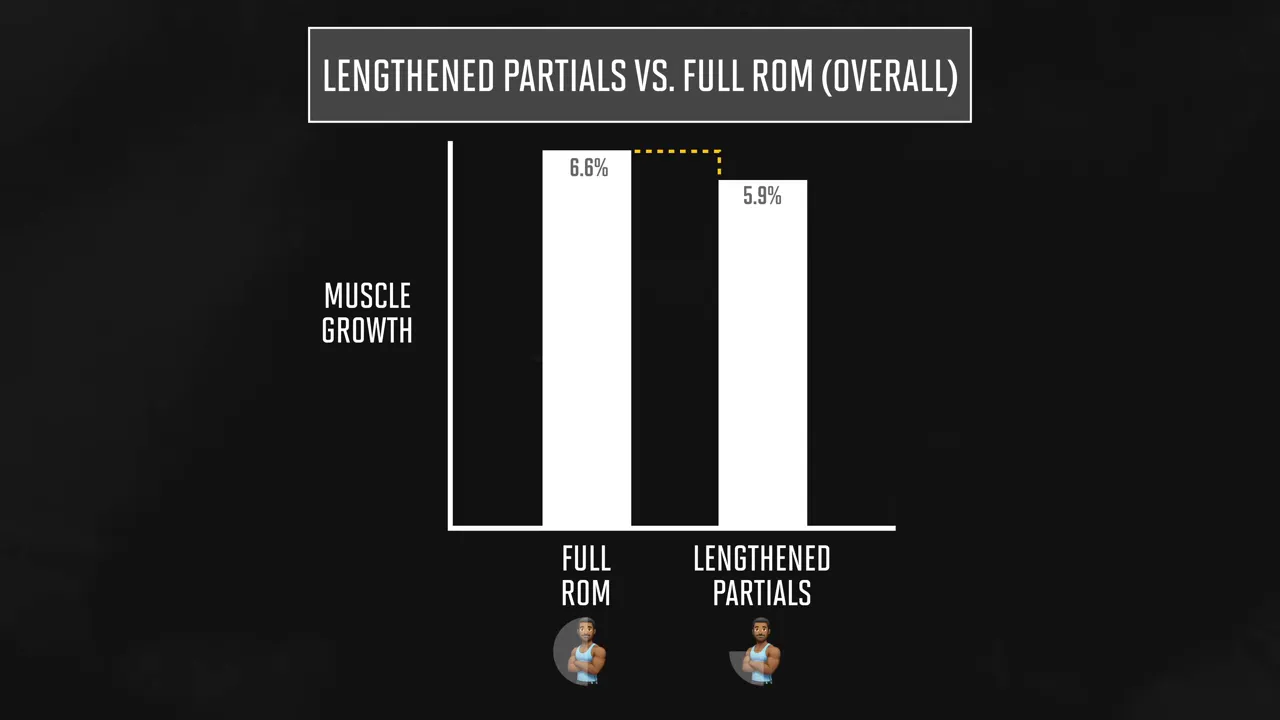
The overall muscle growth averages were:
- Full range of motion: 6.6%.
- Lengthened partials: 5.9%.
Looking only at those numbers, you might think full range of motion won. But there was no statistically significant difference between the conditions.
The biceps results illustrate why you shouldn’t pick a winner just by comparing bar heights. Here, the numerical difference went the other way:
- Full range of motion: 4.4% biceps growth.
- Lengthened partials: 5.1% biceps growth.
Again, there was no statistically significant difference.
Measurements contain noise, people respond differently, and small numerical gaps can occur through random variation. The analysis needs to account for that uncertainty rather than treating every difference in an average as a real training advantage.
The practical reading is that both approaches produced similar growth under these conditions. That isn’t proof that they are identical for every muscle, exercise, or training duration. It means this study didn’t establish that one was better.
Did This Change My Mind About the Stretch?
Initially, I wasn’t quite sure what to make of the result. But there are two useful ways to interpret it.
First, lengthened partials did not outperform full range of motion. If you enjoy full reps, this is good evidence that you don’t need to abandon them.
Second, participants removed the shortened portion of every exercise in the partial-rep condition and still achieved similar growth. A couple of years ago, I would have assumed that doing half reps throughout a program would clearly lose to full range of motion. That assumption doesn’t hold up very well here.
Oddly enough, the study made me more comfortable using lengthened partials in my own training. On some exercises, completing the fully squeezed portion feels harder or more awkward. If leaving it out produces similar hypertrophy, that gives me another useful option.
It also suggests that the squeeze may contribute less to growth than many people assume, at least for the exercises and muscles tested. Removing it didn’t produce a detectable disadvantage.
What I Am Walking Back
I do think these findings should temper expectations. Focusing exclusively on the stretch did not supercharge muscle growth in these experienced trainees.
I still think the stretched portion is probably the most important part of the range of motion for many muscles. But that is different from saying lengthened partials are a huge upgrade over full reps.
Dr. Pak’s interpretation was similarly measured: one study should shift your position, not completely rewrite it. The result nudged his expectations toward a smaller advantage for lengthened partials, although he would still lean toward them if forced to bet.
Exercise selection may also matter. We shouldn’t assume every exercise or muscle will respond exactly the same way. Earlier research on muscles such as the calves and hamstrings leaves room for lengthened partials to outperform full range of motion in some situations.
What This Means for Your Training
You have more flexibility than the internet debate makes it sound.
- If you prefer full range of motion, keep using it. It was clearly effective in our experienced participants.
- If you prefer lengthened partials on certain exercises, they’re a legitimate option. You don’t have to include the fully shortened position in every exercise to stimulate growth.
- If you use partials, pay attention to which portion you train. These findings don’t validate arbitrary half reps that avoid the stretch.
- Keep the reps controlled and the effort high. The study tested deliberate, hard training, not loose, bouncy reps.
- Don’t expect a miracle from changing your range of motion. Lengthened partials are a useful tool, not a shortcut to an entirely different physique.
My position now is pretty simple: don’t neglect the stretched portion, but don’t feel obligated to eliminate full reps either. Both full range of motion and properly performed lengthened partials can build muscle in experienced lifters.
The stretch still matters. The claim that focusing on it exclusively will dramatically accelerate your gains deserves more restraint.
A Note on Nutrition Tracking
We also gave the study participants free access to my nutrition app, MacroFactor, so they could log their nutrition during the intervention. The app adjusts nutrition recommendations each week using your logged data and estimated energy needs over time.
If you’d like to try it, code JEFF gives you a two-week free trial.
|