A lot of people start lifting partly because they want to attract a partner. Fair enough. But do all those hours in the gym actually translate into a better love life?
I surveyed 50,000 people to find out how strength, body fat, and muscularity relate to dating success. I asked people to identify their body type, choose the physiques they found most attractive, and answer questions about their romantic lives.
Some of the results genuinely surprised me. Stronger people reported more intimate partners. Having a six-pack did not seem to help men’s partner counts at all. And the physique most men wanted was noticeably more muscular than the physique women tended to prefer.
But the most useful finding wasn’t about getting as jacked as possible. It was about putting the physical stuff into perspective.
Key Takeaways
- Greater strength and muscularity were associated with more lifetime intimate partners in my survey.
- Men’s body fat showed little relationship with partner counts, but higher levels correlated with romantic dissatisfaction.
- Women most often preferred moderate muscularity, while men generally wanted more muscular physiques for themselves.
- Kindness and intelligence ranked above physical attractiveness for women across the sexual orientations studied.
Table of Contents
- Do More Plates Really Equal More Dates?
- Six-Pack or Dad Bod: Does Body Fat Matter?
- Does More Muscle Mean a Better Love Life?
- What Level of Muscularity Do Women Find Most Attractive?
- The Physical Traits We Fixate On Explain Less Than You Might Think
- Kindness Isn’t the Problem With “Nice Guys”
- A Better Approach to Becoming More Attractive
- Putting Your Health and Fitness Goals Into Practice
Do More Plates Really Equal More Dates?
First, everyone’s favorite exercise: the bench press.
The men I surveyed most commonly reported a one-rep max around two plates per side, which I’d consider intermediate strength. Only about 5% could bench three plates, and just a tiny fraction could put up four plates. For context, my all-time best is 380 pounds, just under four plates per side.
When I compared bench press strength with lifetime intimate partners, there was a clear upward trend. Men in the highest category, above four plates, reported the most partners by far, averaging about 16.
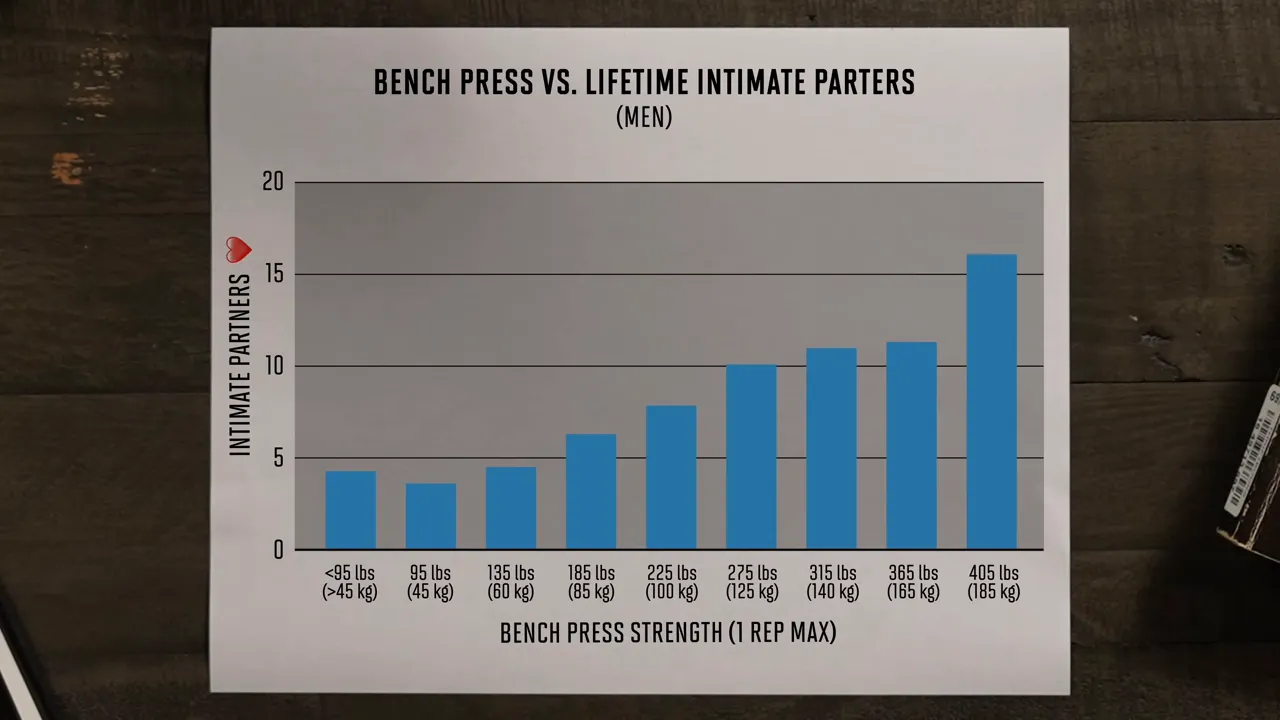
Honestly, I didn’t expect that. I thought the biggest benchers might be so focused on training that they’d have less time or energy for dating. The averages pointed the other way.
What could explain the strength connection?
One possibility is straightforward: stronger men may be perceived as more attractive. Research on upper-body strength and male attractiveness supports that connection.
I also suspect steroid use could help explain the particularly large jump at the strongest end. People benching that much may be more likely to use anabolic steroids, which can increase libido, alongside other, less desirable effects. That’s a possible explanation, not something this survey established.
Age could also matter. Bigger benchers may have trained longer, be older, and have had more time to accumulate relationships. My audience is concentrated in the 18 to 34 age range, with the largest group aged 25 to 34. That gives some context, but it doesn’t rule out age as a contributor.
And this wasn’t just a bench press phenomenon:
- Men showed similar patterns for squat and deadlift strength.
- Stronger women also reported more lifetime intimate partners.
- Individual results varied enormously, even when the group averages followed a trend.
There were plenty of people with relatively low bench presses and lots of partners, and plenty of strong benchers with fewer partners. Your one-rep max is not your romantic destiny.
Six-Pack or Dad Bod: Does Body Fat Matter?
For body fat, I asked men to identify where they fell on a lineup ranging from very lean to overweight. Then I compared those selections with their reported lifetime partners. People could skip the partner question if they preferred.
I expected a sweet spot. My guess was that the leanest men might do slightly worse, perhaps because maintaining that condition could reflect a particularly gym-focused lifestyle, while men around 10 to 15% body fat might do best.
I was wrong.
There was essentially no relationship between men’s body fat category and their total number of intimate partners. The results were remarkably flat across all eight categories, from six-pack shredded to the highest body fat level.
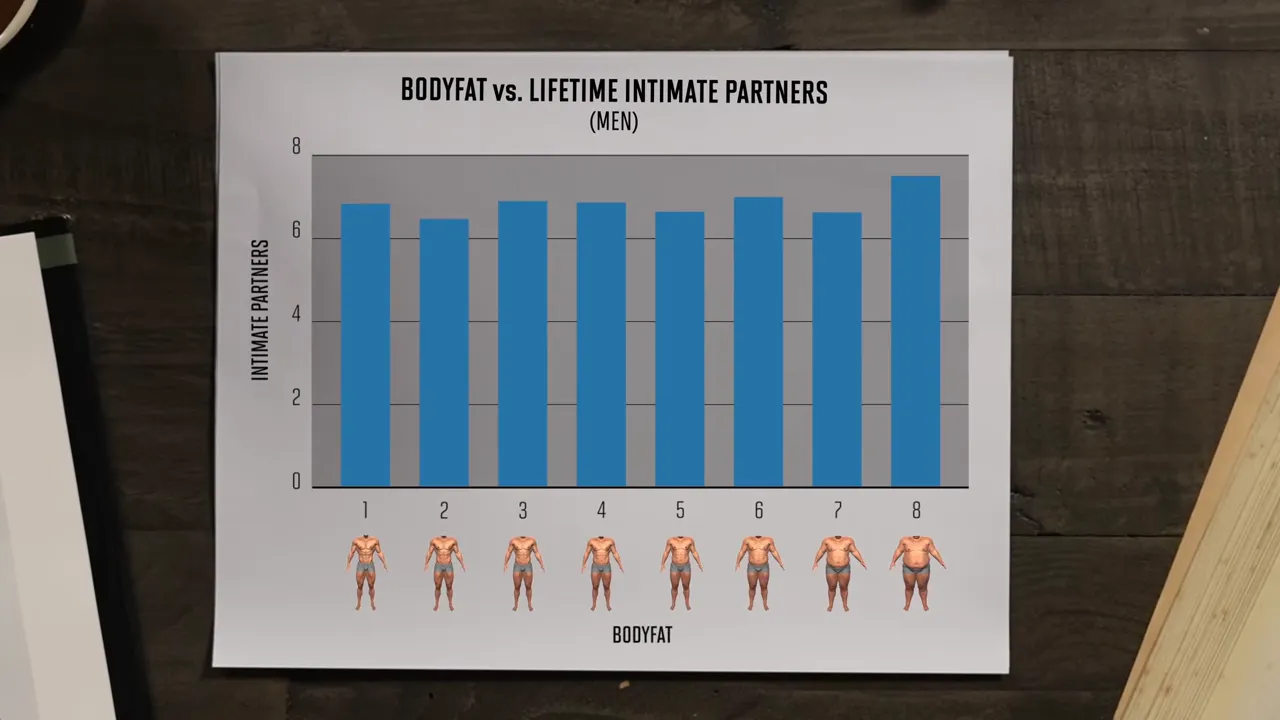
That doesn’t tell us everyone finds every body type equally attractive. It tells us that, in this survey, leaner men weren’t reporting more lifetime partners than heavier men.
Partner count and romantic satisfaction are different things
A higher partner count doesn’t necessarily mean a happier romantic life. To me, satisfaction is the more meaningful outcome.
So I also asked people to rate their romantic satisfaction on a scale from one to seven, with one being the worst and seven the best. Then I looked specifically at the people who selected one, the lowest possible rating.
This time, body fat did show a relationship. The highest body fat categories had the largest proportion of people reporting the lowest romantic satisfaction. The same general pattern appeared in both men and women.
That’s an important distinction: body fat wasn’t associated with men’s lifetime partner counts, but higher body fat was associated with more severe romantic dissatisfaction. It still doesn’t establish that body fat caused that dissatisfaction.
Does More Muscle Mean a Better Love Life?
Muscularity showed a clearer relationship with partner counts than body fat did.
On the eight-level muscularity scale used for this part of the survey, the most muscular men reported the highest number of lifetime intimate partners, averaging about 11. Women showed the same general direction: more muscular women tended to report more partners.
Again, I suspect anabolic steroid use could contribute to the jump at the very muscular end. My assessment is that most people would probably need anabolics to reach the highest level shown on that scale. But the survey can’t tell us whether that explains the result.
More importantly, how did muscle relate to actually being in a relationship?
More muscular men were more likely to report being in a relationship
Men in the lower muscularity categories were less likely to be in a relationship than men in the higher categories. Across the scale, the gap was roughly 20 percentage points, with levels five and six already showing much of the difference. Those levels of muscular development are well within the natural range.
That’s encouraging, but there’s a big qualification: these are correlations, not proof that gaining muscle causes someone to find a partner.
Maybe more muscular people feel more confident and are more willing to approach someone they’re interested in. It might not be the muscle itself doing all the work. Being in a relationship also doesn’t automatically tell us whether that relationship is healthy, happy, or long-lasting.
To get a more direct answer about physical preferences, I asked women which level of muscularity they actually found most attractive.
What Level of Muscularity Do Women Find Most Attractive?
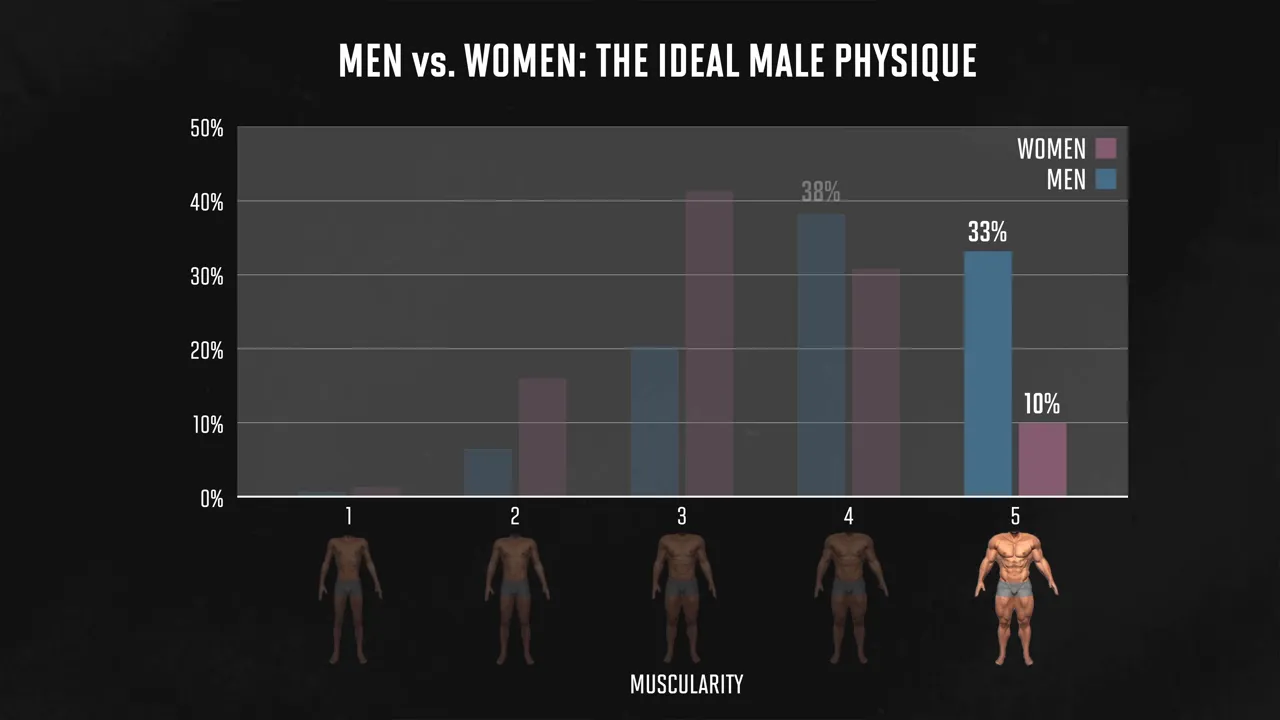
This question used a separate, five-level physique lineup. Level one was the least muscular and level five the most muscular. I’d place level four around the upper limit of what’s naturally achievable.
The most popular choice wasn’t the biggest physique:
- Level three: More than 41% of women selected it as the most attractive.
- Level five: Only about 10% selected the most muscular option.
- Level two: More women preferred it than level five.
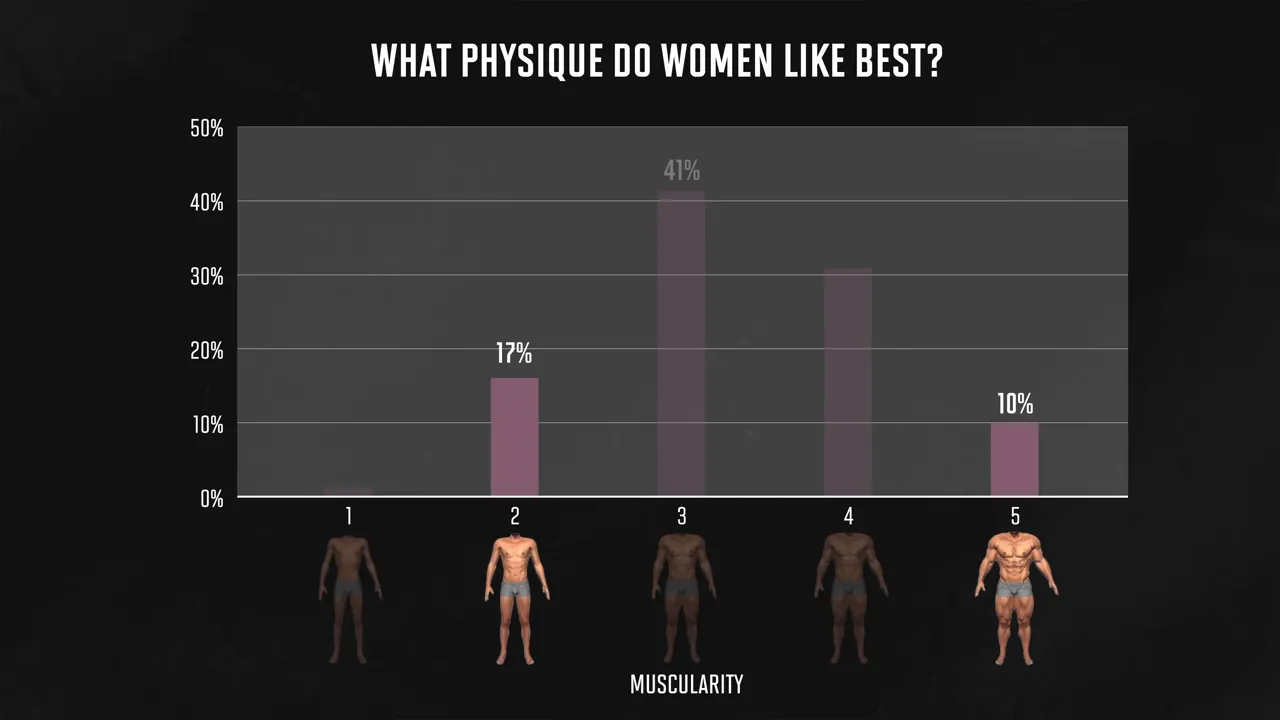
Keep in mind, these responses came from my audience, which is presumably more interested in lifting, and potentially more favorable toward muscular physiques, than the general population.
I think men should find this reassuring. A physique like level two is a realistic goal with a reasonably healthy diet and one or two full-body workouts per week. Getting to level five would demand much more time in the gym and, for many people, likely involve anabolic steroids and their associated risks.
If your main reason for chasing extreme muscularity is to become more attractive to women, the extra effort may not deliver the payoff you expect.
The physique men want isn’t the one women most often prefer
Next, I asked men which level of muscularity they wanted for themselves.
The most common answer was level four. Level five wasn’t far behind: about 33% of men wanted the highest level of muscularity.
That’s a pretty big mismatch. One-third of men wanted the most muscular physique, while only one in ten women rated it most attractive.
I’m obviously not saying men should train only to impress women. There are plenty of reasons to pursue strength and muscle that have nothing to do with dating.
But if attracting women is part of your motivation, and your goal could require significant health risks, it’s worth asking whether you’re pursuing the right target. On average, the women surveyed didn’t prefer maximum size.
The Physical Traits We Fixate On Explain Less Than You Might Think
Of everything I measured in my survey, bench press strength had the strongest relationship with the dating outcomes I analyzed. Men who benched more tended to report more dates, a higher likelihood of being in a relationship, and better romantic outcomes overall.
But I hadn’t asked about everything. What about height? Facial masculinity? Voice pitch?
A meta-analysis involving more than 170,000 participants examined six stereotypically masculine traits and their associations with mating and reproductive outcomes:
- Height
- Voice pitch
- Facial masculinity
- Testosterone levels
- Index-to-ring-finger ratio
- Strength and muscularity
Of those six traits, strength and muscularity had the strongest association with mating success.
But here’s the part that matters most: taken together, those traits accounted for only about 5% of the variation in mating outcomes.
That doesn’t mean all physical appearance matters only 5%, or that we can neatly assign the remaining 95% to personality. It does mean these six traits, which people spend a lot of time worrying about, left most of the differences in outcomes unexplained.
In other words, your love life is not reducible to your height, jawline, testosterone level, or muscle mass.
Kindness Isn’t the Problem With “Nice Guys”
Physical attraction matters. But being a good person matters too, especially if you want someone to stick around.
Kindness is consistently rated as an attractive quality. So why does the idea that “nice guys finish last” have so much staying power?
I think the problem is that people often confuse kindness with neediness. When someone reacts negatively to a stereotypical “nice guy,” they may be reacting to clinginess, desperation, or a lack of independence, not the fact that he treats people well.
Being kind while taking care of yourself, setting goals, and having interesting things going on in your life is a very different proposition.
What the research found
In a study on physical attractiveness and the nice-guy paradox, only 7% of women chose the man portrayed as a jerk in one comparison. The kinder the man was portrayed, the more desirable he became.
Even when researchers made the jerk more physically attractive, he still lost about 85% of the time.
Another study of partner preferences across sexual orientations examined heterosexual, bisexual, and homosexual men and women. Kindness and intelligence ranked above physical attractiveness in every group except heterosexual men, who placed physical attractiveness between kindness and intelligence.
For women across the sexual orientations studied, kindness and intelligence ranked above looks.
Being mean, bullying other people, or making your physique your entire personality is not a shortcut to attractiveness. A great body doesn’t cancel out treating people badly.
A Better Approach to Becoming More Attractive
The encouraging part is that many of the things worth working on are within your control. You don’t need to become the biggest person in the gym to make meaningful progress.
- Build strength and some muscle. Training was associated with better romantic outcomes, without maximum muscularity being the most popular look.
- Take care of basic presentation. Practice good hygiene, look after your teeth, smell good, find a hairstyle that suits your face, and wear clothes that fit your body shape.
- Have a life beyond dating and lifting. Set goals, take care of yourself, and pursue things you find interesting.
- Be genuinely kind. You can treat people well without being clingy or making their approval your entire focus.
- Don’t take yourself too seriously. Confidence doesn’t need to come with an oversized ego.
My takeaway isn’t that muscles don’t matter. They can help. But a bigger bench press and a more muscular physique are only part of the picture.
If you’re looking for long-term romantic success, becoming a kind person who takes care of their health and has more going on than their appearance is a much better goal than simply getting as jacked as possible.
Putting Your Health and Fitness Goals Into Practice
If losing fat, building muscle, or both is part of that process, MacroFactor is the nutrition app I recommend. I’m a part owner, and I’ve used it to improve my own physique and health.
It provides individualized nutrition guidance and weekly diet updates based on your progress, with recommendations tailored to your metabolism. The goal is to help you work toward your fitness goals while leaving room for the rest of your life.
|